Which size home EV charger fits your supply in Malaysia
Last updated
Quick answer: In Malaysia, a home charger can only run as fast as the lowest of three limits: your supply, the charger and your car. To charge at 11 or 22 kW you need three-phase supply, because both are above TNB's 10 kW single-phase limit. Only TNB can upgrade your supply.
Get quotes
Say two quotes offer different charger sizes. The bigger one only helps if your supply and your car can use it.
This page gives four checks to make before you pay for a size. It prints no charge times, no range figures and no prices, because none of the sources below gives them.
Three limits set your charging speed
As we read the sources below, your charging speed follows the lowest of three limits: your supply, the charger and your car. A bigger charger cannot lift the other two.
Picture a chain with three links. The home supply feeds the charger, and the charger feeds the car. The weakest link sets the pace.
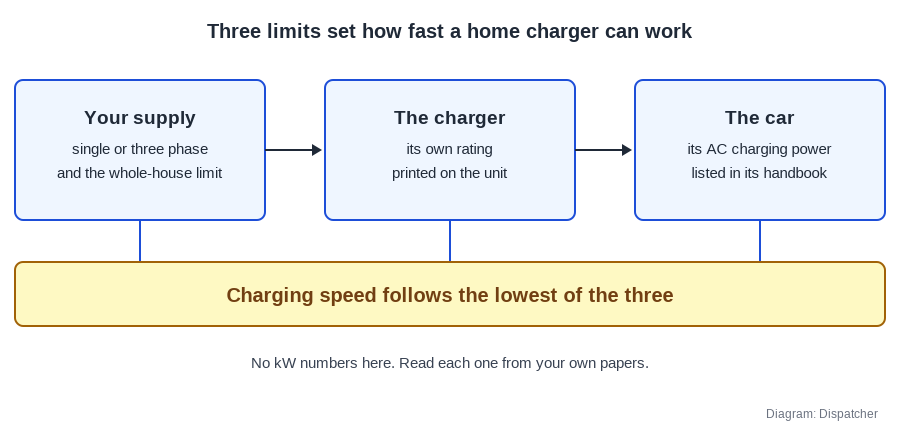
Each limit has its own paper trail. The supply is set at your TNB meter and by the total load in your home. The charger carries its own rating, and your car lists its own AC charging power.
Your supply: single phase or three phase
Single phase supports a total load up to 10 kW, and three phase supports more, says TNB's customer guide "Before You Install an EV Home Charger". TNB is Tenaga Nasional Berhad, the electricity utility.
That total includes the charger. In Step 1, TNB's EV home charger guide asks a registered contractor to confirm your supply scheme and the total load, charger included.
So a charger can fit on paper and still leave no room for the rest of the house. myTNB's upgrade page advises changing to three-phase when household load exceeds 10 kW. Its rule of thumb is a home with three or more air conditioners.
For a home charger, the same page says to consider three-phase if you plan a higher-capacity charger. Its general guide, on myTNB's upgrade page, is that landed homes may benefit from three-phase if the charger is rated at 7 kW and above.
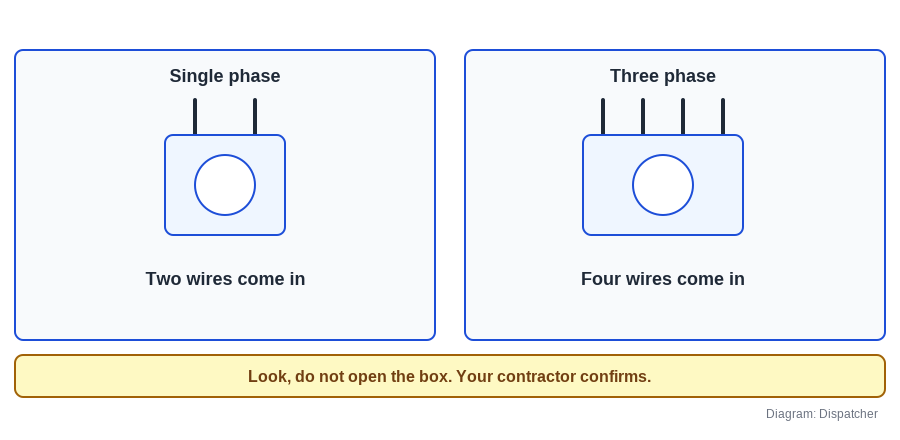
Count the wires at the meter
myTNB's upgrade page says a single-phase meter measures a 230 volt supply through two wires. A three-phase meter measures a 400 volt supply through four wires, says the same page.
Look at the meter box from outside and count. Do not open it.
Your registered contractor confirms the supply. TNB's EV home charger guide also says not to change the TNB fuse yourself.
Who upgrades the supply
The upgrade itself is TNB's job. TNB's EV home charger guide says a single-phase to three-phase upgrade goes through the myTNB portal.
myTNB's upgrade page says to appoint an electrical contractor from the Energy Commission list. It lists Form G (supervision and completion certificate) and Form H (test certificate) among the documents the appointed contractor provides.
This page prints no upgrade fees. Ask your contractor what an upgrade would involve at your address.
The charger: what the size means
As we read it, a charger's kW rating is the most it can deliver. It is a ceiling, not a promise of speed, because your supply and your car can both sit below it.
That is why 11 kW and 22 kW chargers need a three-phase supply: both are above the 10 kW single-phase limit in TNB's EV home charger guide.
A 7 kW charger sits in between, and myTNB's upgrade page says landed homes may benefit from three-phase at that rating. Your contractor's load check decides whether single phase is enough. That check counts the charger in the total, as TNB's EV home charger guide asks.
The circuit behind the charger
A home charger needs its own circuit. ST's EVCS FAQ page says an EV charger must connect to a dedicated final circuit with correctly sized cable. ST is Suruhanjaya Tenaga, the Energy Commission.
The page gives the reason: EV charging is a high, continuous load. It says a dedicated circuit helps cut the risk of overload, cable heating, short circuit, equipment damage and fire.
The wiring box in TNB's EV home charger guide asks for the same: a dedicated circuit with a cable sized appropriately for the charger. Ask your contractor how the cable will be sized for your home.
Your car: the AC charging power line
Your car has its own AC charging power, listed in its spec sheet or handbook. Our reading: a bigger charger cannot speed up a car that takes less.
As one example, MG Malaysia's spec sheet for the MG ZS EV lists "AC Charging Power" as 7 kW. That is one car and one maker, shown only to point at where the line sits. Your car may differ.
Find the same line in your own handbook or spec sheet. Write it down before you compare quotes, so you do not pay for a size the car cannot use.
Before you pay for a bigger size
Check four things before you agree to a size: the wires at your meter, your home's total load, your car's AC line and the circuit.
- Count the wires at the meter. Two wires mean single phase and four mean three phase, as myTNB's upgrade page describes.
- Ask for the total load. The contractor's figure should include the charger, as TNB's EV home charger guide asks.
- Read the car's AC charging power line. It is in your handbook or spec sheet.
- Ask about the circuit and cable. ST's EVCS FAQ page says the circuit must be dedicated and the cable correctly sized.
If one of the three limits is low, a bigger size does not make charging faster. If your supply needs an upgrade, that is a separate job through TNB.
Our requirements checklist covers what a contractor looks at. For where a wall box can go on a terrace house drive, see the terrace house guide. In a condo, approval comes first: read the JMB and MC approval guide.
To see what charging may cost each month, try the EV home-charging cost tool.
Get quotes on Dispatcher
Free for homeowners. Describe the job in one short form and we pass it to matched local contractors, who contact you directly. Have a photo of your DB board ready to send to the matched contractors when they contact you.
Tell each contractor which size you are considering. Ask them to check your supply, your load and the circuit before they price it.
Dispatcher does not do the work. Dispatcher has not checked listed businesses' licences yet, so check each name on the ST public list of registered electrical contractors.
Related guides
- Home EV charger installation requirements
- Terrace house EV charger: where to mount it
- EV charger in a condo: JMB approval steps
- EV home-charging cost a month
Written by the Dispatcher editorial team from the sources above. See how Dispatcher works.
Choosing a charger size? Get quotes
Sources
- Tenaga Nasional Berhad (TNB), customer guide "Before You Install an EV Home Charger", Step 1, Step 2 and the wiring requirements box (Read 20 November 2026).
- TNB, myTNB page "Upgrade / Downgrade Electricity", sections "Household electricity supply", "When to change" and the contractor and forms part of the application process (Read 20 November 2026).
- Suruhanjaya Tenaga (ST), EVCS FAQ in Malay, "Mengapa charger mesti mempunyai litar akhir khas dan kabel bersaiz betul?" (Read 20 November 2026).
- MG Malaysia, "MG ZS EV Price Sheet and Spec Sheet", spec sheet PDF, "AC Charging Power" row only (Read 20 November 2026).
- ST, public list of registered electrical contractors on ECOS, page opened to confirm it loads (Read 20 November 2026).
- Photo source: Wikimedia Commons file page (Read 20 November 2026).
Frequently asked questions
Can I use an 11 kW charger on a single-phase home supply in Malaysia?
No, not on single phase. To charge at 11 or 22 kW you need three-phase supply, because both are above TNB's 10 kW single-phase limit, as TNB's EV home charger guide sets out. Only TNB can upgrade your supply, so ask a registered contractor to check your load first.
How do I know if my house is single phase or three phase?
Look at the wires coming into your TNB meter, without opening anything. myTNB's upgrade page says a single-phase meter measures a 230 volt supply through two wires, and a three-phase meter measures a 400 volt supply through four wires. Your contractor confirms the supply, and you should not change the TNB fuse.
Do I need three-phase for a 7 kW charger?
Not always, but consider it. myTNB's upgrade page says landed homes may benefit from three-phase if the charger is rated at 7 kW and above. TNB's EV home charger guide says single phase supports a total load up to 10 kW including the charger, so your contractor's load check decides.
Will a 22 kW charger charge my car faster?
Only if your car can take that much. Your car lists its own AC charging power, and MG Malaysia's spec sheet for one of its models prints 7 kW. As we read it, a bigger charger cannot give a car more power than it accepts. Read your own handbook first.
Who upgrades my supply to three phase?
TNB does. TNB's EV home charger guide says TNB processes a single-phase to three-phase upgrade through the myTNB portal. myTNB's upgrade page says to appoint an electrical contractor from the Energy Commission list, and lists Form G and Form H among the documents that contractor provides.
Does the charger need its own circuit?
Yes. ST's EVCS FAQ page says an EV charger must connect to a dedicated final circuit with correctly sized cable, because EV charging is a high and continuous load. TNB's EV home charger guide lists a dedicated circuit with an appropriately sized cable in its wiring box. Ask how the cable is sized.
Last updated: 20 November 2026