Aircond power point: what wiring an air-conditioner needs
Last updated
Quick answer: In Malaysia, a home aircond needs its own circuit from the DB box. It connects through a switch, socket or isolator (a switch that cuts power for servicing), not straight into the circuit. Only larger units are fixed directly. Wiring work goes to a registered electrical contractor. Agree with your aircond installer who does which part.
Free for homeowners. Dispatcher does not do the work.
Get quotes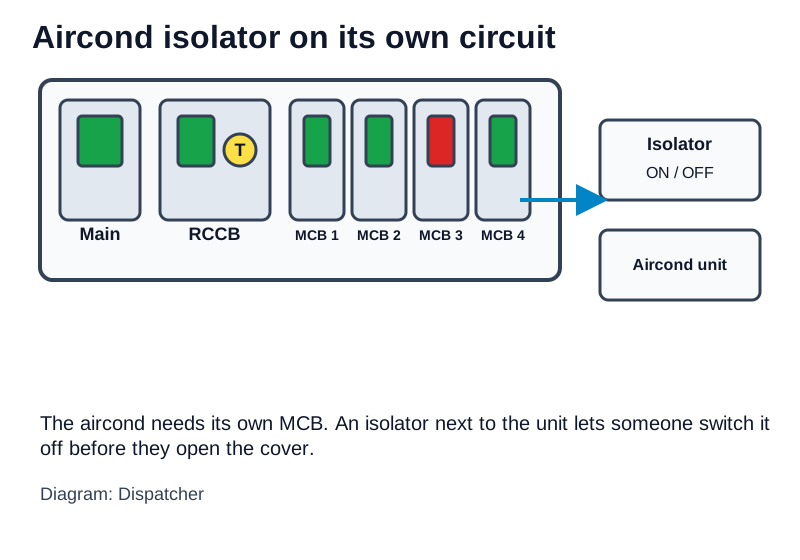
The shop sells you the unit. Someone still has to bring power to it. That is a separate job, with its own rules from Suruhanjaya Tenaga (ST), the energy regulator.
Below: the circuit, the switch or isolator, the cable, your supply and the paperwork. It is general information, not a design for your home.
Do not wire an aircond yourself, and do not open your DB box. Leave both to a registered electrician.
Why an aircond needs its own circuit
An aircond gets a circuit of its own, apart from your lights and sockets. ST's domestic wiring guideline sets this rule. Power circuits for aircond, water heaters, ovens and clothes dryers must be connected separately from other circuits (ST guideline).
In plain words, ask for a separate circuit from the DB box. The cable runs from there to the aircond's switch or isolator. Keep your lights and sockets off it.
So the new point should not be tapped off the nearest socket or light. If your DB box has no spare space, ask the electrician what that means for the job. For that kind of work, see house wiring and DB box contractors.
Switch, socket or isolator: what the rules say
Your aircond must not be wired straight into the circuit. The rules want something between them that you can switch off.
ST's guideline says the connection goes through an electrical accessory such as a switch, a 13A or 15A socket outlet, or an isolator (ST guideline). An isolator is a switch whose job is to cut power so someone can work on the unit.
Whichever you use, it must connect to a breaker with a suitable rating. That lets you cut power for servicing or in an emergency (ST guideline).
Larger units are the exception. The same guideline says an aircond above 3 HP is fixed directly and permanently to a suitably rated breaker or fuse (ST guideline). HP stands for horsepower. Ask the shop for your unit's HP rating before the electrician visits.
Agree with the installer where the switch or isolator goes. You want to reach it easily, and so does the person who services the unit.
Cable size and the breaker
ST's table sets a minimum copper cable size of 4 to 6 mm² for special power circuits such as an aircond (ST guideline, Table 8.2).
The size is given in square millimetres. It tells you how thick the copper inside the cable is. A bigger number means a thicker cable.
That is a range, not one number. Ask the electrician which size they will use for your unit, and why. If a quote shows a size below that range, ask about it before you agree.
The guideline also says every conductor must be protected by a breaker or fuse so the cable's insulation is not damaged (ST guideline).
The right breaker rating depends on your unit. Ask the electrician to read it from the unit's rating label and write it on the quote, next to the cable size.
To see what moves an electrician's quote, read what affects an electrician's quote.
Aircond installer or electrician: who does what
Fitting the unit and wiring the circuit are two jobs. One firm may do both, or you may need two, so settle it before the day.
ST tells homeowners to appoint an electrical contractor registered with ST for new or added wiring (ST, who to appoint for home wiring). So if the aircond shop offers to do the wiring, ask whether the firm doing it is registered.
One clean way to split the work: the electrician's cable ends at the switch or isolator, and the installer connects the unit from there. Write down what you agree.
Settle these with both sides. Who runs the cable from the DB box to the switch or isolator, and who buys it? Who supplies the switch or isolator itself?
Whose job is the cable between the indoor and outdoor units? Who patches the wall or ceiling afterwards? And on which day does each person come, and who lets them in?
Can your home supply take another unit?
It depends on what else you run. Your home's supply has a limit, and a new aircond adds to the load.
TNB, the electricity utility, says single-phase supply suits homes using up to 10 kW in total (TNB guide). It says three-phase suits homes using above 10 kW and up to 37 kW (TNB guide).
Two wires at your meter means single-phase. Four wires means three-phase (TNB guide). Look from a distance only. Do not touch or open the meter.
TNB warns that using more power than your supply allows can cause frequent trips or outages (TNB guide).
Tell the electrician how many aircond units you have now and how many you plan to add. TNB's guide says an ST-registered electrical contractor can help check your usage and any upgrade you need (TNB guide).
Do not let anyone "just upgrade the fuse". TNB says changes to its meter or fuse are not allowed. A contractor cannot upgrade only the fuse without applying to TNB (TNB guide). A move to three-phase also needs an application to TNB (TNB guide).
If your breakers or RCCB (the safety switch that cuts power if current leaks) already trip, read RCCB keeps tripping: what to do at home before you add more load. Not sure which switch is which? What an RCD does sorts that out.
Before the electrician comes
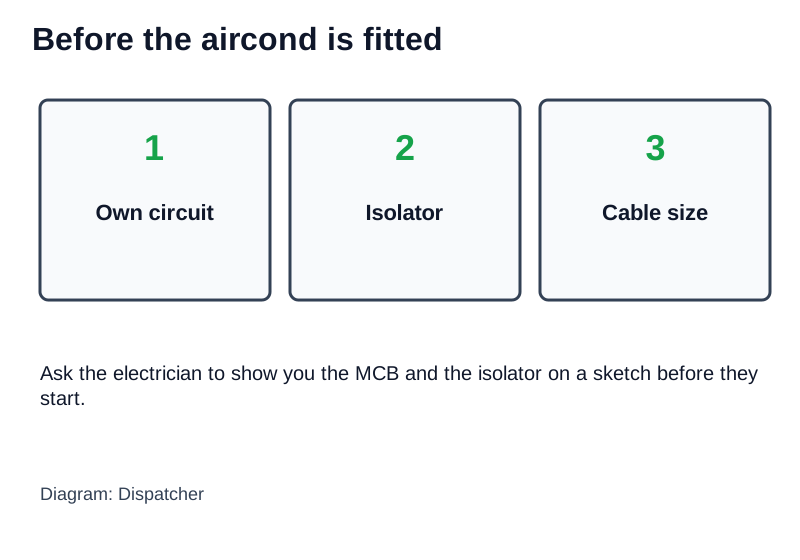
Send four things: a photo of the closed DB box, the planned spots for the indoor and outdoor units, your unit's model and rating, and any building rules.
- The DB box: one photo of the whole board with the cover on. Do not open it to take the photo.
- The two spots: photograph the wall for the indoor unit and the place for the outdoor unit. Say roughly how far each is from the DB box. A longer cable run can change the quote.
- The unit: send the model name and the rating from the shop's quote or the unit's label. Say if you are fitting one unit or several.
- Building rules: in a condo, ask the management office or JMB (the owners' body) whether outdoor units must go in a set spot, and which hours contractors may work. If you own a landed home, skip this one.
There is a message you can copy in booking an electrician home visit.
After the job: forms and checks
Ask for new Form G and Form H. ST's guideline says these forms stay valid only while the wiring is unchanged, and added wiring cancels them (ST guideline).
A new aircond circuit is wiring that was not there before. Ask the electrician plainly whether new forms are needed, and get them if so.
Form G confirms the work was supervised and finished. Form H records the tests. ST's ECOS guide says the forms are filled in online, then printed and signed (ST ECOS, installation registration guide). Keep the signed originals. Form G and Form H explains both in more detail.
Then check the firm. ST publishes a list of registered electrical contractors on ECOS, its online portal. Search for the company's name before you pay a deposit. How to check an electrical contractor walks you through it.
Last, ask the installer to show you where the switch or isolator is and how to turn it off.
Get quotes on Dispatcher
Free for homeowners. Describe the job in one short form and we pass it to matched local contractors, who contact you directly. Have a photo of your DB board ready to send to the matched contractors when they contact you.
This form is for the electrical side: the circuit, the switch or isolator and the breaker. Aircond fitting is not on Dispatcher yet.
Dispatcher has not checked the licences of listed businesses yet, so do the ST check before work starts.
Sources
- Suruhanjaya Tenaga (ST), domestic wiring guideline, titled Garis Panduan Pendawaian Elektrik Pepasangan Domestik, in Bahasa Malaysia (aircond rules in section 9, cable table in section 8, Form G and Form H in section 11). Read from a text copy saved 11 November 2026.
- Suruhanjaya Tenaga, who to appoint for home wiring. Checked 14 November 2026.
- ST ECOS, list of registered electrical contractors. Checked 14 November 2026.
- ST ECOS, installation registration guide (Form G and Form H). Checked 14 November 2026.
- TNB, customer guide on home EV chargers (supply types, meter and fuse, overload). Checked 14 November 2026.
The guideline above is the version dated 1 July 2024. ST can change its guidelines, so check the current rules with ST before you rely on a clause.
Frequently asked questions
Do I need an isolator or is a switch enough for my aircond?
Either can meet the rule. ST's guideline says an aircond connects through a switch, a socket outlet rated 13A or 15A, or an isolator, tied to a suitably rated breaker so you can cut power for servicing or an emergency. The same guideline fixes units above 3 HP directly to a breaker. Ask which suits your unit.
Can I plug my aircond into a normal socket?
Not a shared one. ST's guideline allows a socket outlet rated 13A or 15A for an aircond. But the circuit must be separate from other circuits and tied to a suitably rated breaker. A socket that also feeds other things does not meet that. Ask the electrician to fit a dedicated outlet or an isolator.
Can two aircond units share one circuit?
The part of ST's guideline we checked does not say either way. It only says aircond circuits must be separate from other circuits. So do not assume two units can share one. Ask the electrician to size the cable and breaker for both units, and put the sizes on the quote before work starts.
Does the aircond shop do the wiring?
That depends on the shop, so ask before you pay. Suruhanjaya Tenaga (ST), the energy regulator, tells homeowners to appoint an electrical contractor registered with ST for new or added wiring. Ask whose registration covers the wiring, then look that firm up on ST's public list. If the shop only fits the unit, book an electrician separately.
Do I get a new Form G and Form H after adding a point?
Yes, ask for them. ST's guideline says Form G and Form H stay valid only while the wiring is unchanged, and added wiring cancels them, so new forms are needed. Form G confirms the work was supervised and finished. Form H records the tests. A registered wireman fills them in. Keep the signed originals.
Has Dispatcher checked the electrician's registration?
No. Dispatcher has not checked the licences or registrations of listed businesses yet. The check is yours. Ask the electrician for their ST registration, then search for the company on ST's public list of registered electrical contractors before you pay a deposit.
Ready to sort the wiring? Get quotes
Last updated: 14 November 2026