Burning smell or sparking socket: what to do now
Last updated
Quick answer: Stop using the socket. Switch off that circuit, or the main switch at the DB box, only if you can reach it safely. Do not touch a hot or melted plug. If you see smoke or flames, leave the home and call 999. Then get an electrician to check it, even if the smell fades.
A burning smell near a socket means something is getting hot where it should not. Treat it as urgent, even if you see no flame.
Do this first
Stop using the socket and keep people away from it. Then go down this list from the top, in order.
- Look for smoke or flames. If you see either, do not stay to deal with it. Get everyone out and call 999, the one number for Malaysia's emergency services.
- Do not touch a hot, soft or melted plug or socket. Do not pull on it or wipe it. Leave it where it is.
- Switch off the power, only if it is safe. Stand on a dry floor with dry hands. Switch off the breaker for that room's sockets. Not sure which one it is? Switch off the main switch. Never walk through smoke to reach the DB box (the box with your main switch and breakers).
- Unplug only if the plug is cool and whole. If it is melted, cracked or too hot to hold, leave it in the socket and keep the power off.
- Keep water away. Never throw water on a smoking or sparking socket or plug.
- Keep children and pets out of the room.
- Leave the power off and call an electrician. Do not switch it back on to test it. Do not open the socket or the DB cover.
From a safe distance, take a photo of any burn marks. It helps the electrician plan the visit. Our guide on what to prepare before an electrician visits lists what else to note down.
Smell coming from the DB box
Does the DB box itself smell? Turn off the main switch, but only if you can reach it safely. Then call an electrician. If you see smoke, scorch marks or a box that is too hot to go near, leave the home and call 999.
Never push a breaker back up if it tripped along with a burning smell. A breaker trips to stop a fault. Pushing it up again can feed power into the same fault.
Do not open the DB cover, even to look. Only an electrician should do that.
A breaker that trips with no smell is a different problem. Our page on why an RCCB keeps tripping covers it. To see what the safety switch does and how to test it, read what an RCD does.
Why sockets and plugs burn
Two things can cause this: heat at a poor contact, or too much load on one point.
Current flows through the metal pins and the metal inside the socket. If the grip is loose, worn or dirty, the current squeezes through a smaller contact. That spot gets hot. Heat can soften the plastic around it and darken the metal, which can give off a burning smell.
Too much load causes the same problem from the other side. Suruhanjaya Tenaga (ST), Malaysia's energy regulator, says not to overload a socket with too many connections (ST safety tips). The MELP energy literacy programme says using high-powered appliances together on one extension can damage wiring or cause short circuits (MELP, electrical and gas safety). Kettles, irons and heaters are examples of the high-powered appliances MELP means.
Cables matter too. ST says cables that do not follow the specified size can raise the risk of fire, because they fail to carry the current (ST safety tips). ST also has an awareness poster that tells people not to touch electric cables with damaged insulation (ST, electrical safety awareness).
Socket, plug or appliance? How to tell without opening anything
You can often tell which part failed by looking, once the power is off and everything is cool. You never need a screwdriver.
- Start with the plug pins. Black or brown marks, or melted plastic, point to the plug.
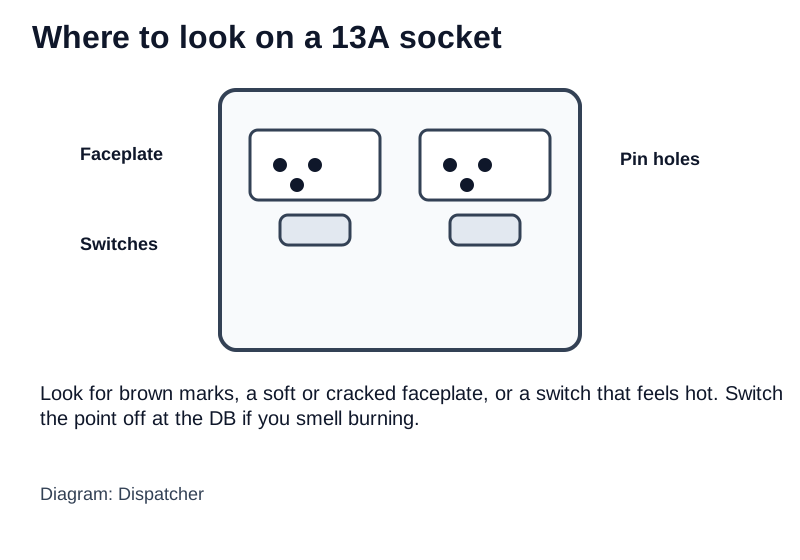
- Then the socket face. Brown scorch marks, cracks or a faceplate that sits crooked point to the socket.
- Then the cord. Damaged insulation means the appliance stays unplugged, and ST's poster says not to touch it.
- Last, compare. One plug is marked but other plugs in that socket look fine? Suspect that appliance or its plug. The socket itself is marked, or different plugs get marked in the same socket? Suspect the socket or the wiring behind it.
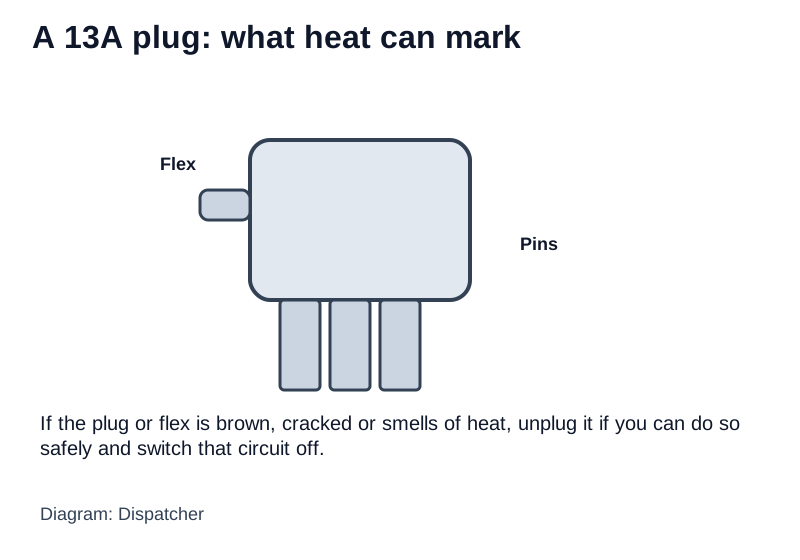
Do not plug in another appliance to see whether the smell comes back.
Whatever you find, the socket stays off until an electrician has checked it. The appliance stays unused until its plug or cord is replaced.
Signs to watch for at other sockets
A burning smell can be the last warning. Earlier signs can show up as marks, heat and noise. Check the other sockets in your home with your eyes and ears.
- Brown or black marks around the pin holes or on the faceplate.
- A plug or faceplate that feels warm after the appliance has been on for a while.
- Crackling, buzzing or a faint hiss when something is switched on.
- A plug that wobbles or falls out of the socket.
- Lights that dim or flicker when a heavy appliance starts.
If you notice any of these, stop using that socket and say so when you book an electrician.
ST also says to switch off sockets when they are not in use (ST safety tips). Spread your kettle, iron and heater across different wall sockets instead of one extension.
If your home is old and several sockets show these signs, ask the electrician about the wiring behind them. Our page on house wiring and DB box contractors covers that kind of job.
What the electrician will do
An electrician checks the socket, the plug and the circuit, fixes the cause, and tells you what they found. ST says to appoint a registered electrical contractor for house wiring work (ST, appointing a contractor for home wiring). Its safety booklet says the same for electrical work at home (ST safety tips).
Expect them to look at the burnt socket and plug, check the cable behind it, and test the other points on the same circuit. They should tell you what needs to be replaced and why.
Ask for these in writing before work starts:
- what they found and which part failed
- what they will replace or repair
- what the price covers, and whether a visit charge applies
Our guide on what affects an electrician's quote helps you compare quotes on the same terms.
To check a company, look it up on ST's list of registered electrical contractors. ST's safety booklet also tells homeowners to check the contractor's Competent Person Identification Card (ST safety tips). Our guide on how to check an electrical contractor walks you through it.
Some things are not the electrician's to change. TNB, the power supplier, says in its home EV charger guide that any change to its meter or fuse is strictly prohibited because it can be unsafe and may cause fire risks (TNB, home EV charger guide).
Renting or in a condo
If you rent or live in a condo, tell your landlord or the building management in writing as soon as the area is safe. A written message gives you a date and a record.
Tenants, send the message first. Then ask who will arrange the electrician and who pays. Your tenancy agreement may say who handles repairs.
Condo owners, tell the management office too. Many buildings have their own rules for contractor access, work hours and permits.
If the smell comes from a corridor, lift lobby or shared board, tell management straight away. Do not try to trace it yourself.
This is general information, not legal advice. Here is a message you can copy:
Hi, on (date and time) I noticed a burning smell at the socket in (room, unit number). I have stopped using it and switched off the power to it. I have photos. Please arrange an electrician to check it, or tell me if I should book one myself. Please reply in writing.
Get quotes on Dispatcher
Free for homeowners. Describe the job in one short form and we pass it to matched local contractors, who contact you directly. Have a photo of your DB board ready to send to the matched contractors when they contact you.
Take that photo only once the socket is switched off and the area is safe. Never open the DB cover to get it.
Dispatcher does not do the work, and it has not checked the licences of listed businesses yet. Do the ST check before work starts. You can also browse electricians for small home jobs.
Sources
- MyGOV (Malaysian government portal), Malaysia Emergency Response Services (MERS) 999, checked 14 November 2026.
- Suruhanjaya Tenaga, Tip Keselamatan dan Kecekapan Tenaga (energy safety and efficiency tips), checked 14 November 2026, for sockets and plugs, electric cables, appointing registered contractors and the CPIC card.
- MELP, electrical and gas safety, checked 14 November 2026, for extension plugs and high-powered appliances.
- Suruhanjaya Tenaga, electrical safety awareness items, checked 14 November 2026, for the poster on damaged cable insulation issued 10 April 2026.
- Suruhanjaya Tenaga, who to appoint for wiring work at home, checked 14 November 2026.
- Suruhanjaya Tenaga ECOS, list of registered electrical contractors, checked 14 November 2026.
- TNB, customer guide on home EV chargers, checked 14 November 2026, for the meter and fuse rule.
Frequently asked questions
Is a burning smell from a plug point dangerous?
Yes. A burning smell means something is overheating, and that can start a fire. Stop using the socket, switch off the power if you can reach it safely, and keep clear of any hot or melted parts. Do not turn it back on. Get an electrician registered with ST to check it first.
My plug pin is burnt, can I keep using the socket?
No. Burnt pins mean heat built up at the plug, the socket, or both. Stop using that socket and that plug, and do not plug anything else in to test it. Have an electrician check the socket and the circuit. Replace the burnt plug or the appliance cord before you use the appliance again.
Can I pour water on a smoking socket?
No. Never pour water on a smoking or sparking socket, because water and live electricity are a dangerous mix. Switch off the power only if you can reach the switch safely and your hands are dry. If you see smoke or flames, leave the home and call 999.
Is it safe to use an extension plug for the kettle and iron together?
No. The MELP energy literacy programme says using high-powered appliances together on one extension can damage wiring or cause short circuits. ST's safety tips also say not to overload a socket with too many connections. Plug heat-making appliances into separate wall sockets, and switch each one off when you are done.
The smell went away, do I still need an electrician?
Yes. A smell that fades does not mean the fault is gone. The hot spot may still be there and can heat up again the next time you use the socket. Keep it switched off, take a photo of any marks from a safe distance, and book an electrician to check it.
Has Dispatcher checked the electrician's registration?
No. Dispatcher has not checked the licences or registrations of listed businesses yet. Before work starts, ask for the company's ST registration and look the name up on ST's ECOS list of registered electrical contractors. Dispatcher does not do the work. The listed business does.
Last updated: 14 November 2026
Ready to book? Get quotes