What decides the cable size for a home EV charger in Malaysia
Last updated
Quick answer: In Malaysia, a home EV charger needs its own circuit from your DB box, with a correctly sized cable, says the Energy Commission's EVCS FAQ. Your installer sets the size from the charger's current, how far the cable runs and how it is laid. Ask to see the working instead of trusting one number on a quote.
Get quotes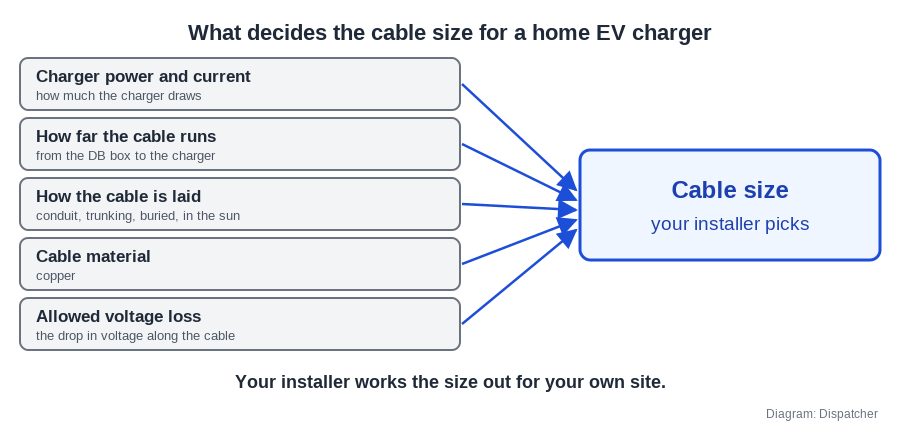
Your quote may name a cable size, or say a longer run costs more. You want to know if that is right.
The size for your own house stays your installer's call.
Why does an EV charger need its own correctly sized cable?
Because EV charging is a high load that keeps running. Suruhanjaya Tenaga (ST, the Energy Commission) says in its EVCS FAQ that a charger should connect to a dedicated final circuit with a correctly sized cable for that reason.
It adds that a dedicated circuit helps reduce the risk of overload, a hot cable, a short circuit, damaged equipment and fire.
A dedicated circuit is a line from your DB box (the distribution board) that feeds the charger and nothing else. TNB's home EV charger guide lists a dedicated circuit with a cable sized appropriately for the EV charger, following its design requirements and safety standards.
It also tells Mode 2 users to avoid extension cords, and says to avoid wall sockets.
The full rule list is in our home EV charger installation requirements guide.
What decides the cable size?
Five things: the charger's current, how far the cable runs, how it is laid, what it is made of and how much voltage loss is allowed. The diagram at the top shows all five.
Cable size here means the cross-section, the thickness of the metal inside the cable. A charger maker's knowledge-centre page on cable cross-section says it comes from the maximum current, the allowable voltage drop and the expected short-circuit current.
Installation method, conductor and insulation material, temperature and cable length also have an impact, the page adds.
Each one in plain words:
- The charger's current comes first. The more it draws, the more the cable must carry, and one maker's manual says the wire gauge depends on the power rating.
- Distance counts too: the manual ties the gauge to the distance between the meter cabinet and the charger.
- How it is laid matters: in conduit, in trunking, buried or out in the sun. The maker's page lists both the installation method and the temperature.
- Material: copper. The manual tells installers to use only copper conductors.
- Voltage loss is the drop in voltage between the DB box and the charger. The allowable voltage drop is one of the three things the maker's page says set the size.
Both are charger makers' pages, not Malaysian rules. They explain what sets the size, and we take no Malaysian limit from them.
The manual itself says to refer to local wiring regulations to select the conductor sizes.
We give no size chart. Your installer works out the size for your site.
Does a longer run need a thicker cable?
It can. One maker's manual says the wire gauge depends on the power rating and the distance between the meter cabinet and the charger.
That manual also says the voltage drop must not exceed 5 %, and that a maximum of 3 % is advisable.
Those are one maker's figures for its own product. They are not a Malaysian limit. The manual adds that local regulations may apply and can vary by country.
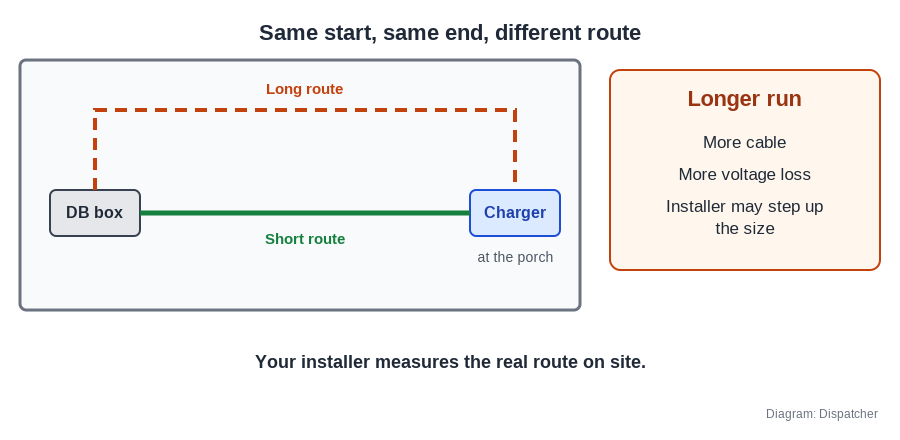
Picture a terrace house with the DB box on one side and the charger at the porch.
A short route and a long route can both get there. The long one uses more cable and loses more voltage, so your installer may step up the size.
Where the charger goes on a terrace house is in our terrace house guide, which says to leave the cable size to the installer.
Living in a condo? Start with how to get JMB or MC approval. JMB and MC are the building's management bodies.
Is six or ten square millimetres the rule in Malaysia?
Not as a rule we can quote. A news report on Paultan.org gives the smallest wiring as 6 mm², with 10 mm² where the wiring is exposed to the sun.
That article names no source document for the figures. TNB's home EV charger guide, which the article is about, asks only for a cable sized appropriately for the charger.
TNB's guide also points readers to ST's EVCS Guideline 2025 for more detail. We could not read the cable clause in the published copy of that guideline.
Our own requirements guide says cable size is the installer's call. So treat the 6 mm² and 10 mm² figures as a media report, not as a rule for your home.
If your quote says six or ten, do not argue with the number. Ask what it is based on: your charger, your run and how the cable is laid.
What should you ask the installer about the cable?
Ask for the size, the reason for it and the working on paper. The card below has the five questions.
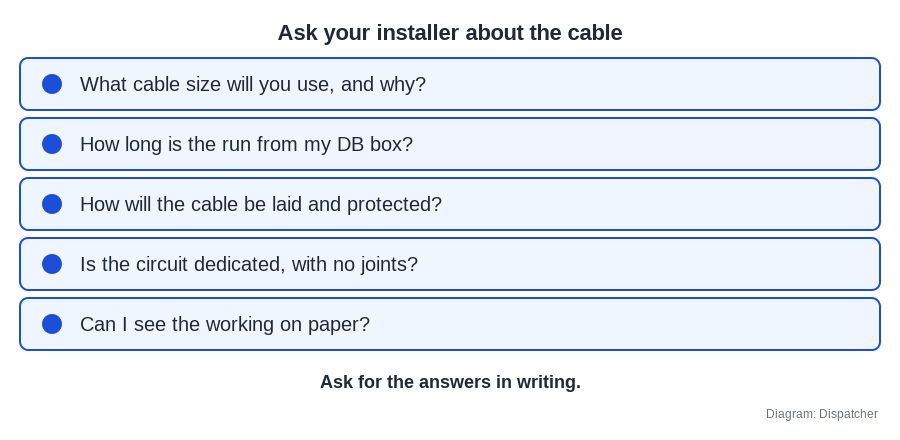
- What size, and why? A good answer names your charger's current, the run and how the cable is laid.
- How long is the run? Ask them to measure the route from your DB box. Do not accept a guess.
- How will it be laid and protected? Our requirements guide says a surface run goes in trunking or a cable tray.
- Is the circuit dedicated, with no joints? That requirements guide also says the cable runs in one piece with no joint.
- Can I see the working on paper? Ask for the sums behind the size, written down.
Ask for the test report too. TNB's home EV charger guide says to get a test report from the appointed contractor after the wall box is installed.
Which RCD goes on the circuit is a separate question. Start with what an RCD does and how to test it each month.
Do not run or change this cable yourself. TNB's guide also says only ST-registered competent persons or contractors should handle wiring, and tells you not to DIY.
Dispatcher has not checked listed businesses' licences yet. Check any installer on ST's list of registered electrical contractors yourself.
Get quotes on Dispatcher
Free for homeowners. Describe the job in one short form and we pass it to matched local contractors, who contact you directly. Have a photo of your DB board ready to send to the matched contractors when they contact you.
Dispatcher does not do the work. Put the five questions on the card to each contractor who replies.
Related guides
- Home EV charger installation requirements: a simple checklist for the full list, including how the cable is run.
- EV charger at a terrace house: where to mount it for the porch or pillar route.
- EV charger in a condo: how to get JMB or MC approval if you live in a block.
- What an RCD does and how to test it each month for the safety switch on the circuit.
Sources
- Suruhanjaya Tenaga EVCS FAQ, "Why must a charger have a dedicated final circuit and a correctly sized cable?" (Malay): st.gov.my. Read 20 November 2026 at st.gov.my.
- TNB customer guide "Before You Install an EV Home Charger" (PDF): tnb.com.my. Read 20 November 2026 at tnb.com.my.
- A charger maker's installation manual (English, version 3.4.1, August 2025), section 4.1, Installation prerequisites: maker's manual PDF. Read 20 November 2026 at the maker's manual PDF.
- A charger maker's knowledge-centre page, "Cable Cross-Section Selection": maker's knowledge-centre page. Read 20 November 2026 at the knowledge-centre page.
- Paultan.org, news report on TNB's home EV charger guide, 9 January 2026: paultan.org. Read 20 November 2026 at paultan.org.
- Dispatcher, "Home EV charger installation requirements: a simple checklist": dispatcher.my. Read 20 November 2026 at dispatcher.my.
- Suruhanjaya Tenaga, public list of registered electrical contractors (for you to check): ecos.st.gov.my. Read 20 November 2026 at ecos.st.gov.my. No fact on this page comes from it.
Frequently asked questions
What size cable does a home EV charger need in Malaysia?
Your installer decides, because the size depends on your charger, your run and how the cable is laid. TNB's home EV charger guide asks for a dedicated circuit with a cable sized appropriately for the charger, and ST's EVCS FAQ says why. Neither prints a size.
Is a six square millimetre cable enough for a home EV charger?
It depends on your charger, your run and how the cable is laid. A Paultan.org report gives 6 mm² as the minimum, and 10 mm² where the wiring is in the sun. That is a media report, not a rule we could check, and TNB's home EV charger guide prints no size.
Does a longer cable run need a thicker cable?
It can: one charger maker's manual says the wire gauge depends on the power rating and the distance from the meter cabinet to the charger. A maker's page also lists cable length as a factor. How much thicker is for your installer to work out, and we quote no Malaysian rule.
Why can't I just use an extension cord or a thin cable?
Because charging is a high, continuous load. The Energy Commission's EVCS FAQ says a dedicated circuit helps reduce the risk of overload and cable heating. TNB's home EV charger guide says to avoid extension cords if you use a Mode 2 charger.
Can the installer join or tap the cable on the charger circuit?
Our requirements guide says no: the cable runs in one piece with no joint. TNB's home EV charger guide asks for a dedicated circuit with a cable sized appropriately for the charger. We could not read ST's guideline clause ourselves, so ask your installer to confirm this in writing.
What should I ask my installer about the cable size?
Ask five things: what size and why, how long the run is, how the cable is laid and protected, whether the circuit is dedicated with no joints, and whether you can see the working on paper. The factors come from a charger maker's page. TNB's home EV charger guide says not to DIY.
Your next step
Written by the Dispatcher editorial team from the sources above. See how Dispatcher works.
Ready to compare installers for your charger circuit? Get quotes
Last updated: 23 November 2026