Which RCD does a home EV charger need in Malaysia
Last updated
Quick answer: In Malaysia, the EV charger FAQ from Suruhanjaya Tenaga (ST) says a charger circuit needs an RCD that trips at 30 mA or less. TNB's home charger guide lists Type A with DC detection, or Type B. ST's FAQ allows Type A only when the charger has built-in DC detection. Your contractor advises which fits your charger.
Get quotes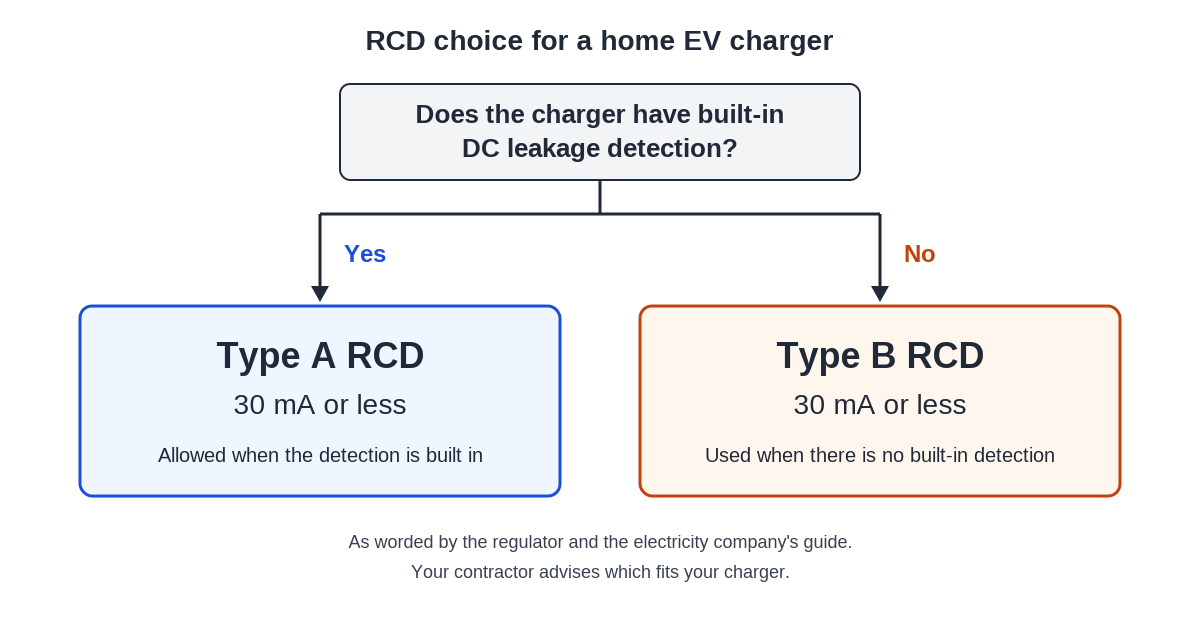
You have a quote for a home EV charger, and one line says RCD. You want to know if that line is needed and what type it should be.
This page sets two official documents side by side. One is TNB's home charger guide. The other is a set of short FAQ pages from ST, the energy regulator.
It gives no prices and names no brand. It does not tell you which RCD to buy, because your contractor makes that call.
What an RCD does on a charger circuit
An RCD is a switch that cuts the power when current leaks out of a circuit. The letters stand for residual current device, as the notes box in TNB's guide spells out.
The regulator's FAQ on main protection says a charger circuit must be protected against leakage current and overcurrent. It must also be properly earthed, and it must have an RCD.
Dispatcher's RCD guide covers how an RCD works and how to test it each month. This page stays on the charger circuit.
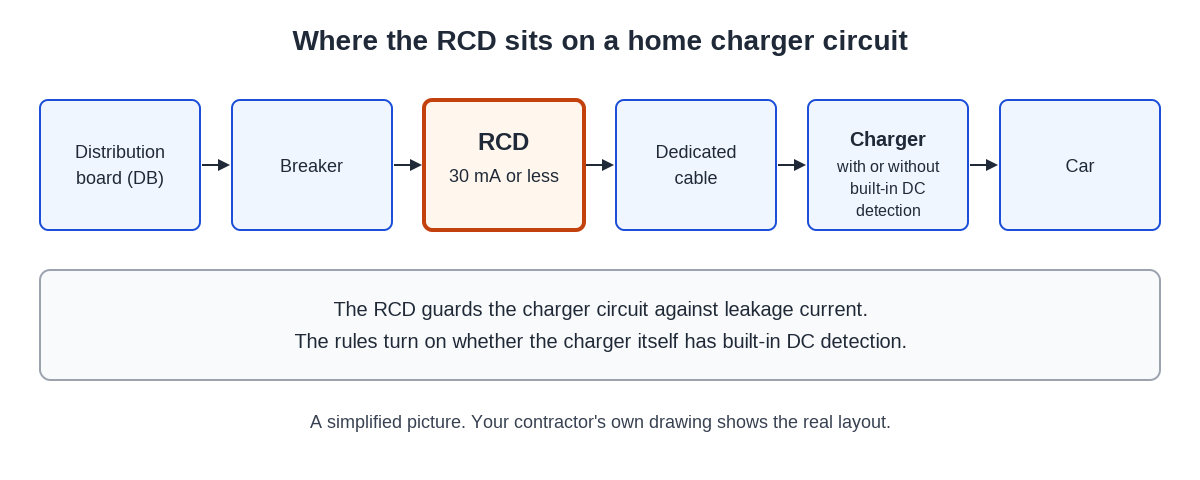
Your contractor's own drawing shows the real layout for your home.
The charger also needs a circuit of its own. The regulator's FAQ on final circuits says a charger must connect to a dedicated final circuit with correctly sized cable. The reason it gives is that charging is a high and continuous load. TNB's home charger guide lists a dedicated circuit in its wiring box too.
What the utility guide and the regulator say
TNB's home charger guide names a 30 mA RCD. The regulator's FAQ says the trip current must not go above 30 mA.
The type is worded a little differently in each document, so the table sets the two lines next to each other.
| Document | What it says about the RCD |
|---|---|
| TNB Customer Guide "Before You Install an EV Home Charger", wiring box | The wiring box line reads: "Protected by 30 mA RCD (Type A RDC+DD or Type B)." The notes box says DD means DC detection. |
| ST EVCS FAQ on main electrical protection (in Malay) | The FAQ says the circuit needs an RCD with a trip current not above 30 mA. Type A may be used only if the wallbox charger has a built-in RDC-DD. If it has none, Type B must be used. |
In Dispatcher's reading, the two lines fit. The guide's Type A with DC detection matches the FAQ's Type A with a built-in detector, and both name Type B as the other route.
The ST page is a short FAQ in Malay, not the full guideline. Check the current wording with ST before you sign, because guidance can change.
Why built-in DC detection comes up
DC detection comes up because DC leakage can stop a Type A RCD from working as it should. BSI's page for the RDC-DD standard gives that as the reason the detector exists.
The regulator's FAQ calls the detector an RDC-DD, short for residual direct current detecting device. The standard for it is IEC 62955, which the IEC web store lists for permanently connected AC charging stations.
BSI's page says the detector is there so Type A or Type F RCDs keep working when DC leakage is above 6 mA. The detector picks up smooth residual DC at 6 mA or above, the same BSI page says.
The regulator's FAQ gives no reason for its rule. Joining the FAQ wording to the BSI description is Dispatcher's own reading, not something ST says.
So it comes down to one check. If the detector is built into the charger, the FAQ allows Type A. If not, the FAQ says Type B must be used.
Your charger's spec sheet should say whether it has the detector. Ask your contractor to show you the line.
Questions to ask your contractor
Ask four questions and get the answers on paper. Your contractor advises which RCD fits your charger, and a clear answer names the type and the reason.
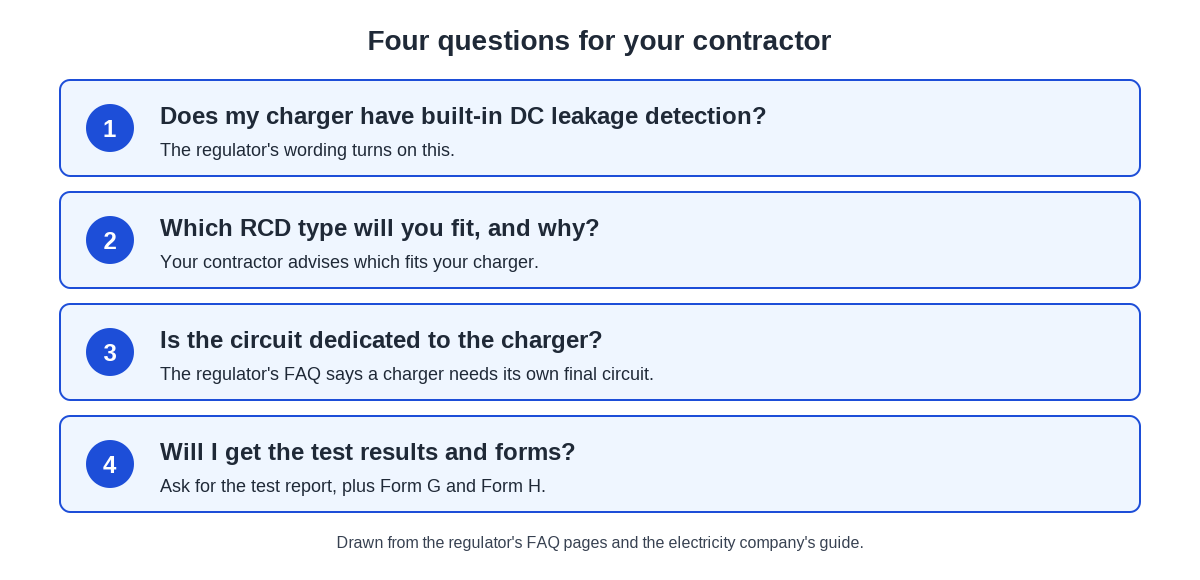
- Does my charger have built-in DC leakage detection? Ask where its spec sheet says so. The regulator's FAQ on documents lists the charger specification among the papers to prepare.
- Which RCD type will you fit, and why? The reason should point to your charger and your circuit.
- Is the circuit dedicated to the charger? TNB's home charger guide and the regulator's FAQ both ask for one.
- Will I get the test results and forms? The next section covers what to ask for.
Ask each firm to write the RCD type on its quote. Then you can compare quotes on the same footing.
Check the firm too. Dispatcher's guide to checking an electrical contractor shows how to look a firm up on ST's public list. Dispatcher has not checked listed businesses' licences yet, so that check is yours.
Test report and forms
Ask for the paperwork before the job and again at handover. TNB's home charger guide says to make sure a test report comes from the ST-registered contractor after the wall box is installed.
The regulator's FAQ on documents says these should be ready before installation: a location plan or floor plan, a single line diagram (SLD), and the charger specification. It adds a letter of permission from the owner or building management, and test documents such as Form G and Form H.
A single line diagram is a simple drawing of the circuit, from the DB board to the charger.
Keep every paper in one folder. If you change contractor or sell the home, the next person can see what was fitted.
The requirements checklist covers the rest of the rules. The terrace house guide covers where the charger goes.
Get quotes on Dispatcher
Free for homeowners. Describe the job in one short form and we pass it to matched local contractors, who contact you directly.
Dispatcher does not do the work. Ask each firm to state the RCD type and the reason in writing, and check each firm on ST's public list.
Related guides
- What an RCD does and how to test it: the plain-words guide to the switch itself.
- Home EV charger installation requirements: the full checklist for a charger job.
- How to check an electrical contractor: what to ask a firm to show you.
- EV charger at a terrace house: where to mount the charger and run the cable.
Sources
- TNB Customer Guide "Before You Install an EV Home Charger" (PDF): wiring box, safety tips box and notes box. Read 20 November 2026.
- ST EVCS FAQ, "Apakah perlindungan elektrik utama yang diperlukan untuk EVCS?" (Malay). Read 20 November 2026.
- ST EVCS FAQ, "Mengapa charger mesti mempunyai litar akhir khas dan kabel bersaiz betul?" (Malay). Read 20 November 2026.
- ST EVCS FAQ, "Apakah dokumen keselamatan/teknikal yang wajar disediakan sebelum pemasangan?" (Malay). Read 20 November 2026.
- BSI Knowledge, product page for the standard "Residual direct current detecting device (RDC-DD) to be used for mode 3 charging of electric vehicles". Read 20 November 2026.
- IEC web store, publication page for IEC 62955:2018. Read 20 November 2026.
- ST, list of registered electrical contractors (public search page). Read 20 November 2026.
Written by the Dispatcher editorial team from the sources above. See how Dispatcher works.
Frequently asked questions
What RCD does a home EV charger need in Malaysia?
The regulator's FAQ says a charger circuit needs an RCD with a trip current of 30 mA or less, and TNB's guide names a 30 mA RCD of Type A with DC detection, or Type B. The two lines fit together. Your contractor advises which type fits your charger, so ask for it in writing.
Can a Type A RCD be used for an EV charger?
Yes, but only when the wallbox charger has a built-in residual direct current detecting device, says the regulator's FAQ. TNB's guide lists Type A together with DC detection. Your contractor advises whether your charger qualifies, so ask to see its spec sheet.
When is a Type B RCD needed?
When the charger has no built-in DC leakage detection, the regulator's FAQ says Type B must be used. TNB's guide also lists Type B. The charger's spec sheet shows whether the detector is built in, so ask your contractor to confirm it and to say why they chose the type.
Does the charger need its own circuit?
Yes, the regulator's FAQ says an EV charger must connect to a dedicated final circuit with correctly sized cable, because charging is a high and continuous load. TNB's guide lists a dedicated circuit in its wiring box too. Your contractor works out the cable size for your home.
What papers should the contractor give me?
The regulator's FAQ says these should be prepared before installation: a location plan or floor plan, a single line diagram, the charger specification, a letter of permission from the owner or building management, and test documents such as Form G and Form H. TNB's guide says to get a test report after the wall box is installed.
Does Dispatcher say which RCD to buy?
No, Dispatcher does not say which RCD or charger to buy, and it does not do the work. This page quotes TNB's guide and the regulator's FAQ, and your contractor advises. Dispatcher has not checked listed businesses' licences yet, so check the firm on ST's public list yourself.
Last updated: 20 November 2026