EV charger wiring explained: the path from your DB to the wall box
Last updated
Quick answer: In Malaysia, a home EV charger is wired on its own dedicated circuit from your distribution board (DB) to the wall box, through a breaker and a leakage-protection device (RCD). A registered electrical contractor sizes the cable and does the work. The electricity company only handles the supply side.
Get quotes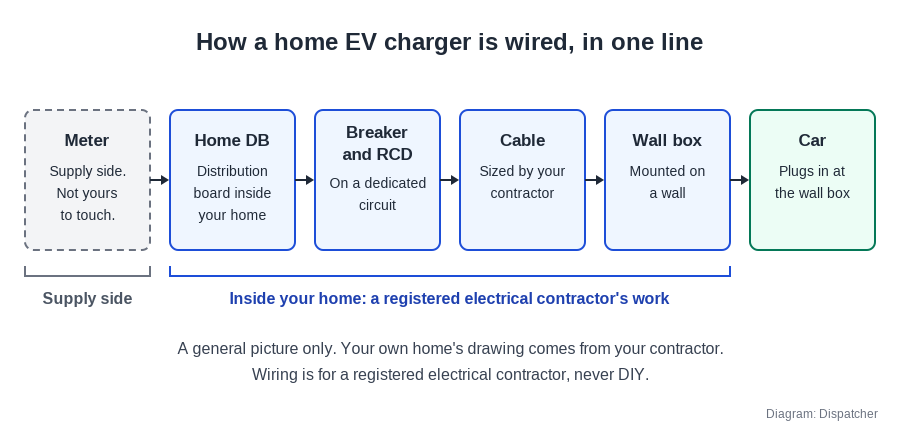
Your contractor says the charger needs a "dedicated circuit". It is hard to picture what that means.
This page draws the path in plain words, one link at a time. It also says who handles each link and which drawing to ask for. It is not a wiring guide, because the work is for a registered electrical contractor.
Where does the charger's wiring start and end?
It starts at your home distribution board (DB) and ends at the wall box. The meter and the supply before it are the electricity company's side, and TNB's guide says only TNB can process supply upgrades.
The first picture shows the whole path. TNB's home EV charger guide describes Mode 3 as a wall-mounted charger with cabling from the home electrical distribution box.
That cabling is the circuit. The same guide asks for a dedicated circuit with a cable sized appropriately for the EV charger, following its design requirements and safety standards.
In plain words, a dedicated circuit is a line used only by the charger. Suruhanjaya Tenaga (ST, the Energy Commission) says charging is a high and continuous load. Its FAQ adds that a dedicated circuit lowers the risk of overload, a hot cable, a short circuit, damaged equipment and fire.
Can you use a normal wall socket instead?
No, TNB's guide rules it out. It says no Mode 1 charging is allowed, only Mode 2 and Mode 3 (AC Type 2).
The notes in the guide define Mode 1 as a direct wall socket and Mode 2 as a wall socket with a safety box. A wall box on its own circuit is the route in the picture above.
What does each part in the chain do?
Each part has one job. The DB feeds the circuit, the breaker and RCD protect it, the cable carries the power, and the wall box connects your car.
The distribution board (DB)
The DB is the box inside your home that splits power into separate circuits. The charger gets its own way out of it.
A contractor looks at it first. TNB's guide says the expert should check your internal wiring and the DB, and may recommend DB enhancements or safety protection devices if the board needs work.
The breaker
A breaker is a switch that trips when too much current flows. TNB's guide lists new main circuit breakers (MCB) among the upgrades an expert may recommend.
ST's EVCS FAQ says the circuit must be protected against overcurrent and properly earthed. This page gives no breaker rating. The guide prints none, so your contractor decides.
The RCD
An RCD is the safety switch that cuts power when current leaks to earth. Our RCD guide covers what it does and how to test it.
For a charger, ST's FAQ says the RCD's residual operating current should not exceed 30 mA.
The same FAQ allows Type A only for a wall box with built-in DC detection (RDC-DD), and Type B otherwise. TNB's guide names the same two types. Your contractor advises which type fits your charger.
The cable
You may see cable sizes quoted online. This page gives none, because TNB's guide only says the cable is sized appropriately for the charger.
Do not copy a size from a website. The guide says the cable follows the charger's design requirements, so your contractor works it out for your charger.
The wall box
The wall box is the charger fixed to your wall, and the car plugs into it. TNB's guide calls this Mode 3.
The guide also allows Mode 2, a wall socket with a safety box. Its safety tips say to avoid extension cords if you use Mode 2, and to avoid 13A wall sockets.
Who handles which part?
The electricity company handles the supply side, up to the meter. A registered electrical contractor handles everything inside your home, from the DB to the wall box.
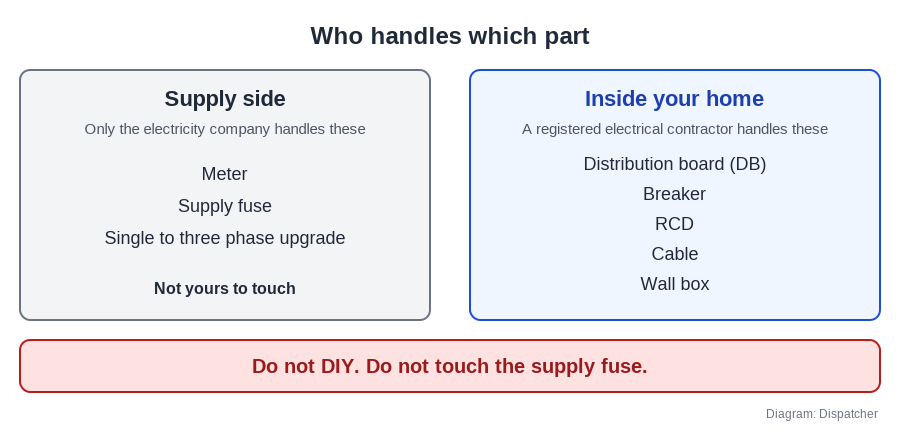
TNB's guide draws the same line. It says only ST-registered competent persons or contractors should handle wiring and safety upgrades. The note under it is blunt: do not DIY, and do not change the TNB fuse.
If your home needs a change from single phase to three phase supply, only TNB can process that upgrade. The guide ties the contractor rule to the Electricity Supply Act 1990 (Act 447).
In a condo, ST's document list includes a permission letter from the owner or building management. Our condo JMB guide covers how to ask.
What drawing and papers should you ask for?
Ask for the single line diagram (SLD) of your charger circuit. An SLD is a simple drawing that shows each part of the circuit in one line, from the DB to the charger.
That drawing is the wiring diagram for your home. The picture on this page is general only.
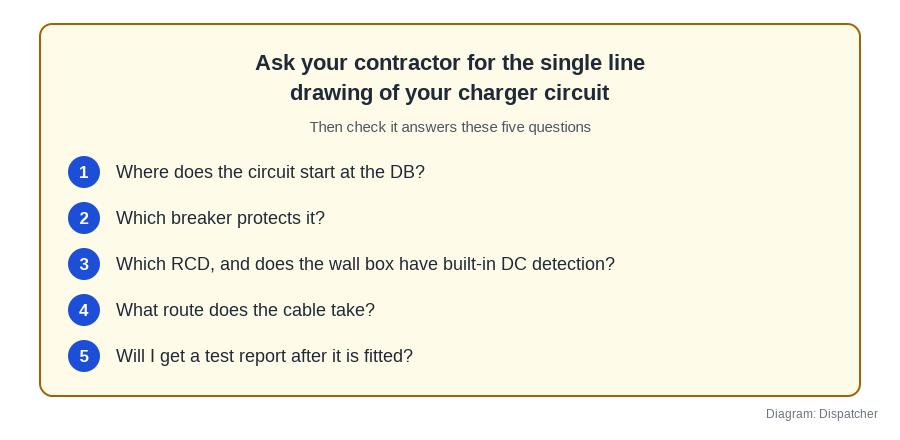
ST's EVCS FAQ lists the documents to prepare before installation. They are a site or floor plan, schematic drawings or an SLD, the charger specification, a permission letter, and test documents such as Form G and Form H.
Our guide to Form G and Form H explains what each of those test papers shows.
TNB's guide adds one more. After the wall box goes in, ask for a test report from the ST-registered contractor.
Before you hire, check the business on ST's public list of registered electrical contractors. Dispatcher has not checked listed businesses' licences yet, so this check is yours. Our guide to checking an electrical contractor shows how.
Why a general diagram is not your home's diagram
A general picture has never seen your home, so it cannot show your cable route. TNB's guide starts with a visit instead: an expert should check your internal wiring and DB and assess the load.
That assessment, not a template, decides whether you need internal upgrades, a TNB supply upgrade, or both.
Our terrace house guide covers where a wall box can go. Our installation requirements checklist lists what else to get ready.
This page leaves out cable size, breaker rating and wire colours on purpose. TNB's home EV charger guide prints no cable size or breaker rating, and wiring steps are for your registered contractor.
Get quotes on Dispatcher
Free for homeowners. Describe the job in one short form and we pass it to matched local contractors, who contact you directly. Have a photo of your DB board ready to send to the matched contractors when they contact you.
Dispatcher does not do the work. Ask each contractor for the single line diagram and test report described above.
Related guides
- Home EV charger installation requirements: a simple checklist for the full list of things to prepare.
- What an RCD does and how to test it each month, if the safety switch is the part you want to understand.
- EV charger at a terrace house: where to mount it for landed homes.
- Completion and test certificates after a home rewiring job to read before the job is signed off.
Sources
- TNB, "Before You Install an EV Home Charger" customer guide (one-page PDF): tnb.com.my. Used for the dedicated circuit, the charging-mode notes, the contractor and supply boxes and the test report tip. Read 20 November 2026.
- Suruhanjaya Tenaga EVCS FAQ, "Why must a charger have a dedicated final circuit and a correctly sized cable?" (Malay): st.gov.my. Read 20 November 2026.
- Suruhanjaya Tenaga EVCS FAQ, "What main electrical protection does an EVCS need?" (Malay): st.gov.my. Read 20 November 2026.
- Suruhanjaya Tenaga EVCS FAQ, "What safety and technical documents should be prepared before installation?" (Malay): st.gov.my. Read 20 November 2026.
- Suruhanjaya Tenaga, public list of registered electrical contractors (link only, for readers to check): ecos.st.gov.my. Link as printed by ST, added 20 November 2026; the list did not open for us that day, so no fact on this page comes from it.
Frequently asked questions
Does an EV charger need its own circuit from the DB?
Yes. TNB's guide for home EV chargers lists a dedicated circuit with a cable sized for the charger.
The Energy Commission's FAQ says charging is a high, continuous load, and a dedicated circuit lowers the risk of overload, a hot cable and fire. Your contractor sizes the cable for your charger.
Can I plug a home EV charger into a normal wall socket?
No, not directly. TNB's guide says no Mode 1 charging is allowed, which means a direct wall socket. Only Mode 2 and Mode 3 are permitted.
The guide also says to avoid extension cords if you use Mode 2, and to avoid 13A wall sockets. Mode 3 is a wall-mounted charger cabled from your DB.
Who may wire the charger?
Only a contractor registered with the Energy Commission (ST). TNB's guide says only ST-registered competent persons or contractors should handle wiring and safety upgrades, and tells you not to DIY. Dispatcher has not checked listed businesses' licences yet, so check the ST public list yourself before you hire.
Does the electricity company do the wiring from the DB to the wall box?
No. TNB's guide puts wiring and safety upgrades with ST-registered contractors, not with TNB. TNB's part is the supply side.
For a change from single phase to three phase supply, the guide says only TNB can process it. Do not change the TNB fuse.
Which RCD goes in the circuit?
One with a residual operating current of 30 mA or less, says the Energy Commission's EVCS FAQ. The FAQ allows Type A only if the wall box has built-in DC detection (RDC-DD), and otherwise Type B.
TNB's guide lists the same two types. Your contractor advises which type fits your charger.
Can I get a wiring diagram for my charger?
Yes, ask your contractor for it. The Energy Commission's FAQ lists schematic drawings and a single line diagram (SLD) among the documents to prepare before installation.
That drawing shows your own home's circuit. The picture on this page is a general guide only and gives no sizes.
Your next step
Written by the Dispatcher editorial team from the sources above. See how Dispatcher works.
Ready to compare contractors for your charger circuit? Get quotes
Last updated: 20 November 2026