Outdoor or porch EV charger: weather and safety
Last updated
Quick answer: In Malaysia, a home EV charger can go outdoors on a porch if the unit is made for outdoor use. A law firm's summary of the Energy Commission's guidelines lists IP44 as the outdoor minimum. Read the rating on the label, and leave the wiring to an ST-registered contractor.
Get quotes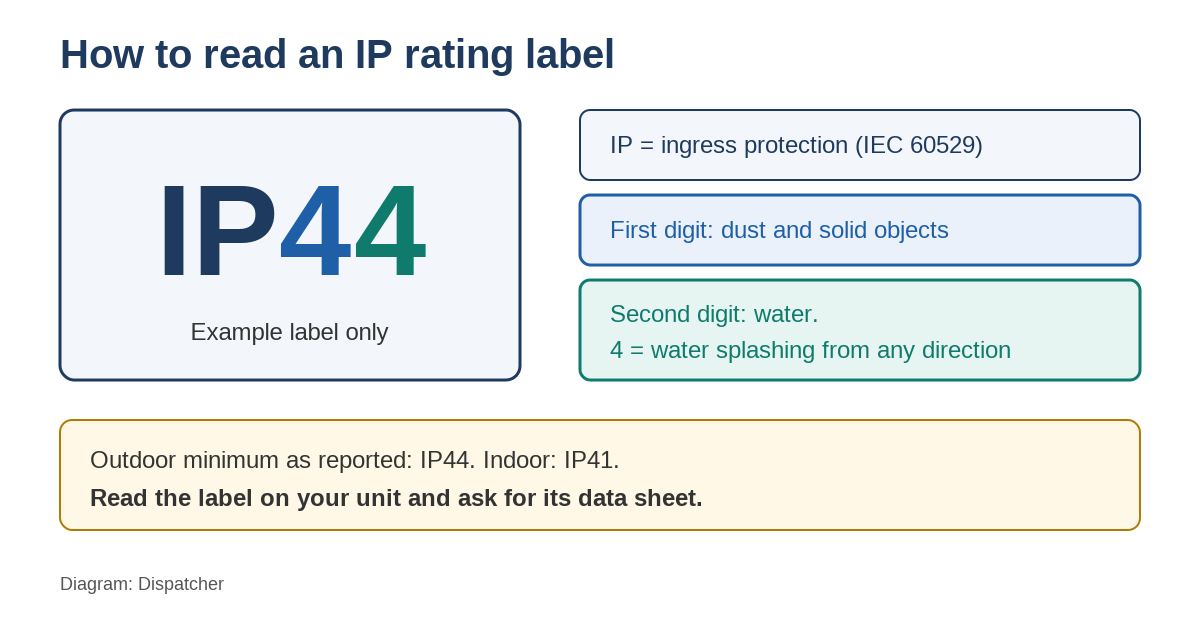
A car porch or open carport has a roof but no walls. Rain can blow in, and the charger sits there every day.
This page explains how to read the water rating on a charger's label, what to do in heavy rain or a flood, and what to ask a contractor. It gives no wiring steps. That work is for a contractor registered with Suruhanjaya Tenaga (ST, the Energy Commission).
Can an EV charger go outside on your porch?
Yes, if the charger is made for outdoor use. A law firm's summary of the Energy Commission's EV charging guidelines says enclosures must meet IP44 for outdoor use.
We could not read the guideline itself as text, because the ST file is a scanned image. So the IP numbers on this page are as reported by the law firm. The label on your own unit is what counts.
The leaflet TNB gives home EV charger buyers adds two lines. It lists a wall box charger labelled by ST-SIRIM, and says only ST-registered contractors should handle wiring.
Where the box goes on the porch is a separate question. Our terrace house guide covers the porch wall, the pillar and the cable route.
How do you read an IP rating on the label?
Look for the letters IP followed by two digits. The first digit is for dust and solid objects, and the second digit is for water, as the IP Code page on Wikipedia sets out.
The code is defined in IEC 60529, a standard from the International Electrotechnical Commission. The first picture on this page shows an example label.
A 4 in the second place means water splashing against the enclosure from any direction should have no harmful effect. A 4 in the first place is a level of protection against solid objects such as most wires and slender screws.
The law firm's summary lists IP41 for indoor units and IP44 for outdoor units. Only the second digit differs: 1 indoors, 4 outdoors.
The rating describes the box. It says nothing about the cable run, the fixing or your porch. A box can look solid and still be made for indoor use, so read the label, not the look.
Ask the contractor for the unit's data sheet. That is the maker's page that lists its rating.
What should you do in heavy rain or a flood?
Do not charge in heavy rain or when your area is flooded. Bernama reported in January 2026 that TNB gave users that advice.
TNB said it about EV charging in general. It was not written as a rule for home wall boxes, so ask your contractor how yours copes.
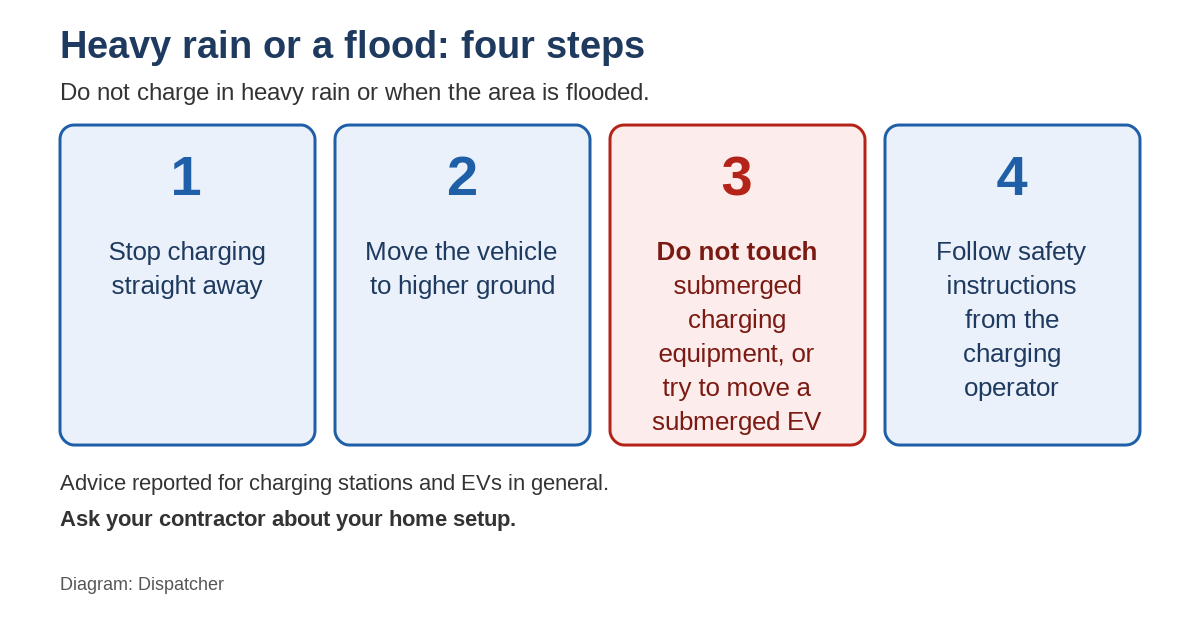
If water rises or a flood hits, TNB's advice as reported by Bernama is:
- Stop charging at once and move the vehicle to higher ground.
- Follow the instructions of the charging operator.
- Do not touch submerged charging equipment.
- Do not try to move a submerged EV.
Do not open or repair a wet charger yourself. TNB's leaflet says only ST-registered contractors should handle wiring and safety upgrades, and not to DIY. Dispatcher is not an emergency service and has no emergency line.
What was said about public charging stations?
TNB also said modern public charging stations are built with water-resistant designs, automatic cut-off systems and moisture sensors, according to The Sun.
The president of the Zero Emission Vehicle Association said critical equipment such as control panels and distribution boards is usually installed at higher levels. Both remarks are about public charging stations.
They do not tell you how high to mount a home charger. This page gives no mounting height or flood height, because we found no Malaysian source for either.
What stays the same outdoors?
The electrical rules do not change because the charger is outside. TNB's leaflet for home EV chargers has one list of requirements and no separate outdoor list.
That one list asks for these:
- A contractor registered with ST, in line with the Electricity Supply Act 1990 (Act 447).
- A wall box charger labelled by ST-SIRIM.
- A dedicated circuit with a cable sized for the charger. Our requirements checklist covers the rest of the paperwork.
- Protection by a 30 mA RCD of the RDC+DD kind, which includes DC detection, or of Type B.
- A test report from the contractor after the wall box goes in.
An RCD is the safety switch that cuts power when current leaks. Our RCD guide explains what it does and how to test it.
What should you ask a contractor about an outdoor unit?
Ask five things before you accept a quote. The card below lists them, and each one is something you can check on paper.
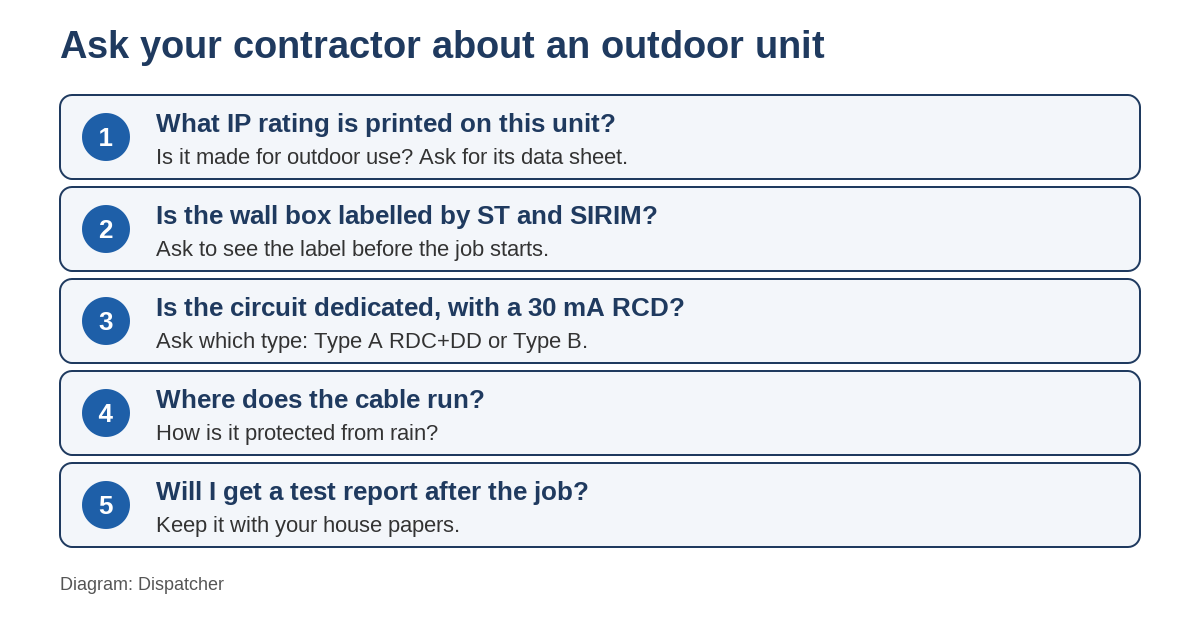
Start with the label and the data sheet. Ask which IP rating is printed on the unit and whether the maker made it for outdoor use. Compare the answer with the outdoor minimum as reported.
Then ask about the cable. Ask where it runs and how it is kept out of the rain. We found no Malaysian source for sun or heat limits, so this page gives none.
Ask for the test report when the job ends. Our installation steps guide walks through the order of the job.
Before you hire, check the business on ST's public list of registered electrical contractors. Dispatcher has not checked listed businesses' licences yet, so this check is yours. Our guide to checking an electrical contractor shows how.
Get quotes on Dispatcher
Free for homeowners. Describe the job in one short form and we pass it to matched local contractors, who contact you directly. Have a photo of your DB board ready to send to the matched contractors when they contact you.
Dispatcher does not do the work. Show each contractor the question card above.
Related guides
- EV charger at a terrace house: where to mount it for the porch wall, the pillar and the cable route.
- Home EV charger installation requirements: a simple checklist for the full list of papers and rules.
- Home EV charger installation steps from the first check to the test report.
- What an RCD does and how to test it each month if the safety switch is the part you want to understand.
Sources
- Lee Hishammuddin Allen & Gledhill, "Watt's New? Energy Commission Issues EV Charging Guidelines", section "Ingress Protection" (a law firm's summary, not the guideline). Read lh-ag.com on 24 November 2026.
- Suruhanjaya Tenaga, EVCS Guideline 2025 (PDF, a scanned image with no readable text; opened only to check this). Read st.gov.my on 24 November 2026.
- Bernama, "EVs Equipped With Advanced Safety System, Safe During Floods - TNB" (January 2026). Used for TNB's flood advice and the Zero Emission Vehicle Association president's remark. Read bernama.com on 24 November 2026.
- The Sun Malaysia, "TNB assures EVs and charging stations are safe during floods". Used for TNB's statement on station design. Read thesun.my on 24 November 2026.
- Wikipedia, "IP Code" (text under CC BY-SA 4.0, quoted briefly), the lead and the table of digits. Read en.wikipedia.org on 24 November 2026.
- TNB, "Before You Install an EV Home Charger" customer guide (one-page PDF), box "EV Charger Installation & Wiring Requirements". Read tnb.com.my on 24 November 2026.
- Suruhanjaya Tenaga, public list of registered electrical contractors (link for readers to check; the page opened with a search form only, so no fact here comes from it). Read ecos.st.gov.my on 24 November 2026.
Frequently asked questions
Can I install an EV charger outdoors at my house in Malaysia?
Yes, if the unit is made for outdoor use. A law firm's summary of the Energy Commission's guidelines gives IP44 as the outdoor minimum. TNB's leaflet says only an ST-registered contractor should do the wiring. Read the rating on the label, and ask your contractor for the unit's data sheet.
What does IP44 mean on an EV charger?
IP stands for ingress protection. The first 4 is a level of protection against dust and solid objects. The second 4 means splashing water from any direction should do the enclosure no harm, under IEC 60529. Read the label on your own unit to see its rating.
Can I charge my EV in heavy rain?
TNB advises against it. As reported by Bernama, TNB said users should avoid charging during heavy rain or when the surrounding area is flooded. That advice was about EV charging in general, not a rule written for home wall boxes. Ask your registered contractor how your own setup copes with rain.
What should I do if my porch floods while the car is charging?
Stop charging at once if water starts to rise, and move the vehicle to higher ground, TNB advised. Do not touch submerged charging equipment, and do not try to move a submerged EV. Do not open or repair the charger yourself. Call an ST-registered contractor. Dispatcher is not an emergency service.
Do outdoor chargers need different electrical protection?
TNB's leaflet gives one list of requirements for home chargers and no separate outdoor list. It asks for a dedicated circuit and protection by a 30 mA RCD, either RDC+DD or Type B. Your contractor tells you which type fits your unit, and what extra protection an outdoor spot needs.
Is a porch charger the same as a public charging station?
No. The weather and flood statements from TNB and the Zero Emission Vehicle Association were about public charging stations. A porch charger is a home setup, so ask your registered contractor how yours is built and fitted. For TNB's statement on charging stations and EVs in general, see Bernama's January 2026 report.
Your next step
Written by the Dispatcher editorial team from the sources above. See how Dispatcher works.
Ready to compare contractors for an outdoor charger? Get quotes
Last updated: 24 November 2026