Adding three-phase wiring to an older house: what happens inside the home
Last updated
Quick answer: In Malaysia, moving an older house to three phase means two jobs. The supply side goes through TNB. The work inside the home, such as DB box changes, circuits split across the phases and a check of the old wiring, is for a registered electrical contractor. Never touch the meter or the fuse.
Get quotes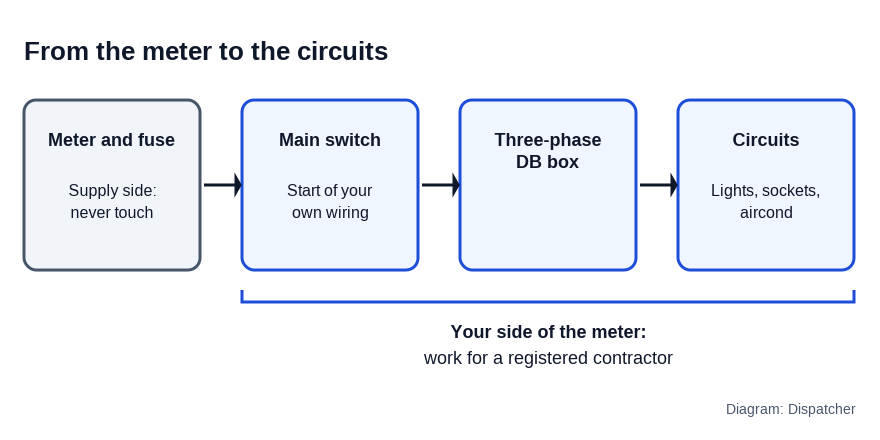
This guide stays inside your front gate: the DB box (your distribution board, where the breakers sit), the circuits and the paperwork. TNB, the electricity supply company, handles the supply upgrade, so this page only points to it.
What changes inside an older house when it goes three phase?
Two parties do two separate jobs, and only one of them happens inside your home. The supply side goes through TNB. The wiring behind the meter is for a registered electrical contractor.
On the supply side, myTNB's Upgrade / Downgrade Electricity page says the electrical contractor you appoint sends in the application. It adds that TNB installs the meter and connects the supply.
Behind the meter, TNB's leaflet "Before You Install an EV Home Charger" lists work a contractor may recommend: wiring improvements, new main circuit breakers or an RCD (a safety switch that cuts power when current leaks), and DB box changes. It is written for EV chargers, so treat it as a list of examples, not the full scope for your house.
A three-phase supply brings four wires to the meter, where single phase brings two, according to TNB's EV home charger FAQ. Your contractor decides which lights, sockets and aircond circuits sit on which phase, so ask how they plan it.
Leave the meter and the fuse alone. The same FAQ answers "Can a contractor upgrade only the fuse without applying to TNB?" with "No. This is not allowed." The leaflet says it in fewer words: do not DIY or change the TNB fuse.
Should your older house move to three phase at all?
That depends on your load, and only a registered contractor can read it. The supply company gives its own advice: myTNB says to change from single phase to three phase when the load of a normal household goes above 10 kW.
Its rule of thumb on the same page is three or more air conditioners at home. TNB's EV home charger FAQ draws the same line: single phase for homes using up to 10 kW in total, three phase for homes above 10 kW and up to 37 kW.
Those are the supply company's numbers, not a verdict on your house. This page does not say you need three phase. It makes no promise about lower bills or fewer power trips, and no official source we opened says three phase does either.
Planning an EV charger? Our home EV charger requirements guide covers what the charger needs from the supply. If you only want one more socket, start with adding a power point.
What does the contractor check in the old wiring first?
The first job is a check of the internal wiring and the DB box. TNB's leaflet lists it as step one, ahead of any upgrade. It says the contractor's assessment decides whether internal upgrades, a supply upgrade or both are needed.
Every home wiring installation must also have a system of isolation, switching and protection, says section 7.1(a) of ST's domestic wiring guideline. In section 7.2(b) the same guideline says these devices must let one circuit be switched on or off without disturbing the others.
ST is Suruhanjaya Tenaga, the Energy Commission. Its guideline is in Malay, so what you read on this page is our plain-English paraphrase. Read the original when you can.
Ask the contractor to write down what they find in the old wiring, what can stay and what must change. Our guide to the signs an old house needs rewiring shows what a tired system looks like.
No official source we opened gives cable sizes or circuit counts for this job, so none are printed here. They come from the contractor's own check of your house.
What changes in the DB box?
The DB box is the part of the job you will see. The picture below is a simplified Dispatcher drawing of the idea, not a rule from any source, and your board may differ.
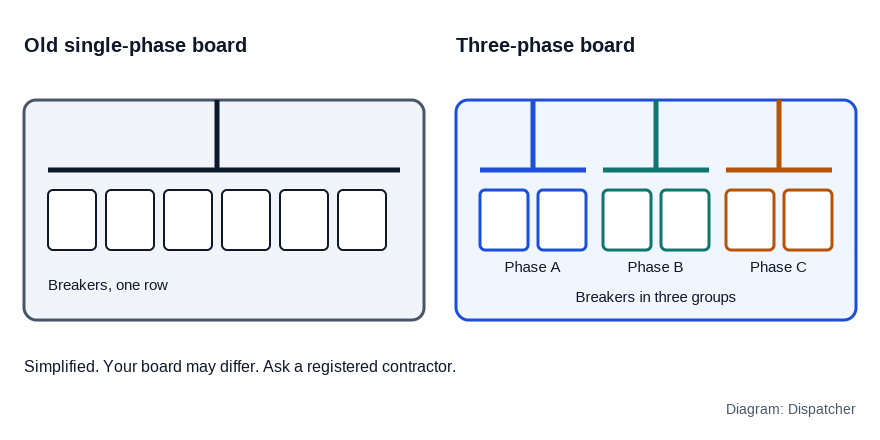
TNB's leaflet names new main circuit breakers or an RCD, and DB box improvements, among the upgrades a contractor may suggest. Our RCD guide shows how to test an RCD.
Section 6.2(d) of ST's domestic wiring guideline says distribution boards follow the standard MS IEC 60670. It also says the main switch must sit where an adult can reach it easily.
Which breaker goes on which phase, and how big each one is, is the contractor's design. This page gives no sizes because no source we opened gives them.
Who does what, and which paperwork follows?
You hire a contractor. The contractor applies to TNB and does the work inside. TNB does the meter and the connection, and a wireman signs the forms.
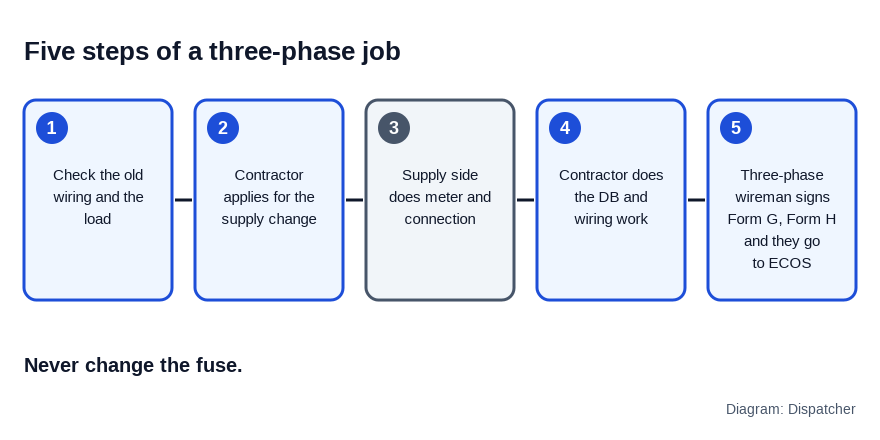
myTNB's page says the contractor must come from the Energy Commission's list of registered electrical contractors. Two forms then follow the wiring work. ST's ECOS page "Garis Panduan Pendaftaran Pepasangan" describes both. ECOS is ST's online system.
Form G is the supervision and completion certificate. A single-phase wireman fills it for single-phase work. A three-phase wireman fills it for three-phase work and must work full time for an ST-registered electrical contractor.
Form H is the test certificate. An authorised wireman fills it for the matching kind of testing work.
Both forms are filled in online, printed, signed and uploaded to ECOS. The applicant keeps the signed originals, and ST may ask for them at any time.
In the table of signing limits on the same ECOS page, the single-phase wireman class covers low voltage single-phase work only. So ask which class of wireman will sign your three-phase job.
Dispatcher has not checked listed businesses' licences yet. You can look a contractor up on ST's list of registered electrical contractors. Our guide to checking an electrical contractor shows how, and what to prepare for a home visit helps you get ready.
How do you compare quotes?
Ask for quotations before you appoint anyone, as myTNB's page advises. Then put the same four questions to every contractor:
- Which class of wireman will sign Form G and Form H for this job?
- What does the DB box work cover: a new board, a new main switch, an RCD?
- Who sends the application to TNB, and who answers if TNB asks for more papers?
- What will you check in the old wiring first, and will you write down what you find?
Ask each contractor to list the same work in writing, so the quotes can be compared fairly. This page prints no RM figures and no timeline, because we found no official source for either. Numbers will come from the quotes.
Get quotes on Dispatcher
Free for homeowners. Describe the job in one short form and we pass it to matched local contractors, who contact you directly. Have a photo of your DB board ready to send to the matched contractors when they contact you.
Dispatcher does not do the work, and it has not checked listed businesses' licences yet. Check each contractor on ST's list before you agree to anything. Dispatcher is not an emergency service and has no emergency line.
Related guides
- Old house wiring: signs it is time to rewire: what a tired system looks like before you call anyone.
- Booking an electrician home visit: what to prepare: what to have ready on the day.
- How to check an electrical contractor before you hire: where to look a contractor up.
- What an RCD does and how to test it each month: the safety switch in your DB box.
Sources
TNB and ST pages change, so check the current wording before you apply or sign anything.
- myTNB, Upgrade / Downgrade Electricity (headings "When to change", "Appoint Contractor" and "Steps"). Read 24 November 2026.
- TNB, leaflet "TNB Customer Guide: Before You Install an EV Home Charger" (Step 1 and Step 2). Read 24 November 2026.
- TNB, web FAQ "TNB Customer Guide EV Home Charger - English" (supply types, how to check your supply, and the fuse question). Read 24 November 2026.
- ST, ECOS page "Garis Panduan Pendaftaran Pepasangan" (Borang G, Borang H and wireman classes). Read 24 November 2026.
- ST, guideline "Garis Panduan Pendawaian Elektrik Pepasangan Domestik" (sections 6.2(d), 7.1(a) and 7.2(b)). Read 23 November 2026.
- ST, list of registered electrical contractors. Read 24 November 2026.
Frequently asked questions
Can I just replace my DB box to get three phase?
No. A new DB box does not change your supply. TNB's leaflet for EV home chargers says only TNB can process supply upgrades, and internal upgrades are for a registered contractor. TNB's EV home charger FAQ adds that a contractor cannot upgrade only the fuse without applying to TNB.
When should an older house move to three phase?
myTNB advises a change from single phase to three phase when a normal household's load goes above 10 kW. Its rule of thumb is three or more air conditioners at home. These are the supply company's own figures, not a verdict on your house. A registered contractor can read your load and tell you.
Who applies for the supply upgrade?
The electrical contractor you appoint applies to TNB. myTNB says that contractor must come from the Energy Commission's list of electrical contractors, and that TNB installs the meter and connects the supply. It also advises asking for quotations before you appoint anyone.
Who signs Form G and Form H for three-phase work?
A three-phase wireman. ST's ECOS guideline page says a three-phase wireman fills Form G for three-phase work, and must work full time for an ST-registered electrical contractor. Form H, the test certificate, is filled by a wireman authorised for that testing work. Both are signed and uploaded to ECOS.
Does the old wiring have to be checked first?
TNB's leaflet for EV home chargers puts a check of the internal wiring and the DB box as step one, done by a registered contractor. It says that assessment decides whether internal upgrades, a supply upgrade or both are needed. Ask your contractor to write down what they find.
Can I keep my old DB if it still works?
Only a registered contractor can tell you, after looking at the board, and this page gives no verdict. Whether a working board meets the rules is theirs to judge. ST's domestic wiring guideline says, in section 7.1(a), that every home wiring installation needs a system of isolation, switching and protection.
Ready to ask for quotes?
Written by the Dispatcher editorial team from the sources above. See how Dispatcher works.
Last updated: 24 November 2026