Completion and test certificates after a home rewiring job
Last updated
Quick answer: After new wiring, rewiring or added wiring at home, ask your electrical contractor for two signed certificates. Form G shows a wireman supervised and finished the work. Form H shows the wiring was tested. Keep the originals. Suruhanjaya Tenaga's domestic wiring guideline says both stay valid only until the wiring is changed.
Free for homeowners. Dispatcher does not do the work.
Get quotesOn this page
- The two certificates in plain words
- Who fills them in
- What the test certificate is based on
- What to keep, and when you need new ones
- Not the same as building completion forms
- How this ties to hiring
- Get quotes on Dispatcher
- Sources
- Frequently asked questions
- Next step
The two certificates in plain words
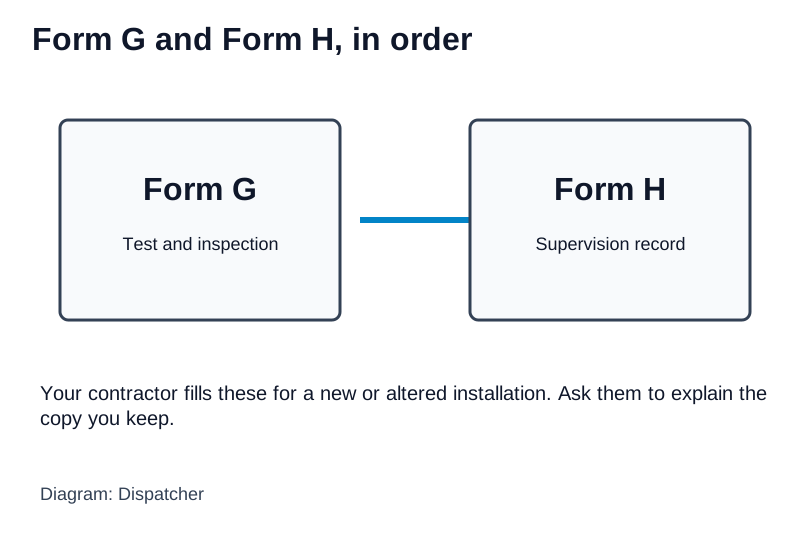
Think of Form G as the sign-off that the work was watched over and is done. Form H is the sign-off that it was tested. In Malay, Form G covers penyeliaan dan penyiapan, and Form H covers ujian.
Suruhanjaya Tenaga (ST), Malaysia's energy regulator, explains the legal side in its domestic wiring guideline. Regulation 12 of the Electricity Regulations 1994 asks for a supervision and completion certificate. Regulation 13 asks for a test certificate once wiring or rewiring is done. Regulation 14 puts them on Form G and Form H (ST, "Garis Panduan Pendawaian Elektrik Pepasangan Domestik", section 11.1).
| Form G | Form H | |
|---|---|---|
| Malay name | Perakuan Penyeliaan dan Penyiapan | Perakuan Ujian |
| What it tells you | A wireman supervised the wiring and it is complete | The finished wiring was tested |
Who fills them in
A wireman fills them in, working through an electrical contractor registered with ST. For Form G, ST's ECOS guide names a single-phase wireman for single-phase work, or a three-phase wireman for three-phase work. That wireman must work full time for the registered contractor (ST ECOS, "Pendaftaran Pepasangan").
Form H needs a wireman who is allowed to test. The same ECOS guide says so for both single-phase and three-phase work.
Your home's supply type decides which wireman fits. Count the wires at your meter. TNB's guide links two wires to a single-phase supply and four wires to three-phase (TNB, customer guide on home EV chargers). Ask the firm which wireman will sign, and check that person's certificate.
What the test certificate is based on
Form H rests on a set of tests the wireman runs on the finished wiring. ST's domestic guideline lists them in section 11.2, and says an inspection comes first (ST, "Garis Panduan Pendawaian Elektrik Pepasangan Domestik").
- Continuity. Checks that the earth wires and live wires are joined up properly from end to end.
- Insulation resistance. Checks that no current leaks between wires, and that the cable insulation holds up.
- Polarity. Checks that each fuse and single-pole switch sits on the live (phase) wire, and that sockets are wired the right way round.
- Earth electrode resistance. Checks the earth rod buried in the ground for your home's earthing.
- Residual current device (RCD). Checks that the safety switch trips in time when current leaks to earth.
- Earth loop impedance. Helps the tester pick the right kind of earth leakage protection.
You do not need to read the numbers yourself. You do need the signed form. Ask the wireman to walk you through it when the job is done.
What to keep, and when you need new ones
Keep the signed originals of both forms. ST's ECOS guide says Form G and Form H are filled in online, then printed and signed, and the originals are kept by the applicant. ST can ask to see them (ST ECOS, "Pendaftaran Pepasangan").
The forms do not last forever. ST's domestic guideline says they stay valid as long as the wiring is not changed. If wiring is added, the old Form G and Form H lapse on their own.
New ones must be made before the home takes power from the electricity supplier. Any new issue of the forms for a home must come from an electrical contractor and a competent person (ST, "Garis Panduan Pendawaian Elektrik Pepasangan Domestik", section 11.2).
The ECOS guide is written for registering an installation, and not every home job goes through that step. Ask your contractor which steps apply to your home, and check current rules with ST before a large job.
Not the same as building completion forms
Form G and Form H for wiring are not the "Form G1 to G21" you may hear about when a new house is handed over. Those are stage certificates for the Certificate of Completion and Compliance (CCC) of a building. One of them, Form G7, covers internal electrical work (Lembaga Arkitek Malaysia, general circular 1/2008 on the CCC).
So if someone says "Form G", ask which one. A rewiring job in a home you already live in is about the electrical Form G and Form H. The circular is from 2008, so ask your architect or local council about the current CCC process.
How this ties to hiring
Ask about the certificates before you accept a quote. A firm that plans to issue Form G and Form H can name the wireman who will sign them.
When you rewire or add new wiring at home, ST says to hire a registered electrical contractor (ST, "Which party should I appoint?"). Look up the firm on ST's ECOS contractor list before you pay a deposit.
Before you sign, see what changes an electrician's quote.
Get quotes on Dispatcher
Free for homeowners. Describe the job in one short form and we pass it to matched local contractors, who contact you directly. Have a photo of your DB board ready to send to the matched contractors when they contact you.
Dispatcher does not do the work, and has not checked whether any listed firm issues these forms. Ask each firm yourself. For a rewire or DB box change, start on the electrical wiring page. For smaller jobs, use the home electrical work page. Read how Dispatcher works, or find other home help guides.
Sources
Sources: every link below was checked on the update date shown above.
- Suruhanjaya Tenaga: Garis Panduan Pendawaian Elektrik Pepasangan Domestik (sections 11.1 and 11.2)
- Suruhanjaya Tenaga ECOS: Pendaftaran Pepasangan (Borang G and Borang H)
- Suruhanjaya Tenaga: which party should I appoint for wiring at my residence?
- Suruhanjaya Tenaga ECOS: Senarai Kontraktor Elektrik Berdaftar
- TNB: customer guide on home EV chargers (meter wires and supply type)
- Lembaga Arkitek Malaysia: general circular 1/2008 on the CCC
Frequently asked questions
What should I ask for when a rewiring job is done?
Ask for both signed forms, Form G and Form H, as originals. The first records who supervised the wiring and that it is finished. The second records the tests. Both come from the wireman working for your electrical contractor. Ask about them when you compare quotes, so the firm hands both over.
How is Form G different from Form H?
Form G says a wireman supervised the wiring and that it is complete. Form H says the finished wiring passed a set of tests, such as continuity, insulation resistance, polarity and the RCD test. ST's domestic wiring guideline ties Form G to regulation 12 and Form H to regulation 13 (ST guideline).
Are these the same as building completion forms?
No. The electrical Form G and Form H are separate from Forms G1 to G21, used for a building's Certificate of Completion and Compliance. Form G7 there covers internal electrical work in a new building. For a home rewire, ask for the electrical Form G and Form H.
Who fills in Form G and Form H?
A wireman fills them in, working full time for an electrical contractor registered with ST. Form G needs a single-phase or three-phase wireman to match your supply. Form H needs a wireman who is allowed to test. Ask the firm to name that person, and check their certificate before work starts.
Has Dispatcher checked that a firm issues these certificates?
No. Dispatcher has not checked licences, and has not checked whether listed firms issue Form G and Form H. Being listed only means the business is in our directory. Ask each firm directly before you accept a quote. A firm that issues both forms should be able to tell you up front.
Next step Planning a rewire or new wiring? Get quotes