House wiring diagram: a simple guide for a Malaysian home
Last updated
Quick answer: In Malaysia, power reaches your home through the supply company's meter. A cable then runs to your DB box (distribution board), which splits it into circuits for lights, sockets and big appliances. The meter side belongs to the supply company. Wiring after it is for an electrical contractor registered with the Energy Commission.
Get quotes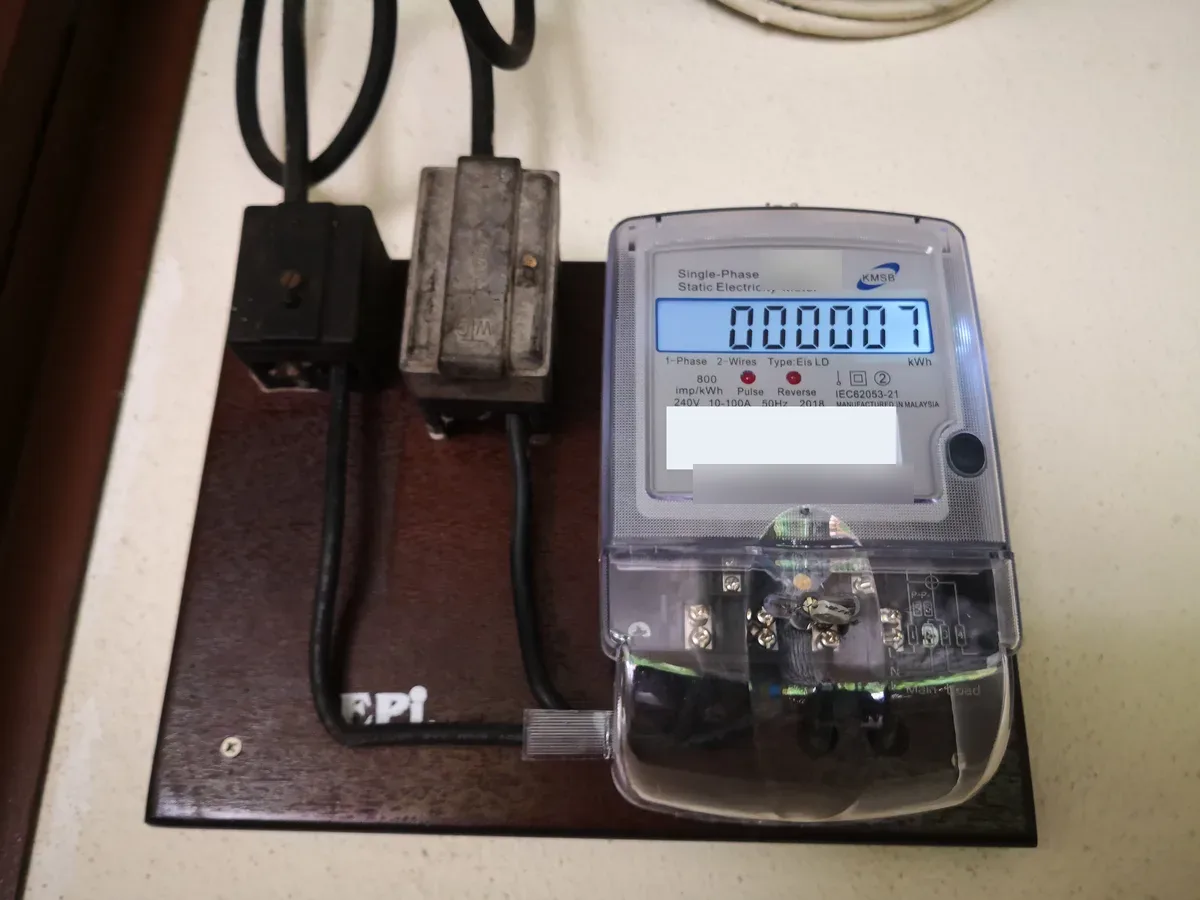
Where house wiring starts: the meter board. A single-phase meter in Malaysia with its cut-outs and cables.
Below, the power runs from the street to your sockets in three simple drawings. Each part is marked as the supply company's or as work for a registered contractor.
Use it to understand your home and to talk to a contractor. It is not a wiring guide.
How does power get from the street to your sockets?
Power goes from the street to the supply company's meter, then along a cable to your DB box. From there it leaves on separate lines for lights, sockets and big appliances. The path follows the parts that ST's home wiring guideline lists for a home.
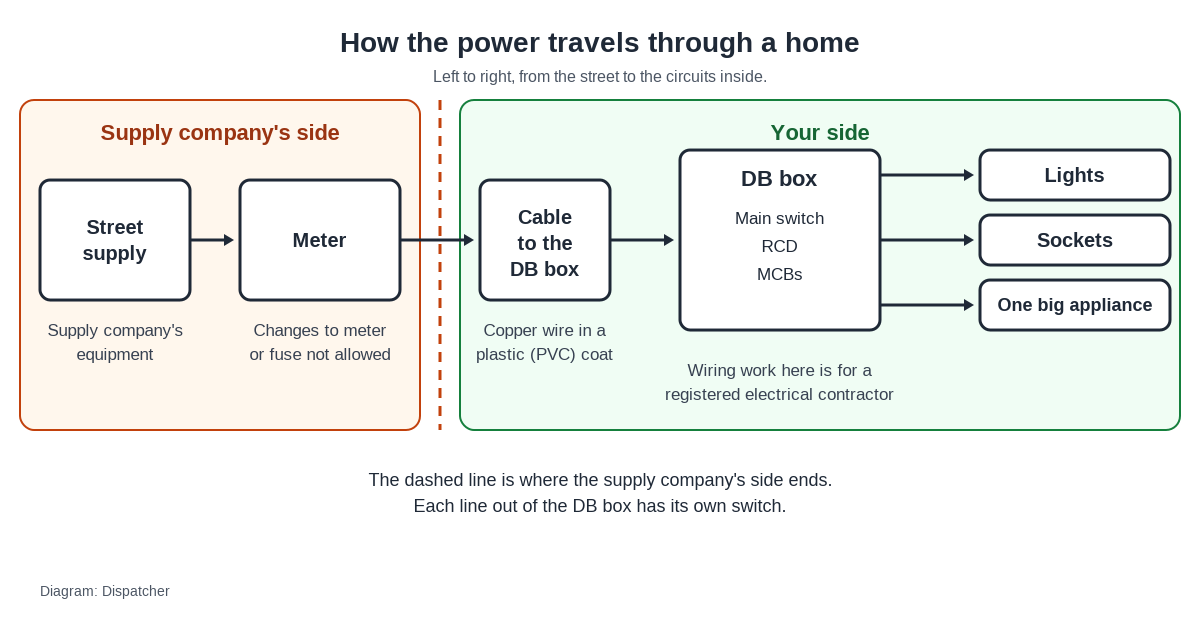
The whole layout in one picture. The dashed line is where the supply company's side ends.
The meter is not yours to touch
The meter is the supply company's. TNB's customer guide for EV home chargers says any change to TNB's meter or fuse is strictly prohibited. It adds that such a change can be unsafe and may cause fire risks.
That answer sits on a charger page. The rule it states is about the meter and the fuse.
The cable to the DB box
After the meter, a cable runs to your DB box. ST's home wiring guideline, in its section on choosing wiring cable, says all wiring cable, including the cable between the utility meter and your distribution board, must have PVC (or PVC over PVC) insulation and copper conductors.
PVC is a plastic. In plain words, it is copper wire in a plastic coat.
Isolating and protecting
The same guideline says every home wiring system must have a system of isolation, switching and protection. It also has its own drawing of the isolating and protective devices a home wiring system must have.
Our picture above is a plainer sketch, drawn from scratch, not a copy of that drawing.
What is inside the DB box?
A DB box (distribution board) holds the main switch, an RCD and a row of MCBs. It splits the supply into separate circuits and guards each one. ST's home wiring guideline lists the main switch, MCB or fuse and RCD among the parts of home wiring.
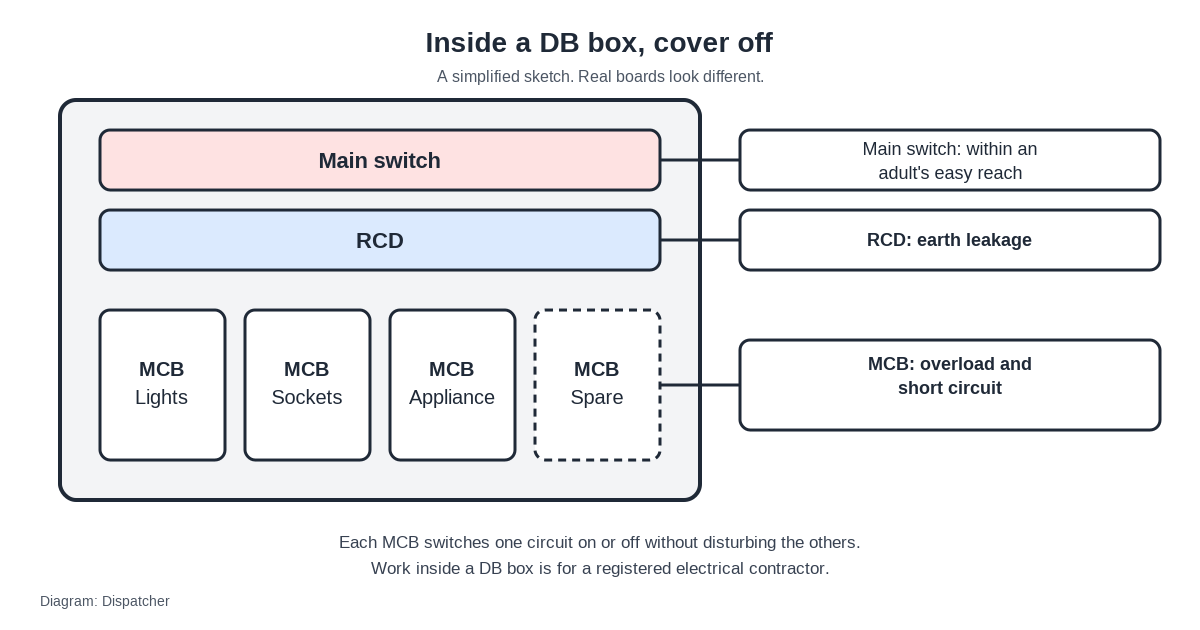
A simplified sketch. Real boards look different, and this page does not ask you to open yours.
The three parts in plain words
- Main switch. Think of it as the master switch for the whole board. The guideline says the board must be fitted so the main switch sits at a height an adult can reach easily.
- MCB (miniature circuit breaker). It switches one circuit on and off. The guideline puts overload and short circuit under overcurrent protection, done by a circuit breaker or a fuse.
- RCD (residual current device). It guards against earth leakage, which means current escaping to earth. The guideline says this protection is there to prevent electric shock.
Those points come from section 7.3 of ST's home wiring guideline and its section on distribution boards.
Each switch or breaker connects and disconnects one circuit without disturbing the others. The same guideline adds that this also guards against shock during maintenance, testing, fault finding and repair.
When the power goes off
Look outside first. The RCCB page in myTNB's Safety and Advisory section says to check whether your neighbours still have electricity. If they do, the problem could be confined to your home.
For what an RCD does and why it trips, read What an RCD does and how to test it each month.
How are lights, sockets and big appliances split into circuits?
Each group gets its own circuit from the DB box: lights on one, sockets on another, and a big fixed appliance on its own line. ST's home wiring guideline names lighting circuits and socket circuits separately. Its table of socket circuits is for general sockets and leaves fixed appliances out.
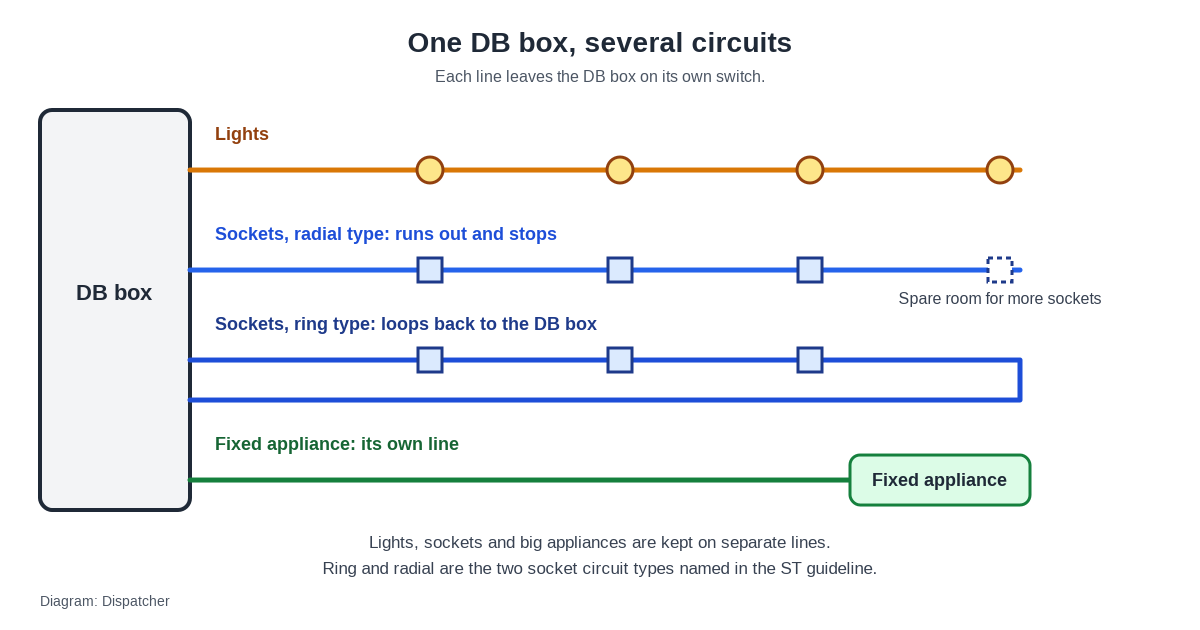
One DB box, four lines. Each line leaves the board on its own switch.
Ring and radial sockets
The guideline's table of circuit types for general sockets lists two kinds: ring (gelang) and radial (jejari). It also has an example drawing for each.
How we read those drawings: in a radial circuit, the cable runs out to the sockets and stops. In a ring circuit, the cable loops through the sockets and comes back to the board.
Why you keep spare room
How many sockets one circuit can serve depends on the circuit type and the largest floor area it covers. The guideline also says to keep a reserve for socket circuits.
So whether you can add a socket depends on the room left on that circuit. Adding a new power point at home: what to know first covers the question.
This page gives no cable sizes or breaker ratings. Those are for the contractor to set for your home.
Is your home single phase or three phase?
Count the wires connected to your meter. TNB's customer guide for EV home chargers says two wires mean single-phase supply, and four wires mean three-phase supply.
That is TNB's wording on a charger page, and this guide uses it only to count wires. The meter in the photo at the top of this page is a single-phase one.
Dispatcher has no advice here on changing your supply. Ask a registered contractor if you think you need a change.
Which parts can you touch and which need a registered contractor?
Leave the meter and its fuse to the supply company. Wiring work after the meter, from the DB box to the sockets, is for a contractor registered with the Energy Commission.
ST's page on new wiring, modification, upgrade, rewiring and extra wiring at a residence says to contact an electrical contractor registered with the Energy Commission. TNB's EV home charger guide covers the meter and fuse.
Dispatcher's summary of those two pages:
| Part | Who deals with it | What you can do |
|---|---|---|
| Street supply and meter | Supply company | Leave to the supply company |
| Cable from meter to DB box | Registered contractor | Ask about it in a quote |
| DB box, switches and RCD | Registered contractor | Know the parts and what each does |
| Lights, sockets and appliance lines | Registered contractor | Say what you want added or moved |
Dispatcher has not checked the licences of listed businesses yet, so the check is yours. ST's public list of registered electrical contractors is the place to look a business up, and How to check an electrical contractor before you hire shows how.
Two more guides help once you have a contractor. Completion and test certificates after a home rewiring job explains the paperwork that follows a rewire. Old house wiring: signs it is time to rewire is for an older home.
Get quotes on Dispatcher
Free for homeowners. Describe the job in one short form and we pass it to matched local contractors, who contact you directly. Have a photo of your DB board ready to send to the matched contractors when they contact you.
Dispatcher does not do the work. The contractor does, so check each business on the ST list first.
Related guides
- What an RCD does and how to test it each month covers the switch that guards against leakage.
- Adding a new power point at home: what to know first is for one more socket.
- Old house wiring: signs it is time to rewire helps you judge an older home.
- How to check an electrical contractor before you hire shows how to use the ST list.
- Completion and test certificates after a home rewiring job explains the paperwork.
Sources
- Suruhanjaya Tenaga (ST), "Garis Panduan Pendawaian Elektrik Pepasangan Domestik", sections 6.2 (parts of home wiring and the main switch), 7.1 to 7.3 (isolation, switching and protection), 8.1(a) (wiring cable) and Table 6.3 (socket circuit types): st.gov.my PDF. Read 20 November 2026.
- Tenaga Nasional Berhad (TNB), web FAQ "TNB Customer Guide EV Home Charger - English", answers to "Can a contractor upgrade only the fuse without applying to TNB?" and "How can I check my current TNB electricity supply at home?": tnb.com.my/faq/tnb-customer-guide-ev-home-charger-english. Read 20 November 2026.
- myTNB, page "Safety and Advisory > RCCB", box "First thing to check when there is no power": mytnb.com.my/safety-and-advisory/rccb. Read 20 November 2026.
- ST, page "I intend to carry out new wiring, modification, wiring upgrade, rewiring, additional wiring in my residence": st.gov.my. Read 20 November 2026.
- ST, public list "Senarai Kontraktor Elektrik Berdaftar" (ECOS), link as printed on the ST page above; the list itself is not opened from our server: ecos.st.gov.my. Read 20 November 2026.
- Hero photo: Wikimedia Commons file "Elektrik Meter Baharu", author Encik Tekateki, CC BY-SA 4.0: file page. Read 20 November 2026.
The guidance above is dated. Check the current rules with ST and TNB before you rely on them.
Frequently asked questions
What is a DB box and what does it do?
A DB box (distribution board) is the box of switches that splits your home's supply into separate circuits. ST's home wiring guideline lists the main switch, MCB or fuse and RCD among the parts of home wiring. It adds that switches and breakers connect and disconnect one circuit without disturbing the others.
Who owns the meter and who owns the wiring after it?
The meter is the supply company's, and the wiring after it is for a registered contractor. TNB's EV home charger guide says any change to TNB's meter or fuse is strictly prohibited. For house wiring, ST says to use an electrical contractor registered with the Energy Commission.
What is the difference between an MCB and an RCD?
An MCB guards a circuit against overload and short circuit, while an RCD guards against earth leakage, which is current escaping to earth. ST's home wiring guideline treats them as separate kinds of protection. For tripping, see What an RCD does and how to test it each month.
How can I tell if my home is single phase or three phase?
Count the wires connected to your meter. TNB's EV home charger guide says two wires mean single phase and four wires mean three phase. TNB's guide also says any change to TNB's meter or fuse is strictly prohibited, as they can be unsafe and may cause fire risks.
Why are sockets and lights on different circuits?
Dispatcher's plain reading: each circuit is switched and protected on its own, so one fault need not switch off the rest. ST's home wiring guideline says switches and breakers work on one circuit without disturbing the others. Its table of socket circuits is for general sockets and leaves fixed appliances out.
Who should work on my house wiring?
An electrical contractor registered with the Energy Commission. ST's page on wiring at a residence says to contact one, and the ECOS site holds the public list. Dispatcher has not checked listed businesses' licences yet, so look the business up first with How to check an electrical contractor before you hire.
Your next step
Once you know the layout, ask local electrical contractors to quote for the job you have in mind.
Written by the Dispatcher editorial team from the sources above. See how Dispatcher works.
Last updated: 25 November 2026