Rewiring a house while you live in it: what to plan for in Malaysia
Last updated
Quick answer: In Malaysia, staying home during a rewire can work if the contractor plans it circuit by circuit. ST's domestic wiring guideline says isolating devices let one circuit be worked on without disturbing the others. It gives no rewire duration and does not say whether you may stay. Get the plan in writing before work starts.
Get quotes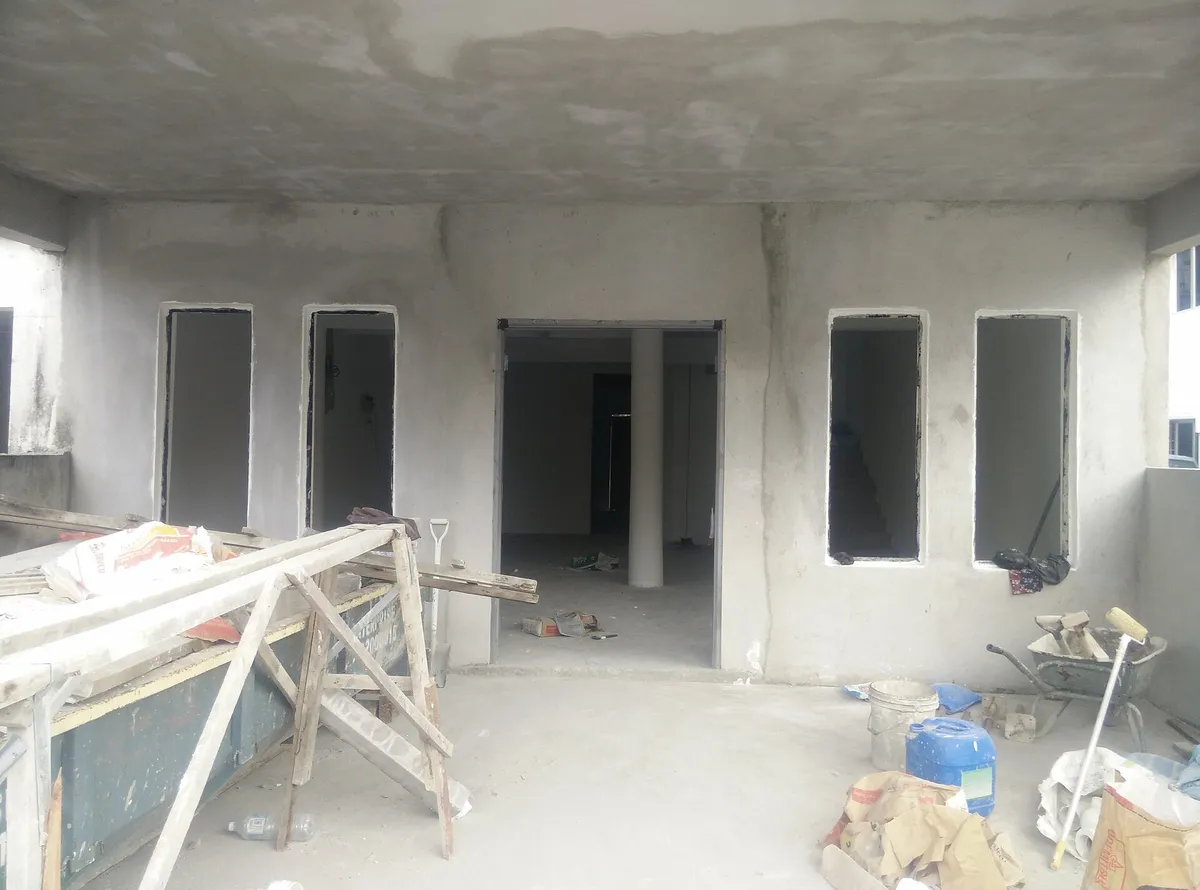
A terraced house during renovation in Selangor. No wiring is visible. The photo only shows what a building site inside a house can look like.
You have a rewire quote, or expect one, and your family still has to sleep, cook and work at home. So the work has to fit around you.
Nothing below shows you how to switch circuits or open the DB box. That is the contractor's job.
Can you stay while the wiring is replaced?
Sometimes, if the contractor builds the plan around your household. ST (Suruhanjaya Tenaga) is the Energy Commission that regulates electricity in Malaysia. Its domestic wiring guideline, Garis Panduan Pendawaian Elektrik Pepasangan Domestik, is silent on whether a household may stay, and gives no time for a rewire.
So it comes down to the plan. If anyone gives you a day count, ask what it is based on, because the guideline gives none. That is also why this page gives no day count.
What decides it is the job itself. Think about how many circuits are replaced, whether walls and ceilings are opened, and who at home needs power. Redoing the sockets in two rooms is a different job from a full strip-out.
Not sure you need a rewire at all? Read our guide on the signs an old house needs rewiring first.
How a rewire can go circuit by circuit
A rewire can be split by circuit because home wiring must have a way to cut power to one circuit alone. Section 7.1 of ST's domestic wiring guideline says every home needs a system of isolation and switching, plus protection.
Section 7.2 names the equipment: switches, plugs, socket outlets and circuit breakers. They connect and disconnect the supply to one circuit without disturbing the others. The same section says they also guard against electric shock during maintenance, testing, fault finding and repair.
The guideline does not set out a rewire sequence. The six steps below are Dispatcher's plain reading of how isolation, testing and the forms fit together, not a quote.
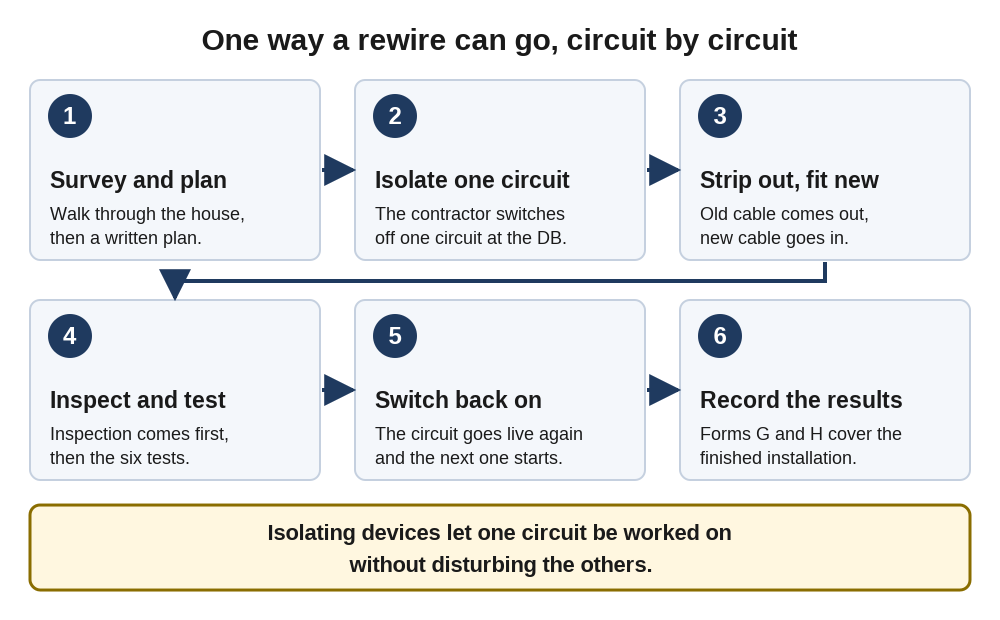
One way the work can run. The forms in step six cover the finished installation, not each circuit.
The circuit breakers in your DB box are one kind of isolating device the guideline names. The DB box is the box of switches, also called the distribution board. Ask the contractor to list which rooms and sockets sit on each breaker.
That list turns a plan by circuit into a plan by room. While one circuit is off, anything plugged into it is off too.
Leave all switching to the contractor. Do not open the DB box or switch a circuit back on yourself, because a circuit that is off may be off for a reason.
Questions to ask before the work starts
Ask for a written plan, by circuit or zone, before any cable is cut. The card below has the six questions to take to each quote visit.
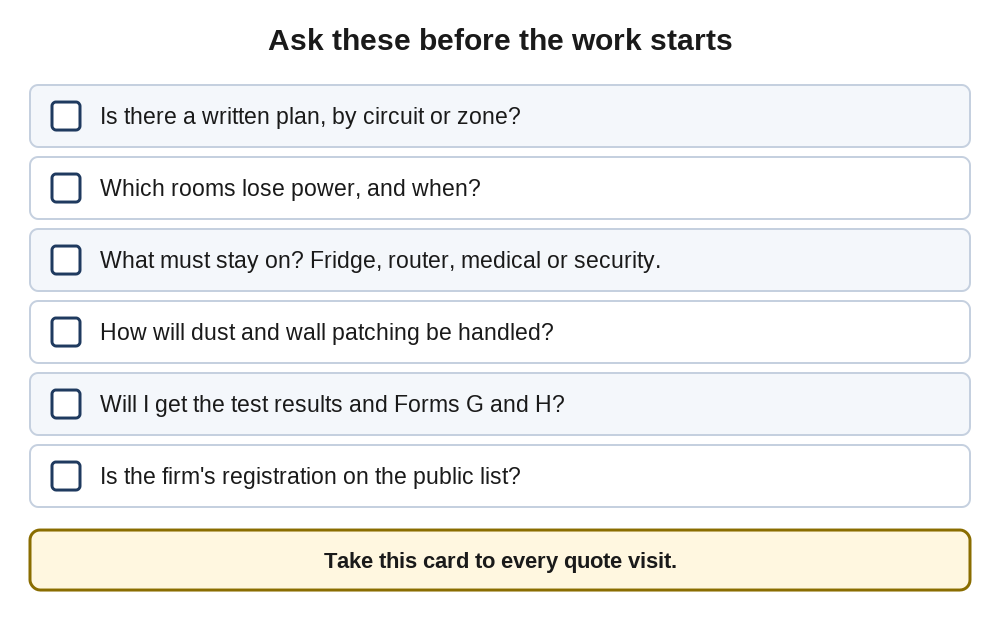
A checklist drawn by Dispatcher. It is not a legal requirement.
What must stay on. Name the fridge, the router, any medical device and any security system. If the circuit that feeds one of them has to go off, ask how it will be covered.
Which rooms lose power, and when. Get the order in writing, room by room or zone by zone. Ask too whether the main switch will ever be off for the whole house, and for how long.
Dust and patching. Opening walls leaves holes. Ask who patches and repaints, whether that is in the quote, and how dust is kept out of the rooms you use.
Papers at the end. Ask now for the test results and Forms G and H, which the next sections explain.
Registration. ST's page on rewiring and extra wiring says consumers should contact an electrical contractor registered with the Energy Commission. The public list is on ECOS, ST's online system.
Dispatcher has not checked the licences or registration of listed businesses yet, so the check is yours. Our guide on how to check an electrical contractor shows the steps.
What the supply company keeps
Your contractor must leave TNB's meter and fuse alone. In TNB's customer guide for home EV chargers, the answer to "Can a contractor upgrade only the fuse without applying to TNB?" is no, and it is "not allowed".
The same answer says changes to TNB's meter or fuse are "strictly prohibited" because they can be unsafe and may cause fire risks. That guide is written for EV chargers. In Dispatcher's own reading, the same rule covers a meter or fuse change on any other job, a rewire included.
Everything from your main switch and DB box onwards is home wiring. That is the part a registered contractor rewires. If your quote mentions a bigger fuse or a new meter, ask who applies to TNB for it.
Testing and papers at the end
Inspection comes first, then six tests, then two forms. Section 11.2 of ST's guideline says the wiring is inspected before it is tested.
The same section lists these tests for the test certificate:
- continuity
- insulation resistance
- polarity
- earth electrode resistance
- the RCD test (the RCD is the safety switch that cuts power if current leaks)
- earth loop impedance
You do not need to know how each test is done. Ask the contractor to show you the readings and explain any you do not follow.
Form G is the supervision and completion certificate. Form H is the test certificate.
Section 11.1 of the guideline points to Regulations 12 to 14 of the Electricity Regulations 1994. They require the wireman who supervises the work to sign Form G, and a finished rewire to be tested and given a Form H.
If a quote or web page uses another name for these papers, ask the contractor which one it means. The guideline names Form G for completion and Form H for testing. Our guide on Form G and Form H explains both.
ST's ECOS page on installation registration says the forms are filled in online, printed and signed, and the signed originals are kept. Ask for your copies.
The forms hold only while the wiring stays as tested. Section 11.2 of the guideline says added wiring voids them, and new Forms G and H must be made before supply is taken from the supplier. If you plan to add a point later, see our guide on adding a power point.
When moving out is easier
Moving out is easier when the job is big, messy or hard to split. The guideline sections we read do not require you to leave, so this list is Dispatcher's own judgment, not a rule.
- The whole house is being stripped back and rewired at once.
- Ceilings are being opened to run new cable.
- Someone at home needs power all day, for a medical device or for working from home.
- The plan means long hours of dust and noise in the rooms you use.
- The contractor cannot give you a written plan by circuit or zone.
A part-way move can work too. You might stay with family on the loudest days only. Ask the contractor which days those will be.
Get quotes on Dispatcher
Free for homeowners. Describe the job in one short form and we pass it to matched local contractors, who contact you directly. Have a photo of your DB board ready to send to the matched contractors when they contact you.
Do not open the DB box for that photo. Shoot the closed cover. In your description, say that you will be living in the house during the work and that you want a written plan by circuit.
Dispatcher does not do the work. It has not checked the licences of listed businesses yet, so check each one on ST's public list of registered electrical contractors first. You can also browse electrical wiring contractors in KL and Selangor.
Related guides
- Old house wiring: signs it is time to rewire, for deciding whether you need a rewire at all.
- Completion and test certificates after a home rewiring job, on Forms G and H.
- How to check an electrical contractor before you hire, with ST's public list.
- What an RCD does and how to test it each month, on the safety switch.
Written by the Dispatcher editorial team from the sources above. See how Dispatcher works.
Planning a rewire? Get quotes
Sources
Rules change, so check the current position with ST and TNB before you book work. The guideline is written in Malay. This page paraphrases it in English and names the section each time.
- Suruhanjaya Tenaga (ST), Garis Panduan Pendawaian Elektrik Pepasangan Domestik: sections 7.1, 7.2, 11.1 and 11.2. Read 19 November 2026 from a saved text copy, because st.gov.my cannot be fetched from our server.
- ST, page on appointing a registered electrical contractor for rewiring and extra home wiring. Read 20 November 2026.
- ECOS list of registered electrical contractors, published by ST. Read 20 November 2026.
- ST, ECOS guideline page on installation registration (Form G and Form H). Read 20 November 2026.
- Tenaga Nasional Berhad (TNB), customer guide for home EV chargers, answer on upgrading only the fuse. Read 20 November 2026.
- Photo credit: Wikimedia Commons file page, author Frostpolar, CC BY-SA 4.0. Read 20 November 2026.
Frequently asked questions
Can I live in my house while it is being rewired?
Possibly, if the contractor plans the work circuit by circuit. Section 7.2 of ST's domestic wiring guideline says isolating devices let one circuit be worked on without disturbing the others. The guideline does not say whether you may stay, so ask for a written plan showing which rooms lose power and when.
How long does a rewire take in Malaysia?
ST's domestic wiring guideline gives no time for a rewire. How long it takes depends on the house: how many circuits are replaced and whether walls and ceilings are opened. Ask for a written schedule, circuit by circuit, before you agree to the job, and ask what any day count is based on.
What tests are done after rewiring?
Six tests are listed for the test certificate. Section 11.2 of ST's guideline names continuity, insulation resistance, polarity, earth electrode resistance, the residual current device (RCD) test and earth loop impedance, and says an inspection comes before any testing. Ask the contractor to show you the results.
Do I need new Form G and Form H after rewiring?
Yes. Section 11.1 of ST's guideline says a wireman signs Form G when wiring is finished, and a tested installation, including a rewire, gets Form H. Section 11.2 says extra wiring later voids both forms, and new ones are needed before supply is taken from the supplier.
Can the contractor change my meter or fuse?
No. TNB's customer guide for home EV chargers says a contractor cannot upgrade only the fuse without applying to TNB. It adds that any change to TNB's meter or fuse is strictly prohibited because it can be unsafe and may cause fire risks. If your quote mentions either, ask who applies to TNB.
How do I check a rewiring contractor is registered?
Search the firm on ST's public list of registered electrical contractors on ECOS. ST's page on rewiring says consumers should contact an electrical contractor registered with the Energy Commission. Dispatcher has not checked listed businesses' licences yet, so the check is yours. Our guide on how to check an electrical contractor shows the steps.
Last updated: 20 November 2026