Replacing a toilet bowl in a Malaysian home: what to measure and who does what
Last updated
Quick answer: In Malaysia, replacing a toilet bowl starts with the outlet. Check whether the pipe goes into the floor or the wall, and measure to its centre before you buy. A plumber then fits the bowl. A tiler is only needed if the floor or wall is touched.
Get quotes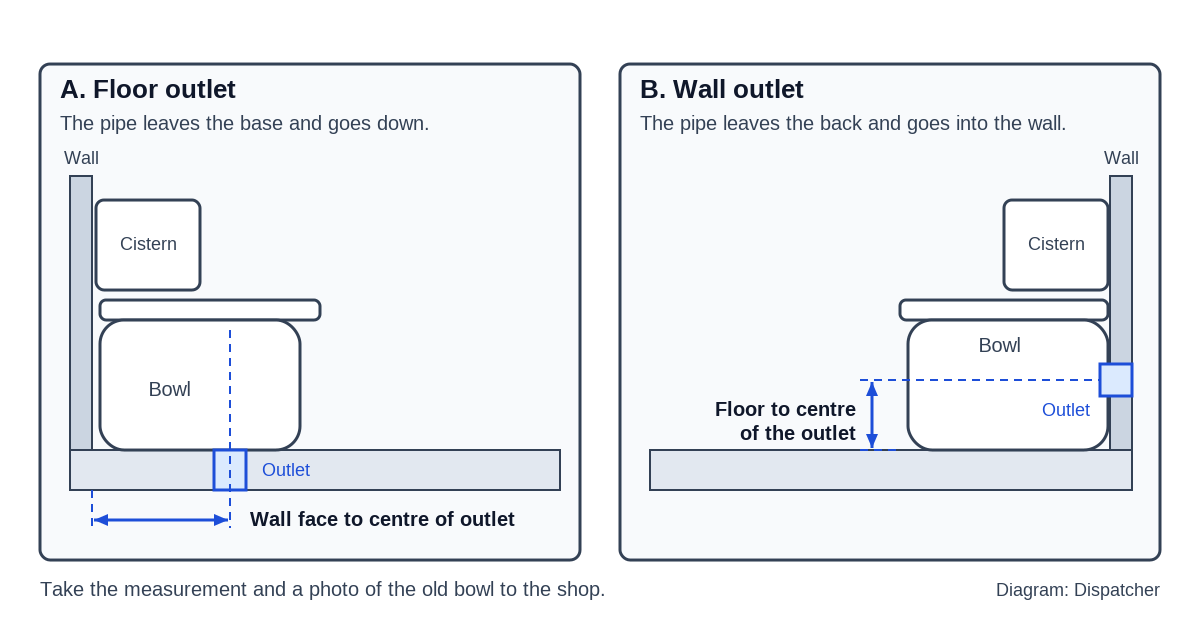
This guide covers one job: taking out a toilet bowl and fitting another in the same place. Moving the toilet to a new spot is a bigger job, and our guide to plumbing for a renovation covers the planning.
Dispatcher does not do plumbing work. This page helps you measure, ask the right questions and compare quotes.
Repair or replace the toilet bowl?
Repair first if the fault is in the cistern or at a joint. Think about replacing if the bowl is cracked, repairs keep failing or the bathroom is being redone. This is Dispatcher's own checklist, not a rule.
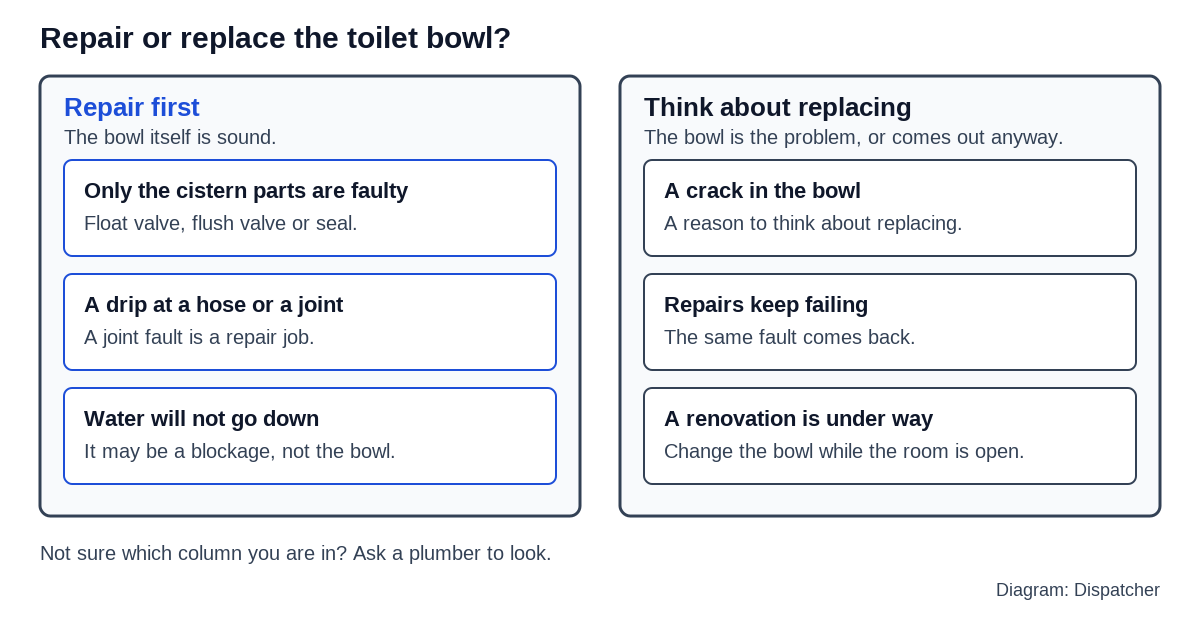
A worn float valve, flush valve or seal is a repair job. Our guide to a toilet that will not flush or keeps running goes through the cistern parts, so you may not need a new bowl at all.
If water will not go down, you may have a blockage and not a bowl problem. Start with blocked toilet or sink.
A crack in the bowl itself is a reason to think about replacing. So is a fault that comes back after each repair. Ask the plumber whether another repair makes sense.
A renovation is the third reason. If the floor tiles are coming up anyway, the bowl can be changed while the room is open.
This page gives no age for a bowl, no outlet sizes, no cost and no job time. We found no public source for any of them, so we left them out.
Floor outlet or wall outlet: what to measure before you buy
Look at where the pipe leaves the bowl. If it goes down into the floor, you have a floor outlet. If it goes straight back into the wall, you have a wall outlet.
The outlet is the fixed point. A new bowl has to line up with it, unless the floor or wall is opened up. The first diagram above shows both types and where to measure.
- Floor outlet. Measure from the tiled face of the wall to the middle of the outlet. The tiled face is what you see, not the bare brick behind it.
- Wall outlet. Measure from the finished floor up to the middle of the outlet.
Write the distance down in millimetres and note which type you have. Then take three photos: the old bowl from the side, the back of the bowl, and the spot where the water pipe meets the cistern.
Show the distance and the photos to the shop, and ask whether the bowl you like fits an outlet like yours. The same photos help a plumber quote for the job.
Measure your own bathroom instead of relying on a size someone else quotes.
What a new bowl and cistern must do under the plumbing rules
The Water Services Industry (Water Reticulation and Plumbing) Rules 2014 put duties on the person who installs a water closet, the rules' word for a toilet. Five of them matter when you buy and fit a new bowl. They are duties on the installer, and they do not tell you which bowl to buy.
- Standards and a flushing cistern. Under rule 63, the installer shall comply with the recognised standards. The water closet shall also "be installed with a proper flushing cistern" or other suitable and efficient apparatus.
- Water from a storage cistern. The same rule, in rule 63(3), says the cistern's water "shall be supplied from a storage cistern and not directly from the service water pipes". A storage cistern is a water tank. The service water pipes bring the supply into the premises.
- A float valve on the inlet. Every flushing cistern, other than an automatic one, needs "a float operated valve" or another effective way to control the water coming in and stop overflow, according to rule 64.
- Dual flush. A cistern serving a water closet pan must give dual flushes with "a nominal volume of a full and partial flush not exceeding 6 and 3 litres, respectively", in the words of rule 65(1). A cistern using a siphonic system is left out of that limit. Rule 65(2) adds the recognised standards again.
- A pan that clears in one flush. The pan must be built so that it is "efficiently cleaned by a single flush", says rule 69, and it must meet the recognised standards too.
The rules say "recognised standards" but we could not read the standard itself, so this page does not name one. Dispatcher cannot tell you whether a bowl on a shop shelf meets these rules. Ask the shop and your plumber.
This is the gazette copy as we read it on 25 November 2026. Rules change, so ask your plumber for the current text.
The job in order
A plumber does this job in five steps: isolate the water, take out the old bowl, set the new bowl on the outlet, connect the cistern inlet and run a flush test. This is an outline to help you compare quotes. It is not a DIY guide, and your plumber's own method comes first.
- Isolate the water. The plumber shuts the supply to the cistern first. If there is no shut-off valve on that pipe, ask each business how it will do this.
- Take out the old bowl. The bowl comes off the cistern pipe and off the outlet, and the plumber lifts it away. The floor or wall around the outlet may be left rough, and that is where a tiler may come in.
- Set the new bowl on the outlet. The new bowl has to line up with the outlet you measured. This is why you measure before you buy.
- Connect the cistern inlet. The inlet pipe needs a float valve or another effective way to stop overflow, as rule 64 puts it. Ask the plumber to show you that part.
- Run a flush test. The plumber flushes the toilet and watches the joints and the cistern. Because rule 69 expects a pan to clear in a single flush, one flush that clears the bowl is what to look for. That reading is Dispatcher's, not the rule's.
One more case: a fitting that comes out for good. If a person permanently disconnects water fittings, rule 70 says the pipe that supplies them must be removed or isolated.
In a like-for-like bowl swap the new bowl uses the same supply, so this matters when a toilet is taken out and not replaced. Our guide to how the water pipes in your home work shows where each fitting gets its water.
Who does what: plumber or tiler?
The plumber handles the water and the bowl. A tiler or renovation contractor handles the floor and wall finish around it. That split is Dispatcher's checklist, so agree it with each business before work starts.
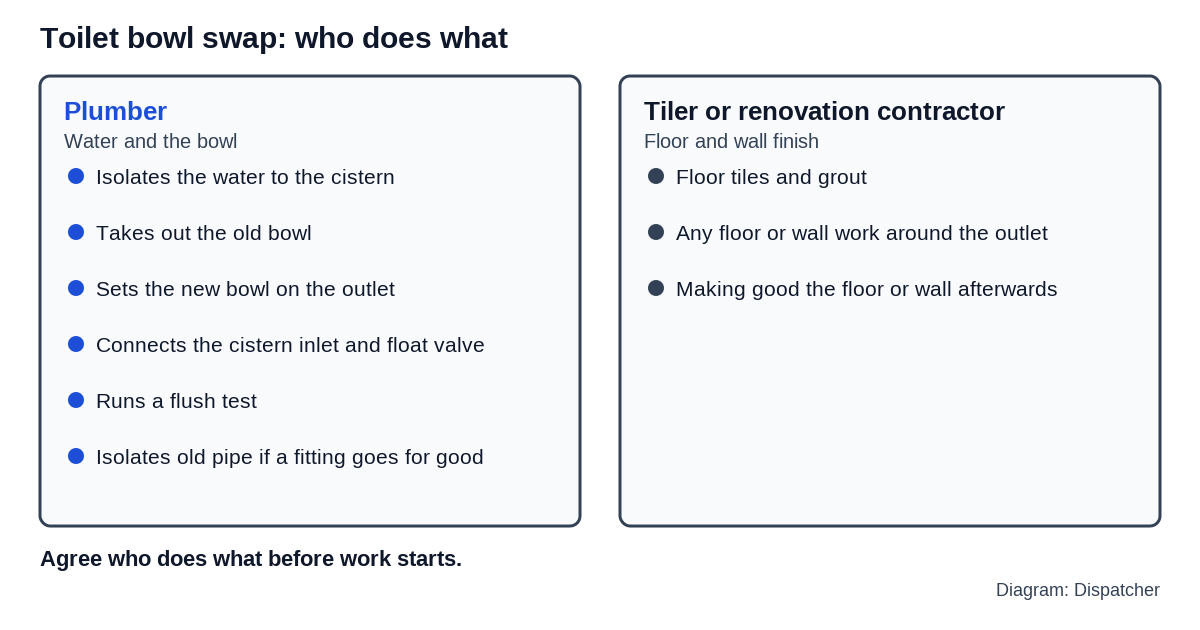
If the new bowl lines up with the old outlet and the tiles stay whole, the job may need no tiler at all. If tiles crack, the floor or wall has to be opened, or the outlet has to move, a tiler or renovation contractor comes in.
Ask each business who will make good the tiles afterwards. Put the answer in your request so every quote covers the same work.
If the whole bathroom is being redone, the bowl is one item on a bigger plan. Our guide to plumbing for a renovation shows how to plan it.
Ask your plumber what registration they hold, and whether a bowl swap needs a permit. This page does not answer that, because we read no source that does. Dispatcher has not checked listed businesses' licences or registrations, so you check, and our guide on how to check a plumber's permit shows where to look.
Get quotes on Dispatcher
Free for homeowners. Describe the job in one short form.
Say that you want a bowl replaced, and whether the outlet goes into the floor or the wall. Give the distance you measured, say who will do the floor, and keep a photo of the old bowl and its outlet ready.
Dispatcher does not do the work.
Related guides
- Toilet flush not working or running nonstop: what to check
- Blocked toilet or sink: what to do next
- Plumbing for a bathroom or kitchen renovation: what to plan
- How to check a plumber's permit before you hire
Sources
- Water Services Industry (Water Reticulation and Plumbing) Rules 2014, P.U.(A) 36/2014, rules 63, 64, 65, 69 and 70, English text of the gazette copy. Read 25 November 2026.
- The Rakyat Post, "No one's watching what you throw down the toilet, but someone's paying the price", 27 December 2023, the quote from the Head of Operations and Maintenance at Indah Water Konsortium. Read 25 November 2026.
Written by the Dispatcher editorial team from the sources above. See how Dispatcher works.
Frequently asked questions
Can I replace a toilet bowl myself in Malaysia?
This page does not say whether a licence or permit is needed, so ask a plumber and read our permit guide. The rules put their duties on the person who installs a water closet. Under rule 63, that person must follow the recognised standards and fit a proper flushing cistern or other suitable and efficient apparatus.
How do I know if my toilet has a floor or wall outlet?
Look at where the pipe leaves the bowl: down into the floor means a floor outlet, and back into the wall means a wall outlet. Measure from the tiled wall face to the middle of a floor outlet, or from the floor to the middle of a wall outlet. This is Dispatcher's own checklist, not a rule.
How much water may a new toilet cistern use per flush?
Rule 65(1) says a cistern serving a water closet pan must give dual flushes with a nominal volume of a full and partial flush not exceeding 6 and 3 litres, respectively. A cistern using a siphonic system is left out of that limit. Rule 65(2) adds that it must follow the recognised standards.
Does the cistern need a float valve?
Rule 64 says the inlet pipe of a flushing cistern must have a float operated valve or another effective means of controlling the inflow of water, designed to prevent overflow. An automatic flushing cistern is left out of that rule. Ask your plumber what is fitted in the cistern you buy.
What happens to the old water pipe when the bowl comes out?
If a fitting is taken out for good, rule 70 says the pipe that supplied it must be removed or isolated. In a like-for-like bowl swap the new bowl uses the same supply, so the rule matters most when a toilet is removed and not replaced. This is Dispatcher's reading of the rule.
What should I not flush after fitting a new bowl?
The Head of Operations and Maintenance at Indah Water Konsortium (IWK) named sanitary pads, cigarettes, oil, grease and plastics as items that can harm the sewerage system, potentially leading to blockages. This is a news quote, not a plumbing rule. It comes from a Rakyat Post article of 27 December 2023.
Last updated: 25 November 2026