Plumbing for a bathroom or kitchen renovation: what to plan
Last updated
Quick answer: Plan the plumbing for a bathroom or kitchen renovation before any tiles are chosen. Decide where each fixture goes, check the old pipes, and have the new pipes pressure-tested while the walls are still open. Test the bathroom floor before tiling, and fit taps and toilets last. In a condo, get written approval from management first.
Free for homeowners. Dispatcher does not do the work.
Get quotesDecide where everything goes first
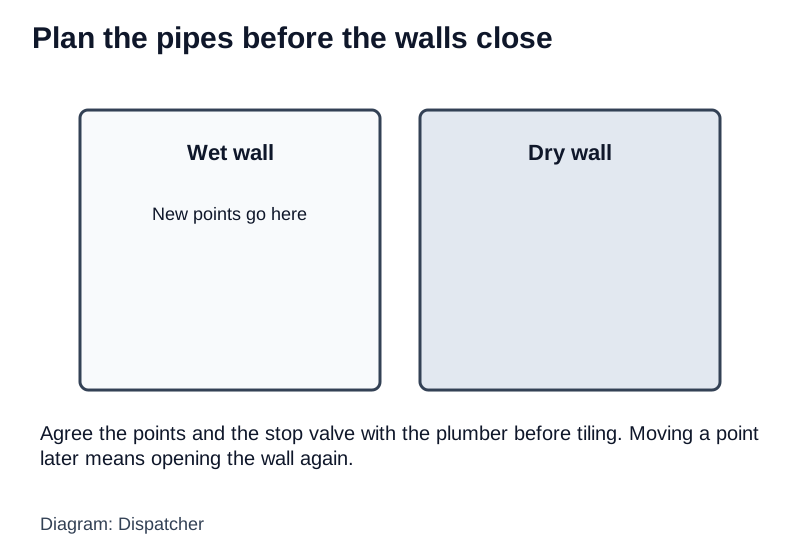
Pipes are the hardest thing to change once the tiles are on. So settle the layout before anyone hacks a wall.
Walk through the room with a measuring tape. Mark where each item will sit. For a bathroom, that means the toilet, basin, shower, floor trap and water heater. For a kitchen, it means the sink, any filter, the dishwasher or washing machine point, and the hood.
The fewer things you move, the simpler the plumbing. Leaving the toilet and floor trap in place saves the most work. Their waste pipes are the widest, and they need a steady slope to drain. A basin or a shower mixer moves far more easily.
Write the final layout on paper and give the same copy to every plumber you ask. If you are not sure what a part is called, our guide to plumbing fittings explained can help you name it.
Check the old pipes before you hack
A renovation is the easiest moment to replace old pipes, because the walls and floor are already open. Ask the plumber to look at what you have before the design is fixed.
Signs worth raising are rusty or brown water when a tap first runs, low pressure at one tap only, old patch repairs, or stains around a pipe joint. Our guide to home pipe materials explains the common pipe types and how to tell which one you have. The home water pipes guide shows how water moves through a house.
Ask the plumber a plain question: "If we leave these pipes, what will we have to break open later?" A clear answer helps you decide whether to replace them now.
The order of plumbing work
Plumbing goes in two rounds, with tests in between. The pipes go in first, they get tested while you can still see them, and the taps and toilet come last.
The order, from bare walls to finished room:
- First fix: run the new water and waste pipes to the marked spots, before plastering or tiling.
- Pressure test: fill the new pipes and hold them under pressure, so a weak joint shows before it is covered.
- Floor falls: shape the bathroom floor so water runs to the floor trap, not to the door.
- Test before tiling: flood the floor or shower area and check for leaks below or beside it.
- Second fix: after the tiles, fit the taps, basin, toilet, shower set and water heater, then run every tap.
Ask to see the pressure test yourself, or for a photo of the gauge during the test. Once tiles cover the pipes, there is no easy way back.
Waterproofing is a separate job from plumbing, often done by the tiler or a waterproofing contractor. Agree who is doing it before work starts, so the floor test has a clear owner.
Kitchen: sink, filter and the direct tap
Under the national plumbing rules, the kitchen tap is normally the only tap fed straight from the mains. Every other tap runs through a storage tank, and that shapes where your kitchen sink pipes go.
The Water Services Industry (Water Reticulation and Plumbing) Rules 2014 say a storage tank must sit between the meter and every tap, except the tap that feeds the kitchen (P.U.(A) 36/2014, rule 46). Rule 42 says each home gets a tap on the service pipe for the kitchen, unless the building shares a storage tank. No other tap may join that pipe. The one exception is a tap for use outside the building, with a backflow preventer fitted (P.U.(A) 36/2014, rule 42).
The same rule sets the outlet of that tap at least 150 millimetres above the top edge of the sink below it (P.U.(A) 36/2014, rule 42(2)). Tell the plumber if you plan a new sink, a deeper sink or a new worktop height.
Moving the sink to an island or another wall means a new run of mains pipe as well as a new drain. Ask the plumber how both will reach the new spot.
Planning a water filter under the sink? Say so now, so the plumber leaves room and a point for it. You can ask for quotes for water filter fitting separately.
Bathroom: toilet, shower and water heater
In a bathroom, the toilet decides most of the plumbing. Moving it is the big job, because its waste pipe is wide and must slope all the way to the stack or sewer line.
A shower or basin can move more easily, but each new spot still needs a hot and cold feed and a drain. Ask the plumber where the new pipes will run and how far the floor must be raised, if at all.
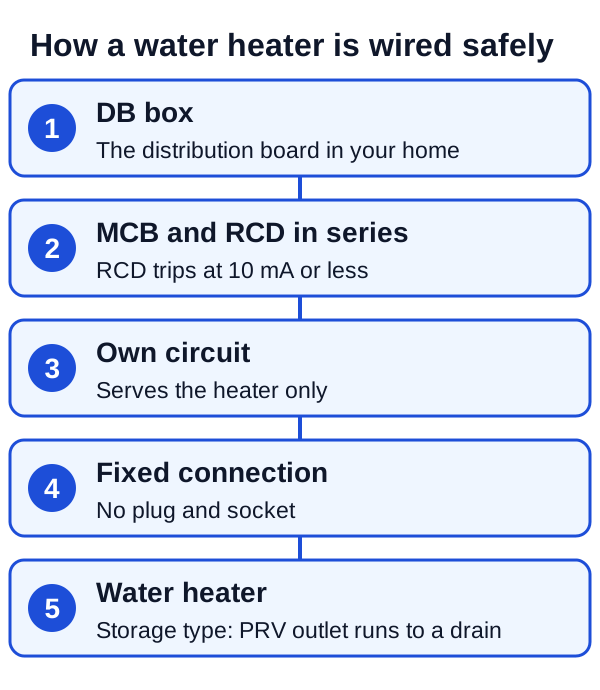
An electric water heater needs both trades. The plumber connects the water side. The power point is electrical work. Suruhanjaya Tenaga (ST) is the Energy Commission. Its safety tips say to pick a heater with the ST-SIRIM label and a hose that is not metal. The heater should be protected by a 10 mA RCD at the distribution board. Any electrical work should go to an ST-registered electrical contractor (ST, Tip Keselamatan dan Kecekapan Tenaga, PDF).
So plan the heater spot with the electrician at the first fix. Our water heater page covers the full checklist, and our guide shows how to check an electrical contractor.
Condo or flat: rules before you start
In a condo or flat, renovation needs written approval from management before work begins. Moving any plumbing needs it too.
The standard by-laws in the 2015 Strata Management (Maintenance and Management) Regulations set this out (Third Schedule, full-text copy, PDF):
- By-law 27 says you need prior written approval from the management corporation for any renovation. Management may ask for a deposit and a finish date. The work must stay inside your unit and off common property.
- By-law 28 says you need written approval from the authority and management before you shift any plumbing or sewerage system in your unit.
- By-law 29 bans hacking or drilling within 300 mm of hidden pipes or conduits. Contractors must use a metal detector and check the as-built plans at the management office.
- By-law 27(9) says that if you change a wet area's floor finish, the damp-proof layer must be replaced and turned up the wall at least 150 mm (by-laws 27 to 29).
Shared pipes are the building's job. Air Selangor's meter migration FAQ says the JMB or MC runs and maintains the pump house, storage tanks and distribution pipes up to each unit's meter (Air Selangor meter migration FAQ, PDF). Under regulation 58, a defect in a pipe that serves more than one unit counts as a common property defect, while a defect in a pipe that serves only your unit counts as yours (regulation 58, same copy).
A leak into the unit below after your renovation is a real risk. The Strata Management Act 2013 presumes a leak comes from the unit or common property above, unless proven otherwise (Act 757, section 142, PDF). That is one more reason to insist on the tests before tiling.
We read these rules on 13 November 2026, in a law firm's full-text copy of the regulations. Your building may also have its own extra by-laws. This is general information, not legal advice, so ask your management office for the current rules and its renovation form.
What to put in the plumber's quote
A good renovation quote describes the work, so two plumbers can be compared on the same job. Send every plumber the same layout and ask each quote to say:
- which fixtures stay where they are and which ones move
- the pipe material for water and for waste
- when the pressure test and the floor test happen, and who is there
- who removes the old fittings and takes the debris away
- who handles waterproofing, and who fixes tiles if a pipe must be reached later
- which parts the plumber supplies and which ones you buy
- the plumber's name and SPAN permit, so you can check it
Check the permit on Air Selangor's public list, using our guide on how to check a plumber's SPAN permit. For the rest of the hiring check, read how to choose a plumber.
There are no prices on this page, because renovation jobs vary too much to quote fairly here.
Get quotes on Dispatcher
Free for homeowners. Describe the job in one short form and we pass it to matched local contractors, who contact you directly.
Dispatcher only connects you with local businesses. It does not employ plumbers or do the work, and it has not checked listed businesses' licences yet. You agree the price with your chosen plumber and pay them directly.
Browse plumbing services in KL and Selangor to see who lists plumbing near you.
Sources
- Water Services Industry (Water Reticulation and Plumbing) Rules 2014, P.U.(A) 36/2014, rules 42 and 46, gazette copy hosted by PBA (PDF). Read 13 November 2026.
- Strata Management (Maintenance and Management) Regulations 2015, regulation 58 and Third Schedule by-laws 27 to 29, full-text copy by Lee & Partners (PDF). Read 13 November 2026.
- Strata Management Act 2013 (Act 757), section 142, copy hosted by Perbadanan Putrajaya (PDF). Read 13 November 2026.
- Air Selangor, meter migration FAQ (PDF): who runs a building's internal water system. Read 13 November 2026.
- Suruhanjaya Tenaga, Tip Keselamatan dan Kecekapan Tenaga (PDF): water heater safety tips. Read 13 November 2026.
Frequently asked questions
Can I move my toilet to a new spot?
Yes, but it is the biggest plumbing change in a bathroom. The toilet's waste pipe is wide and needs a steady slope, so the floor may need hacking or raising. In a condo, the strata by-laws say you need written approval from the authority and management before shifting any plumbing. Ask each plumber how they would route it.
When should the plumber test the pipes?
Test the new water pipes under pressure after the first fix, before the walls and floor are closed up. Test the bathroom floor for leaks again after waterproofing and before the tiles go on. Ask to see both tests, or for photos. After the tiles are laid, a hidden leak is hard to reach.
Do I need building approval in a condo?
Yes. The standard strata by-laws say you need prior written approval from the management corporation before any renovation, and approval to shift plumbing. Management may ask for a deposit and a finish date. Ask your management office for its renovation form, and check whether your building has extra by-laws.
Should I change old pipes during a renovation?
Often it makes sense, because the walls and floor are already open. Ask the plumber to check the pipe material and condition first. Rusty water, weak pressure at one tap, or old patch repairs are signs to raise. Replacing them later means breaking new tiles, so decide before the first fix.
Who connects the water heater power point?
An electrical contractor registered with Suruhanjaya Tenaga does the power side. The plumber connects only the water pipes. The Energy Commission's safety tips also call for a heater with the ST-SIRIM label and a 10 mA RCD at the distribution board. Plan the heater spot with both trades before the walls are closed.
Has Dispatcher checked plumbers' permits?
No, not yet. Dispatcher has not checked any listed plumber's licence or SPAN permit. Ask each plumber for their name and permit number, then look them up on Air Selangor's public Find a Plumber list. Dispatcher does not do the work, so you agree the job directly with the plumber.
Planning a renovation? Get quotes