Fitting a water pump at home in Malaysia: tank, pump and what to ask
Last updated
Quick answer: In Malaysia, the plumbing rules say a pump that can change mains pressure needs a suction tank upstream of it. So it does not go straight onto the main pipe. Dispatcher's checklist starts with the cause of weak flow, since a pump does not fix a leak. Then it covers placing, piping, wiring and testing the pump.
Get quotes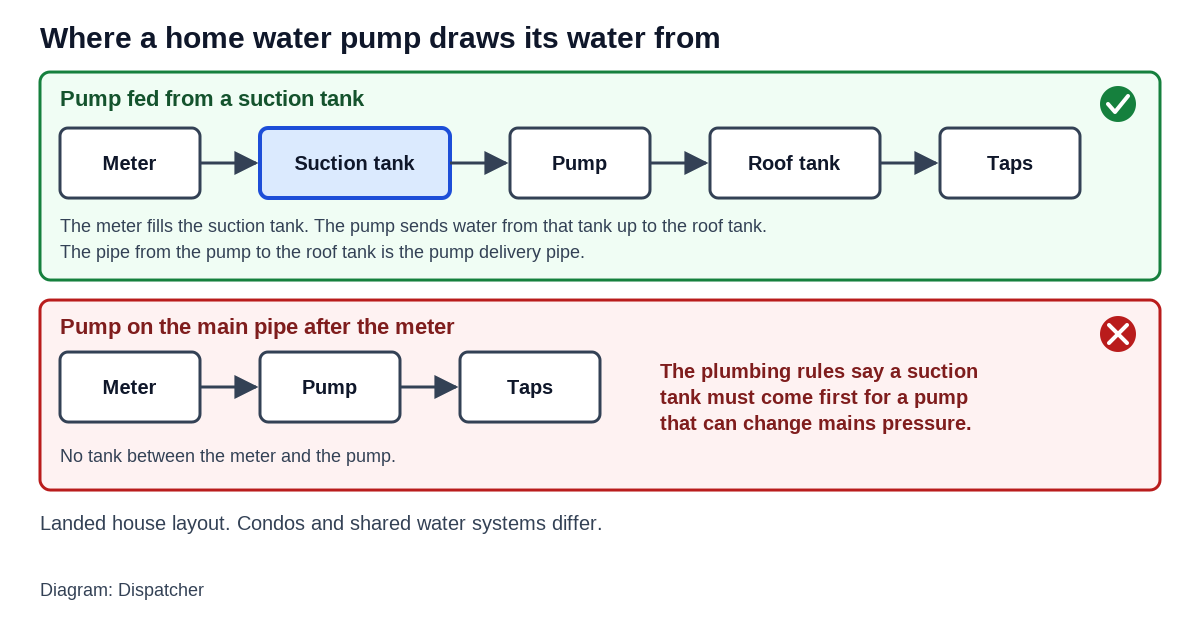
This guide covers the fitting job. It shows where a home pump draws its water, what a plumber does in order and what to ask before you book. It is a checklist for judging a quote, not a method for fitting a pump yourself.
Dispatcher does not do plumbing work. It gives you the facts to ask a plumber the right questions.
Does a pump go on the main pipe or on a tank?
A pump on mains water draws from a tank, not from the main pipe. Rule 45(1) of the Water Services Industry (Water Reticulation and Plumbing) Rules 2014 covers any pump that can change the pressure of water from a public main, after the meter. It says no one may install or use that pump unless a suction cistern sits upstream of it.
Upstream means on the meter side. In plain words, water from the meter goes into a tank first, and the pump draws from that tank. Breaking the rule is an offence under rule 45(2) of the same rules.
In the diagram, the green row is the layout the rules describe. The red row is the one they rule out.
The rules use their own words for the parts:
- Suction tank. The rules call it a suction cistern and define it as any cistern used for supplying water to a pumping system.
- Roof tank. This is the tank your taps draw from. The rules call it a storage cistern.
- Pump delivery pipe. It is the pipe that carries water from the suction tank, through the pump, up to a storage tank that sits higher.
The rules' definitions fit one order: a suction tank first, then the pump, then the pump delivery pipe up to a higher tank. So the pump does not sit on the pipe that comes straight off the meter.
Your house may already have a tank. Rule 46(1) puts a storage tank between the meter and all taps, except the draw-off tap for the kitchen tap. Rule 42(1) adds a draw-off tap on the service pipe for that kitchen tap, except in buildings with a shared storage tank.
This page reads the English text of the 2014 gazette copy. Rules can be amended, so check the current text before you act.
Is a pump the right fix for weak water?
Not always. On Dispatcher's checklist, a pump moves water but does not cure a leak, a half-closed valve or a blocked tap.
Find the cause first. Three questions help:
- Is the flow weak at one tap or at every tap?
- Is the roof tank slow to fill, or full while the flow is still weak?
- Has your water bill jumped as well?
Our guide to low water pressure at home goes through the checks. If the tank itself is the trouble, read home water tank problems. If your bill has jumped, read how to check for a hidden leak.
If a plumber quotes a pump, ask what problem it solves and how they know.
This page gives no pump size, power or price, because no public document we opened sets one for a home.
What does the plumber do, in order?
The plumber confirms the cause, checks the suction tank, places the pump, pipes it in and out, wires and tests it, then runs it and looks for leaks. That is Dispatcher's six-step checklist, shown in the card.
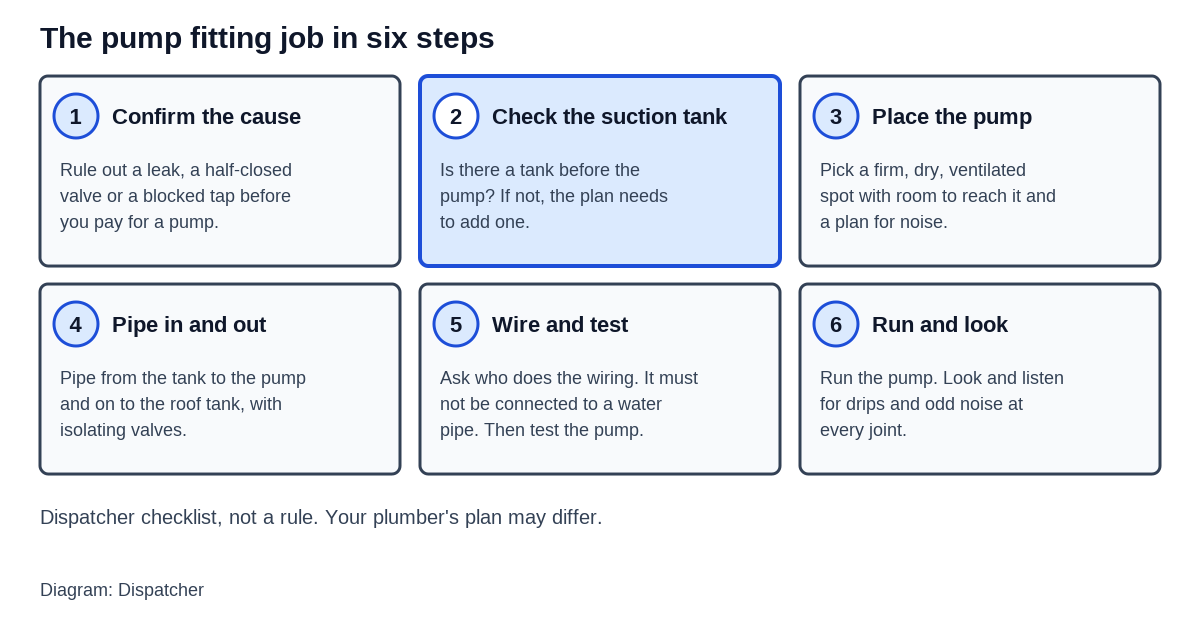
No rule or maker's manual is quoted for these steps, so your plumber's plan may differ.
- Confirm the cause. Weak flow can come from a leak, a closed valve or a blocked tap. The plumber should tell you what they found before a pump goes on the quote.
- Check the suction tank. The rules need one upstream of a pump on mains water. If your house has none, the plan has to add one.
- Place the pump. A firm, dry, ventilated spot with room to reach it suits a pump. Ask how the noise will be kept down.
- Pipe in and out. Water goes from the suction tank into the pump. It leaves through the pump delivery pipe to the roof tank. An isolating valve shuts off one part of the pipework, such as the pump, for repair.
- Wire and test. Rule 44(1) says electrical wiring must not be connected to any service water pipe, distribution pipe or pump delivery pipe. The pump still needs power. Ask who does the wiring and how it is kept off the pipes.
- Run and look. The plumber runs the pump and checks every joint for drips. Ask about any odd noise before they leave.
This page says nothing about how long the job takes, because homes differ.
Living in a condo or flat?
Speak to the management office first. In a block on individual meters, the pump house and tanks stay with the building's management (the JMB, MC or a government agency).
Air Selangor's FAQ on moving from bulk meters to individual meters describes the internal water distribution system. It says the system includes the pump house, storage tanks and piping up to the individual meters. It stays run and maintained by the Joint Management Body (JMB), the Management Corporation (MC) or the relevant government agency.
The same FAQ says Air Selangor is not responsible for running or maintaining that internal system after the move. So Air Selangor is not the first call for a pump.
Asking the management office before you book a plumber is Dispatcher's advice, not a line from the FAQ. This page does not say how rule 45 applies inside a block.
What to ask before you book
Ask where the pump draws its water from, whether a suction tank is in the quote, who does the wiring, where it sits, what the written quote covers and what happens if the flow stays weak.
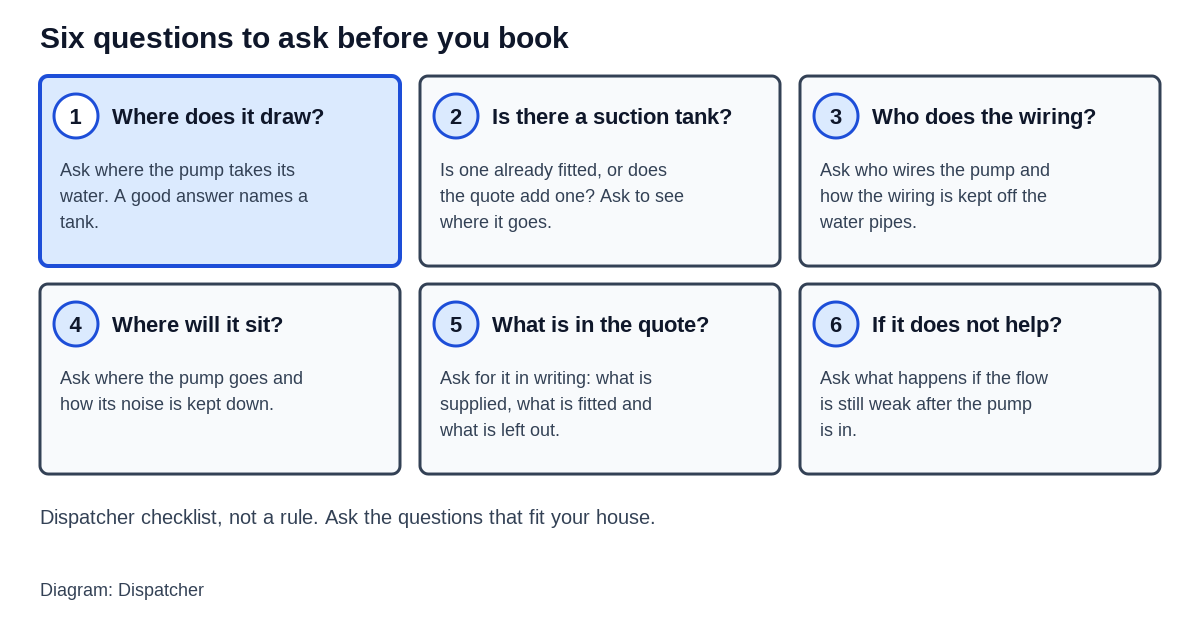
Where does the pump draw its water from? A good answer names a tank. If the answer is "the main pipe", ask where the suction tank is, because rule 45(1) needs one upstream of the pump.
Is the suction tank already there, or is it in the quote? A new tank is a separate item, so it should be written on the quote.
Who does the wiring, and how is it kept off the water pipes? The wiring step above explains why you ask.
Where will it sit, and how is noise kept down? See the spot before the day of the job.
What does the written quote cover? Get it in writing. It should list what is supplied, what is fitted and what is left out.
What happens if the flow is still weak? Find out before you pay.
Ask any plumber what registration they hold, and ask to see it. Dispatcher has not checked listed businesses' licences yet, so you check them. Our guide shows how to check a plumber's permit.
Whether a pump job needs a permit is a question for the plumber. This page does not answer it.
Get quotes on Dispatcher
Free for homeowners. Describe the job in one short form and we pass it to matched local contractors, who contact you directly.
Say you want a home water pump looked at, and add your area and whether you have a roof tank or a suction tank. Dispatcher does not do the work. It has not checked the licences of listed businesses yet, so you check them.
Related guides
- Low water pressure at home: causes and what to check
- Home water tank problems: overflow, leaks and dirty water
- How do the water pipes in your home work?
- How to check a plumber's permit before you hire
Sources
- Water Services Industry (Water Reticulation and Plumbing) Rules 2014, P.U.(A) 36/2014, rule 2 definitions (suction cistern, pump delivery pipe, storage cistern), rules 42(1), 44, 45 and 46(1), English text of the gazette copy hosted by PBA. Read 25 November 2026.
- Air Selangor, FAQ on migration of bulk meter water supply accounts to individual meter water supply accounts (2025), the answers on the internal water distribution system and who operates and maintains it. Read 25 November 2026.
Written by the Dispatcher editorial team from the sources above. See how Dispatcher works.
Frequently asked questions
Can a water pump be fitted straight on the main pipe?
Not under the plumbing rules. Rule 45(1) says a pump that can affect the pressure of water from a public main, after a meter, needs a suction cistern installed upstream of it. Breaking it is an offence under rule 45(2).
What is a suction tank?
A suction tank is a tank that supplies water to a pump. The plumbing rules call it a suction cistern and define it as any cistern used for supplying water to a pumping system. In a pumped house, water goes from that tank to the pump, then up to a storage tank that sits higher.
Does my house need a tank before a pump?
Yes, if the pump can change mains water pressure. Rule 45(1) needs a suction tank upstream of it. Separately, rule 46(1) puts a storage tank between the meter and all taps, except the draw-off tap for a kitchen tap.
Can a pump be wired to the water pipe?
No. Rule 44(1) says electrical wiring must not be connected to any service water pipe, distribution pipe or pump delivery pipe. The pump still needs power, so ask your plumber who does the wiring and how it is kept off the pipes.
I live in a condo: can I fit my own pump?
Speak to your management office first. Air Selangor's FAQ on moving to individual meters says the pump house, storage tanks and piping up to the individual meters stay operated and maintained by the JMB, the MC or a government agency. Asking them before you book a plumber is Dispatcher's advice.
Will a pump fix weak water?
It depends on the cause. The checklist above starts there, since a pump does not cure a leak or a blocked tap. If a plumber quotes a pump that can change mains pressure, rule 45(1) needs a suction tank upstream of it.
Ready for a plumber? Get quotes
Last updated: 25 November 2026