Home water tank problems: overflow, leaks and dirty water
Last updated
Quick answer: Water running from the small overflow pipe can mean the float valve is not shutting. A wet ceiling under the tank can point to the tank, a joint or a pipe. Brown water in only your home points to the tank or old pipes. Check from the ground, never from the roof space, then call a plumber.
Get quotes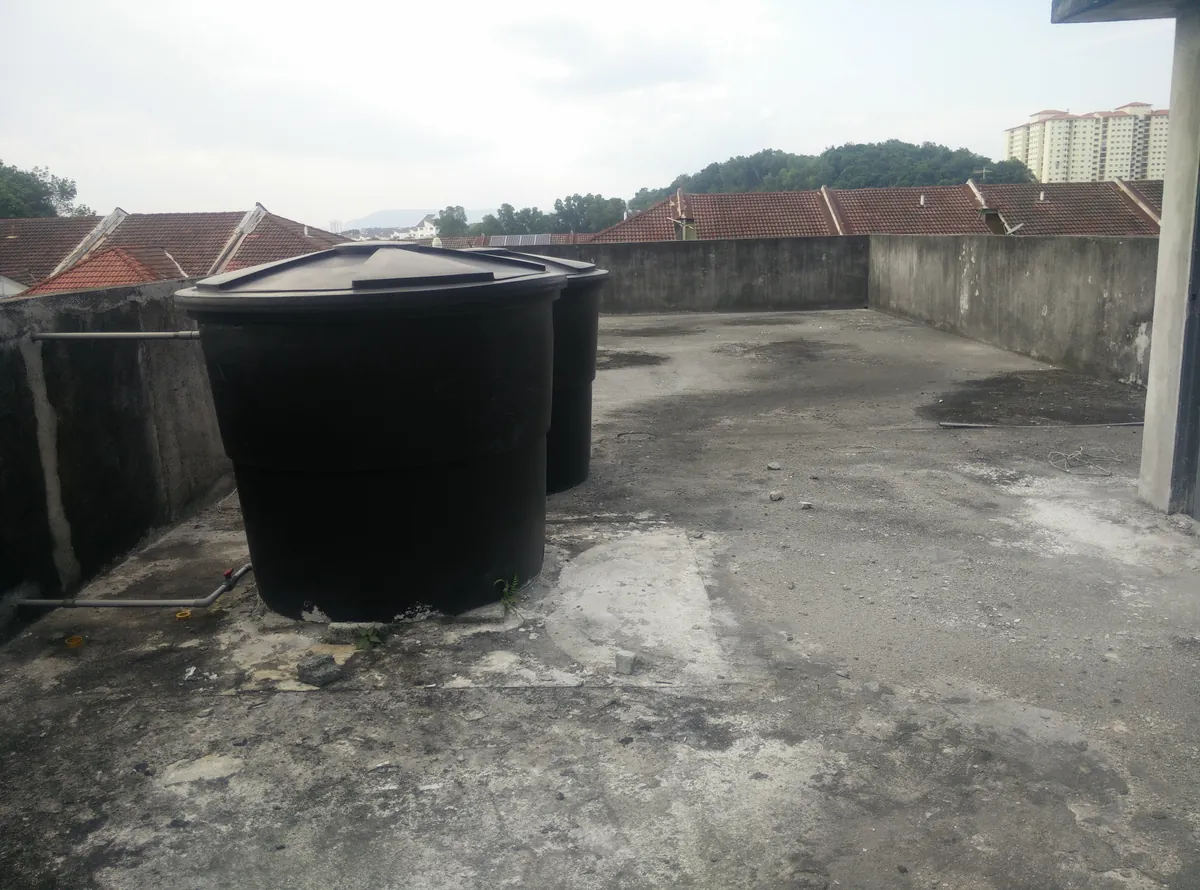
This page is for water that turns up where it should not, when the cause may be the roof or ceiling tank. It covers a running overflow pipe, a wet ceiling, brown water and a tank that seems to lose water.
Weak pressure is a different job, so it sits in our guide to low water pressure. The meter test for a hidden leak is in our guide to a high water bill.
How a home water tank works
A roof or ceiling tank stores water and feeds most taps in your home. The plumbing rules say a home with a water supply needs a storage tank between the meter and all taps, apart from the one that feeds the kitchen tap (P.U.(A) 36/2014, rule 46).
Five parts matter here.
The float valve lets water in. A float rides on the water and shuts the valve when the tank is full, and the rules ask for a float operated valve or another effective way to stop the tank overfilling (rule 47).
The overflow pipe lets extra water leave. A tank of up to 4,500 litres needs one, and it must also be a warning pipe (rule 51). A warning pipe has its outlet where you can easily see water coming out (rule 2).
The outlet takes water from near the bottom to the house. It sits at the opposite end of the tank from the inlet (rule 47).
The cover keeps out dust and mosquitoes. It has an opening over the float valve, so a plumber can reach the valve without lifting the whole cover (rule 47).
The scour pipe has its own stop valve and drains sediment from the bottom (rule 47).
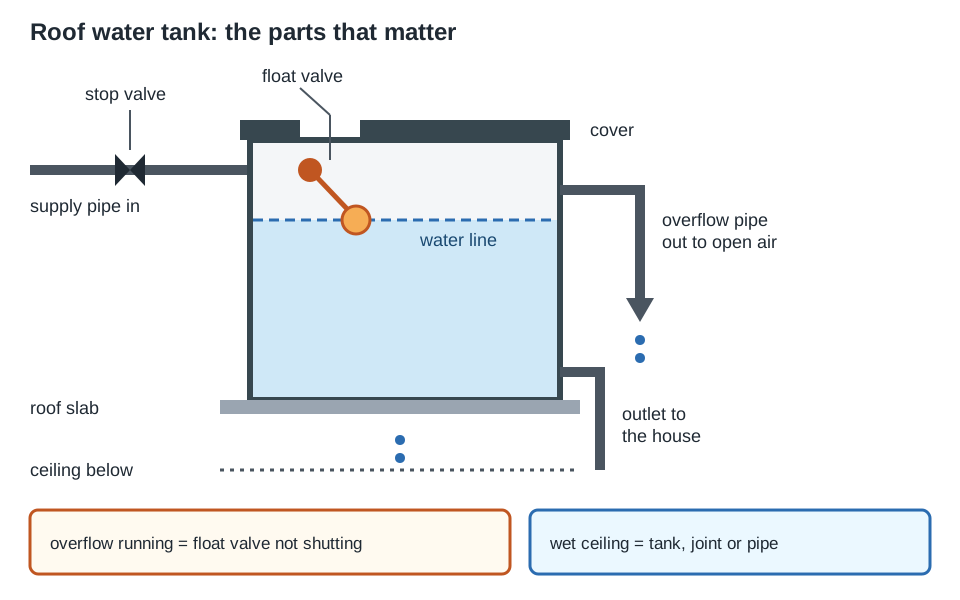
Use the diagram to match what you see to a part. A running overflow pipe can point to the float valve. A wet ceiling can point to the tank body, a joint or a pipe.
Our guide to how the water pipes in your home work shows the whole path from the meter to your tap.
Overflow pipe keeps running
If water runs or drips from the overflow pipe while nobody is using water, the float valve may not be shutting. The tank keeps filling, and the extra water leaves through the overflow pipe.
You can check this from the ground. Find the small pipe that comes out of the wall or roof edge near the tank. Watch whether it runs, drips or stays dry.
Air Selangor's leak page says that if a storage tank overflows, the inlet valve may be faulty and may need replacing (Air Selangor leak check). A plumber can reset the float arm, clean the valve or fit a new one. Which one depends on what they find.
Do not cap or plug the overflow pipe to stop the dripping. It is the safety exit, and a blocked pipe sends the water into your ceiling instead.
A long-running overflow may also show up on your water bill. The meter test is in our high water bill guide.
If you can reach a stop valve from the floor, such as the main stop valve near the meter, closing it stops new water reaching the tank. That also cuts the supply to most taps, so open it again once the plumber has fixed the valve. Do not go into the roof space to look for another valve.
A float valve that will not open is the opposite problem. Taps run weak and the tank is slow to fill. That case is in our guide to low water pressure.
Water on the ceiling under the tank
A wet ceiling under the tank can mean the tank body, a joint or a pipe is leaking, especially when the overflow pipe is dry. Keep yourself safe first, then get the leak fixed.
Stay off the ceiling boards. They are not made to carry a person, and you cannot see what is above them.
Switch off the lights and sockets near the wet patch. Do not touch them with wet hands.
Put a bucket under any drip. Take dated photos of the stain, so a plumber or your management office can see how it grows.
Look at the stain from the floor. A damp patch right under the tank points to the tank or its joints. A stain that shows up only after rain may be a roof leak, and that is a job for a roofer.
Only someone who can see the tank can say which part is leaking.
Brown or dirty water from the tank
If only your home gets brown water, Air Selangor lists the home water tank and ageing internal pipes among the possible causes (Air Selangor water quality page). The same page says the supply network can also turn water brown, when a change in pressure or flow stirs up sediment in the mains.
Start with the simple steps. Air Selangor says to let the tap run for 5 to 10 minutes until the water clears (Air Selangor water quality page). If it does not clear, it asks you to contact it.
Then ask a neighbour. If their water is clear, Air Selangor says to check your own plumbing (Air Selangor water quality page). That points back to your tank and pipes.
A tank collects sediment at the bottom, so a scour pipe with a stop valve is required to drain it (rule 47). A cover that keeps out dust and mosquitoes is required too, so a cracked or missing cover lets dirt in (rule 47).
Ask a plumber to look at the cover, the scour pipe and the inside of the tank. This page gives no cleaning-chemical advice. Ask whoever cleans your tank what they use and why.
Rust-coloured water can also come from old metal pipes. Our pipe materials guide shows how to tell the types apart.
Tank level drops when no one uses water
A tank that loses water while every tap is closed has a leak somewhere between the tank and your taps, or at the tank itself. You cannot see inside most roof tanks from the ground, so the clues are indirect.
Taps that run dry sooner than before are one clue. A pump that keeps starting is another. A wet patch on a wall or ceiling is the third.
The meter test is the quickest check. Close every tap, wait about an hour, then read the meter again. If it moved, Air Selangor says you may have a leak (Air Selangor leak check).
Our high water bill guide walks through the test step by step.
Rule out the easy causes first: a running toilet, a dripping tap or a loose hose on the washing machine. If the meter still moves, the loss may be at the tank, its outlet joint or the pipes after it.
A plumber can cut the tank off from the rest of the house to see where the water is going. That is not a job to try from a ladder.
If the water seems to vanish only when the tank is full, look back at the overflow section above. A float valve that is not shutting can look like a leak.
Old, cracked or sagging tank: repair or replace?
Repair a tank only if the plumber says it can be made watertight again and stays safe for drinking water. Replace it when cracks keep coming back or the support is failing.
The plumbing rules are clear on what a sound tank looks like. It must be watertight, properly supported, protected from corrosion, rodents and insects, and safe for storing water that people drink (rule 47). Rule 47 also wants the tank in shade or insulated, or made of a material that resists ultraviolet light if it sits in the open (rule 47).
Tell your plumber if you see cracks near the base or around the pipe fittings, a tank that leans, or a stand that is cracked or rusting. Also mention leaks that come back after an earlier patch, or a broken cover that no longer keeps insects out.
A patch on a tank that holds drinking water is a plumber's call, so do not reach for glue yourself. Ask them whether the patch is safe for drinking water and how long they expect it to hold.
The support matters as much as the tank. A competent person must sign off the foundation of a tank, confirming the structure can carry the load (rule 47). When you get a new tank, ask who checks the stand. A tank must also be reachable for maintenance and replacement (rule 47).
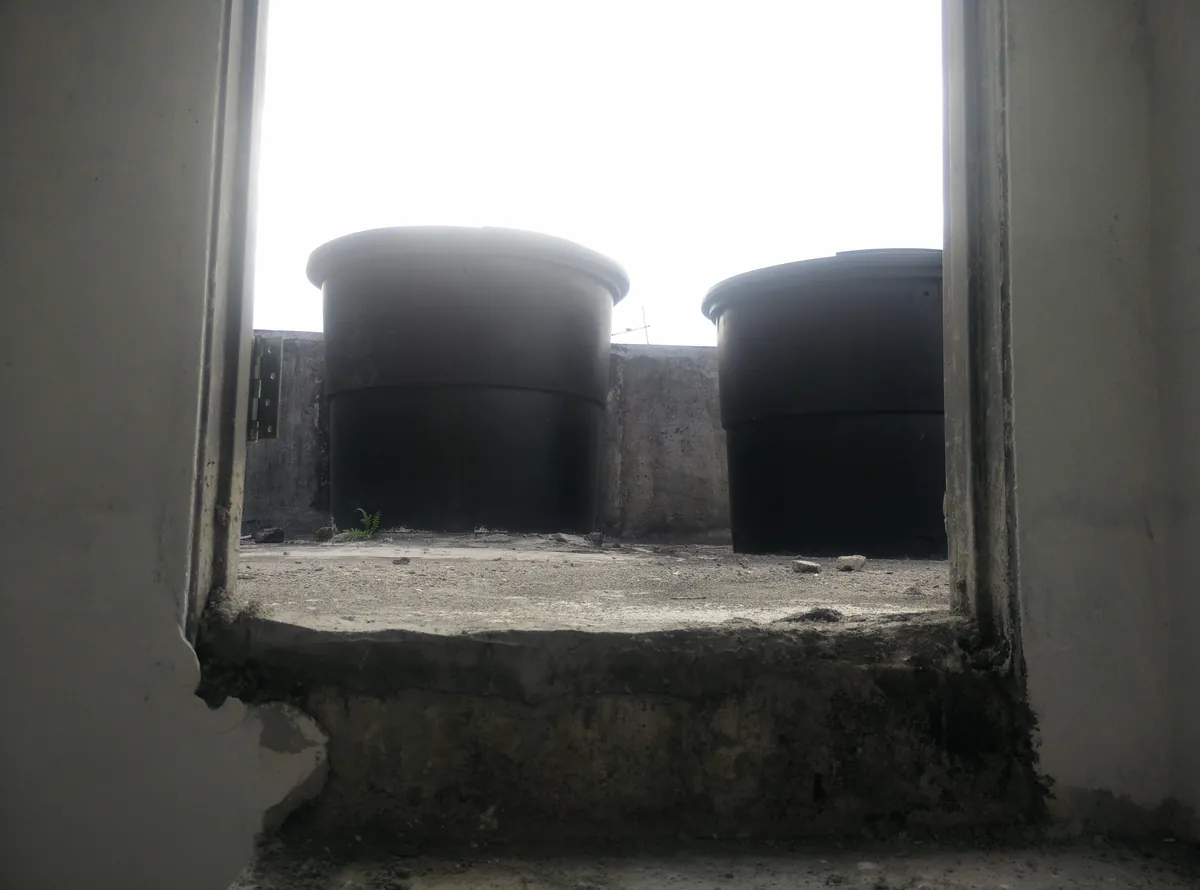
Prices change with the tank type, its size and how hard it is to reach. This page gives no price, because the quickest way to a real one is to ask for quotes. Describe the tank, where it sits and how you reach it.
Condo and apartment tanks
In a high-rise, the pump house and storage tanks belong to the building's own water system, so report a tank problem to your management office first. Air Selangor's FAQ on meter migration says that system is run and maintained by the JMB or MC (the building's management body) or a government agency, and not by Air Selangor (Air Selangor FAQ).
The same FAQ says the JMB or MC repairs internal pipe leaks, maintains or fixes water tanks and restores supply to affected units (Air Selangor FAQ). It also says that a leak inside one unit is for the unit owner to fix (Air Selangor FAQ).
That FAQ was written for the meter migration programme. Check the current position with your management office or Air Selangor. This is general information, not legal advice.
When you report it, give the date, your floor and unit, and photos of the stain. Mention if your neighbours are affected too.
In a landed house, our guide to which pipes are yours explains the split between Air Selangor's side and yours. Ask Air Selangor if you are unsure.
When to call a plumber and how to check them
Call a plumber when the overflow pipe keeps running, a ceiling is wet or the water stays brown after you run the taps. Do not leave a wet ceiling to dry on its own.
Air Selangor keeps a public Find a Plumber list for Selangor, Kuala Lumpur and Putrajaya (Air Selangor plumber list). Its Hydro Hub post tells customers to use a qualified plumber for pipe problems inside the home, and points to that list, which is organised by area (Air Selangor Hydro Hub).
Dispatcher has not checked listed plumbers' permits. You check the list yourself. Our guide to checking a plumber's permit shows the steps.
Ask who on the team holds the permit, and put that name on the written quote. Tell the plumber where the tank is, how you reach it, whether the overflow runs or stays dry and where the ceiling is wet.
Get quotes on Dispatcher
Free for homeowners. Describe the job in one short form and we pass it to matched local contractors, who contact you directly.
Dispatcher does not do the work. It has not checked listed businesses' licences or permits yet, so check the plumber yourself before you agree to a job.
Related guides
- Low water pressure at home: when the tank is fine but the taps run weak.
- High water bill and hidden leaks: the meter test, step by step.
- How the water pipes in your home work: meter, tank and pipes in one picture.
- How to check a plumber's permit: use Air Selangor's public list.
Sources
- Attorney General's Chambers of Malaysia, Water Services Industry (Water Reticulation and Plumbing) Rules 2014, P.U.(A) 36/2014, rules 2, 46, 47 and 51 (gazette copy hosted by PBA, checked 16 November 2026).
- Air Selangor, Understanding the water quality (brown water, checked 16 November 2026).
- Air Selangor, How to do a DIY internal leak assessment (meter test and tank overflow, checked 16 November 2026).
- Air Selangor, FAQ on migration from bulk meter to individual meter (internal water system in high-rise buildings, checked 16 November 2026).
- Air Selangor, Find a Plumber (public plumber list, checked 16 November 2026).
- Air Selangor Hydro Hub, post on contacting a plumber (checked 16 November 2026).
Rules and guidance change. Check the current position with Air Selangor, SPAN or your building's management before you rely on any line above.
Frequently asked questions
Why is water coming out of the small pipe on my roof?
That small pipe is usually the tank's overflow pipe. Water running from it means the tank is taking in more water than it holds, so check whether the float valve is shutting. Do not cap the pipe. Close a stop valve you can reach from the ground, then ask a plumber to check the valve.
Is it safe to go into the roof to check the tank?
No. Ceiling boards are not made to carry a person, and the roof space is dark and hard to see in. Check from the ground instead: the overflow outlet, ceiling stains and the meter. Leave anything above the ceiling to a plumber.
Why is only my house getting brown water?
Air Selangor lists your home tank and old pipes as possible causes when your neighbours' water is clear. Run a tap for five to ten minutes first. If it stays brown, report it to Air Selangor. Ask a plumber to check the tank and pipes.
What should I ask before getting a new water tank?
Ask if the tank is made for storing drinking water, has a cover that keeps out dust and mosquitoes, and comes with a float valve, an overflow pipe and a scour pipe. Ask who checks the stand. Ask where the inlet and outlet sit. The plumbing rules cover these points.
My ceiling under the tank is wet, who do I call?
Call a plumber first. A wet ceiling under a tank can point to the tank, a joint or a pipe. Keep off the ceiling boards and switch off lights and sockets near the stain. In a condo, tell your management office first. If the stain only shows after rain, ask a roofer.
Has Dispatcher checked the plumber's permit?
No. Dispatcher has not checked listed businesses' licences or permits yet. You check the plumber yourself on Air Selangor's public Find a Plumber list, which covers Selangor, Kuala Lumpur and Putrajaya. Ask who holds the permit and put that name on the written quote.
About this guide
Written by the Dispatcher editorial team from the sources above. See how Dispatcher works.
Last updated: 16 November 2026
If your tank is overflowing, leaking or giving dirty water, a plumber needs to see it. Get quotes