Bathroom tap, shower or bidet spray: a fit guide for Malaysian homes
Last updated
Quick answer: In Malaysia, swapping a tap, shower hose or bidet spray like for like is a short job only if you can shut the water off and nothing is wired. Call a plumber if the work moves a pipe, there is no isolating valve or a joint leaks at the wall. Call an electrician for any heater wiring.
Get quotes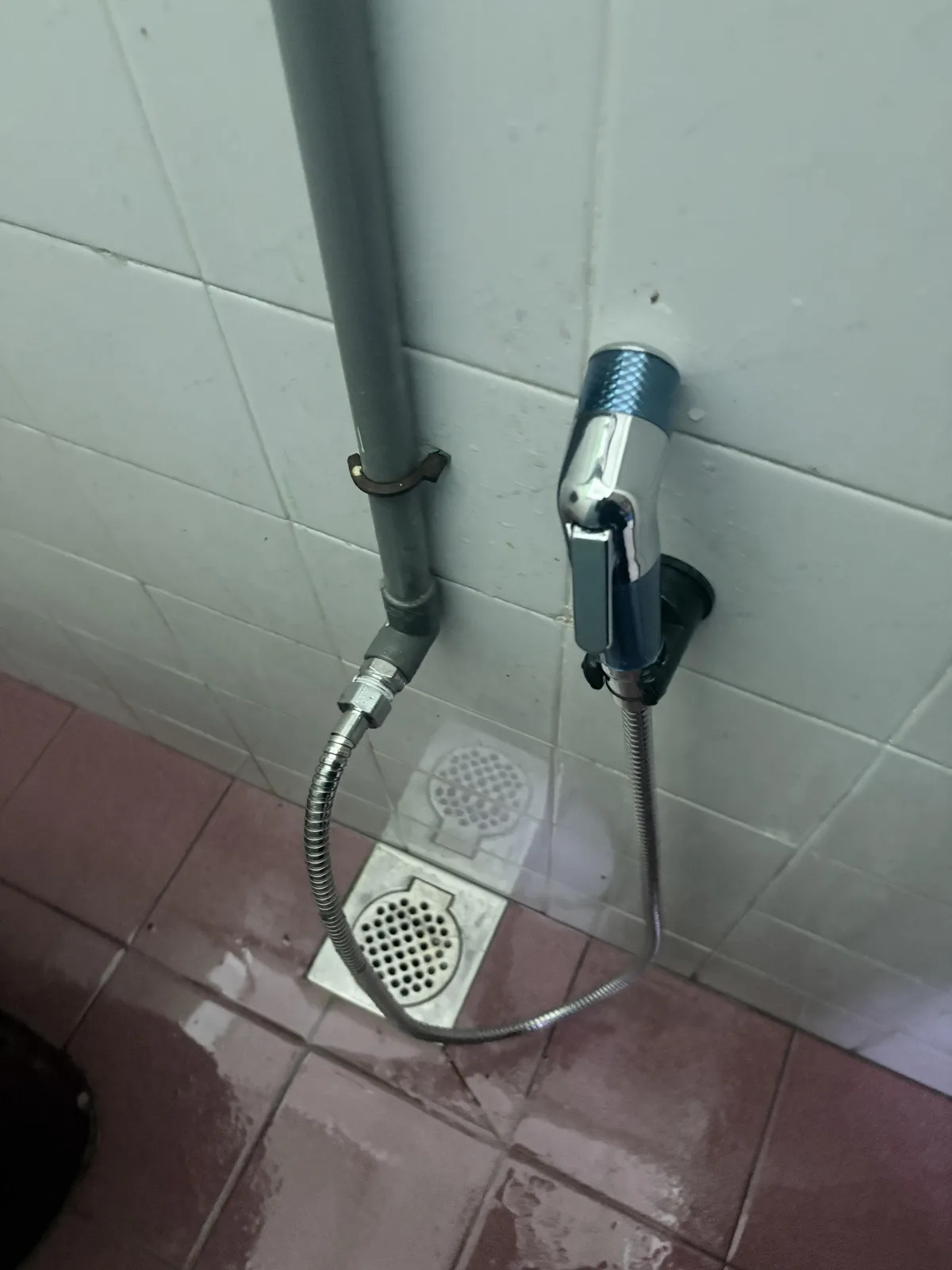
You have a new tap, shower set or bidet spray in the box. Two things decide the job: can you shut the water off, and does anything need wiring? Below are the checks before you buy, the swap itself, and the point where a plumber or an electrician takes over.
Which bathroom fixtures can a plumber fit?
A plumber can fit all three: a tap or mixer, a shower set with its hose, and a handheld bidet spray. Each one joins a different part of your plumbing, so the swap is not the same job each time.
- Tap or mixer. It sits on the basin or the wall and joins the supply pipes below it. A mixer blends hot and cold.
- Shower set and hose. A shower head, a hose and a wall bracket, fed by a mixer or a water heater.
- Handheld bidet spray. A small spray head on a hose, kept in a holder beside the toilet.
This guide is about a like for like swap. Choosing a water heater has its own guide on instant or storage water heaters. Moving a pipe to a new spot is a plumber's job and is not covered here.
For the names of joints and valves, see plumbing fittings explained.
You may want to do a like for like swap yourself. We found no Malaysian rule that says whether this swap needs a plumber or a permit, so we do not say either way. Ask your plumber, and read how to check a plumber's SPAN permit.
Where does the water for each fixture come from?
Dispatcher's reading of rules r62(c) and r63(3): a fixed basin and a bidet's flushing water come from the tank side, not straight from the service pipe. None of the rules we read says this about taps directly.
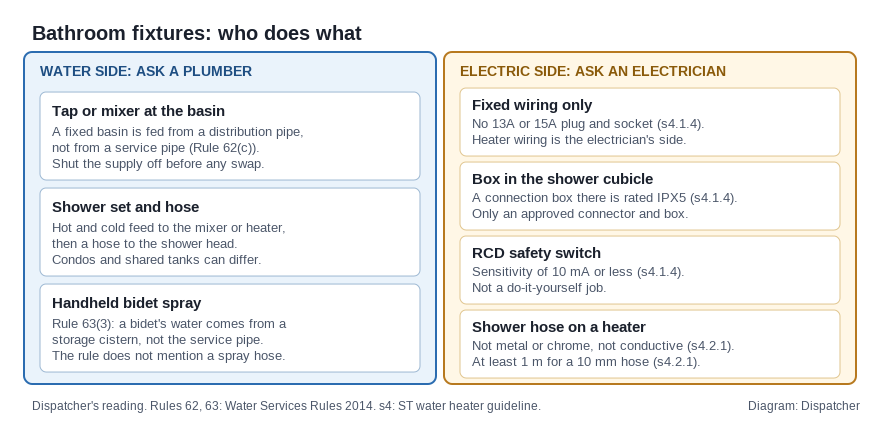
The rules say a fixed bath or lavatory basin must be supplied from a distribution pipe, not from a service water pipe (Water Services Industry (Water Reticulation and Plumbing) Rules 2014, rule 62(c)). When a supply is new or altered, a storage tank goes between the meter and every tap except the kitchen tap (Rules 2014, rule 46(1)).
The kitchen tap is the odd one out. It may draw straight from the service pipe, except in buildings with a shared storage tank (Rules 2014, rule 42(1)). Our guide to how the water pipes in your home work shows the path from the street to your tap.
The bidet rule says the water for a bidet's flushing cistern or other flushing apparatus must come from a storage cistern, not directly from the service water pipes (Rules 2014, rule 63(3)). That rule is about a bidet's flushing apparatus. It does not name a handheld spray hose, so we do not say it covers one.
For a shower, we found no rule that names the pipe it takes water from. Condos and buildings with shared tanks can differ from a landed house, so ask your management office before you touch a pipe.
Some shops describe a spray as a T-valve job: a small splitter on the pipe that already feeds the toilet cistern. The Rules require a suitable stop valve on the inlet pipe of every flushing cistern (Rules 2014, rule 40(4)(b)).
Our tip: if your spray is fitted that way, look there first to shut the water off. The parts of a cistern are in our toilet flush repair guide.
What does a shower with a heater need on the electric side?
A shower heater needs fixed wiring, a safety switch and a hose that is not metal, and the wiring is an electrician's job. Suruhanjaya Tenaga (ST), the Energy Commission, sets these points in its water heater guideline.
That guideline is about water heater systems. It says nothing about ordinary taps or bidet sprays, so the points below apply only to a shower with a heater.
The hose. ST's water heater guideline, section 4.2.1, says the flexible hose from the heater to the shower head must not be metallic or chrome based, and must not be conductive. For a hose with a 10 mm inside diameter, the same section sets a minimum length of 1 metre (section 4.2.1, page 21).
The steel hose in the photo above belongs to a bidet spray. It does not run from a heater, so this hose rule does not apply to it.
The connection. Section 4.1.4 of the guideline allows only a fixed and permanent connection. It says a 13A or 15A plug and socket must not be used (section 4.1.4, page 18).
If there is a connection in between, only an approved connector and connection box may be used. Inside the shower cubicle, below the ceiling, that box must be IPX5 rated (section 4.1.4, page 18).
The safety switch. An RCD is the safety switch that cuts the power if current leaks. For the heater circuit, the guideline says its sensitivity must be 10 mA or less (section 4.1.4, page 13). A note beside figure 3 calls a 10 mA RCD in a wet area a statutory requirement under Regulation 36(2) of the Electricity Regulations 1994 (guideline, page 16).
Who does what. A plumber fits the water side. An electrician does the wiring, and you should not wire a heater yourself. You can search ST's list of registered electrical contractors to check one.
Check the fixture before you buy it
Before you buy, check six things on the shelf and on your wall: thread and valve size, hose length and ends, wall or deck fixing, hose material on a heater shower, whether it needs power, and whether you can shut the water off.
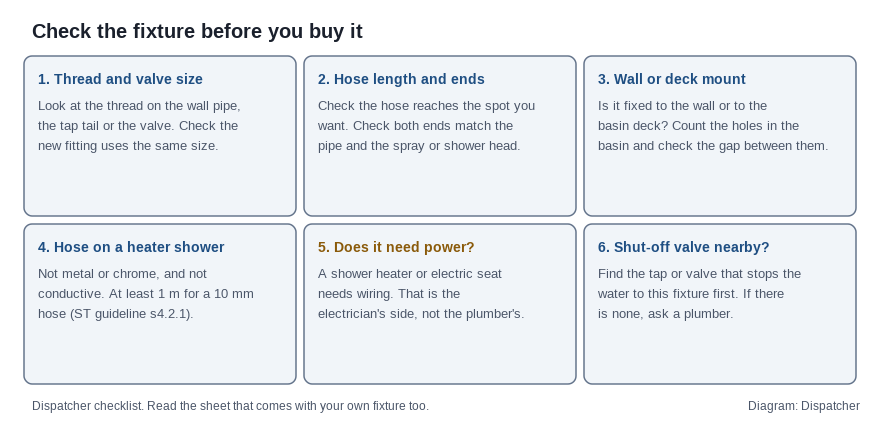
Take a photo of the wall pipe, the valve and the old fixture with you. A shop can match the thread and the hose ends much faster from a photo than from memory.
The swap in order
Shut the water off, drain the line, swap the fixture, open the valve slowly and look for leaks. These steps are generic, so follow the sheet that comes with your own fixture.
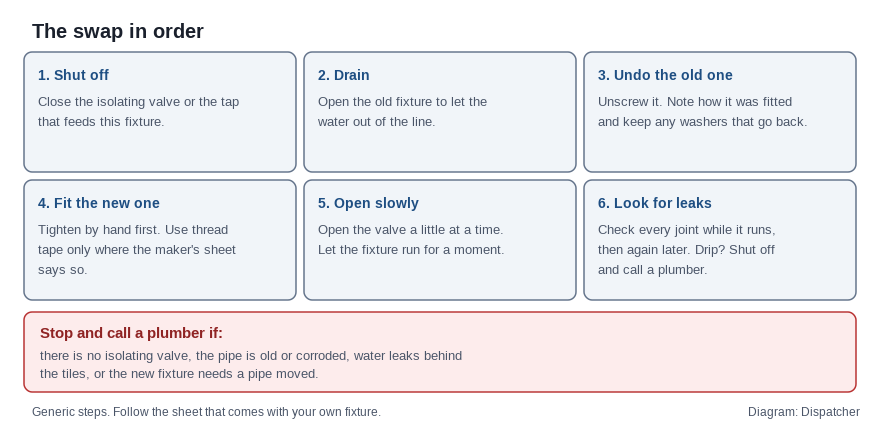
- First, shut off. Close the isolating valve for this fixture. If you cannot find one, stop and read the next section.
- Next, drain. Open the old fixture and let the water run out of the line.
- Then undo the old fixture. Unscrew it and note how the parts sit, including which way each washer faces.
- Fit the new one. Tighten by hand first. Add thread tape to a joint only where the maker's sheet says to.
- Open slowly. Turn the valve a little at a time so the line fills gently.
- Last, look for leaks. Watch every joint while the water runs, then check again later.
Do not cut a pipe to make a fixture fit. If the swap needs a pipe cut or moved, stop and hire a plumber.
When to call a plumber
Call a plumber when the swap is not like for like, or when you cannot keep the water shut off. These are the signs:
- There is no isolating valve for the fixture.
- The pipe is old, rusty or crusted.
- Water leaks behind the wall or the tiles.
- The new fixture needs a pipe in a different place.
- The bathroom is being renovated. Our guide to plumbing for a renovation covers the order of work.
- A joint at the wall still leaks after you tighten it.
Ask the plumber whether your swap needs a permit, because none of the sources we read says. Dispatcher has not checked listed businesses' licences yet, so check them yourself. Our guide shows how to check a plumber's SPAN permit.
For heater wiring, check the electrician on ST's list of registered electrical contractors. In a condo, tell your management office before any pipe work.
Get quotes on Dispatcher
Free for homeowners. Describe the job in one short form and we pass it to matched local contractors, who contact you directly.
Dispatcher does not do the work. In your request, say which fixture you have, whether it is a swap or a new position, whether it has a heater, and whether you live in a condo.
Related guides
- Plumbing fittings explained: the names of joints and valves, and what each one does.
- Plumbing for a bathroom or kitchen renovation: what to plan and the order of work.
- How the water pipes in your home work: the path from the street to your tap.
- How to check a plumber's SPAN permit: what to ask before work starts.
Sources
- Water Services Industry (Water Reticulation and Plumbing) Rules 2014, P.U.(A) 36/2014, the gazette copy hosted by PBA: rules 40, 42, 46, 62 and 63. Read 20 November 2026.
- Suruhanjaya Tenaga, Guideline for the Design, Installation, Inspection, Testing, Operation and Maintenance of Water Heater Systems (GP/ST/No.6/2016): sections 4.1.4 and 4.2.1, and the note on page 16. Read 20 November 2026.
- Suruhanjaya Tenaga, list of registered electrical contractors: where to check an electrician. Read 20 November 2026.
This page gives general information. Rules change, so check the current text with SPAN and ST before you rely on it.
Frequently asked questions
Can I fit a handheld bidet spray myself in Malaysia?
Possibly, if it is a like for like swap and you can shut the water off. We found no Malaysian rule that says whether a plumber or permit is needed, so ask your plumber and follow the maker's sheet. Rule 63(1) says whoever installs a bidet must follow recognised standards.
Is a bidet fed straight from the service pipe?
Not its flushing water. Rule 63(3) says the water for a bidet's flushing apparatus must come from a storage cistern, not directly from the service water pipes, and that rule is about the bidet itself, not a handheld spray hose. Condos with shared tanks can differ, so ask your building management.
What hose can I use for a shower with a water heater?
ST's water heater guideline, section 4.2.1, says the hose must not be metallic or chrome based and must not be conductive. For a hose with a 10 mm inside diameter, the minimum length is 1 metre. Check the hose pack, and ask the electrician fitting the heater.
Can I plug a shower heater into a socket?
No, not under ST's water heater guideline. Section 4.1.4 allows only a fixed and permanent connection, says a 13A or 15A plug and socket shall not be used, and any connection box in the shower cubicle must be IPX5 rated. Heater wiring is work for an electrician.
Does a shower with a water heater need a special connection box?
Yes, a shower with a water heater needs a special connection. ST's water heater guideline, section 4.1.4 says the heater must have a fixed and permanent connection, and any connection box inside the shower cubicle must be IPX5 rated. The wiring for that connection is an electrician's job, not a plumber's.
When should I call a plumber instead?
Call a plumber if there is no isolating valve, the pipe is old or corroded, water leaks behind tiles, or the fixture needs a pipe moved. Also call one if a joint at the wall still leaks after you tighten it. Ask to see the plumber's SPAN permit first, because Dispatcher has not checked listed businesses' licences yet.
Your next step
Written by the Dispatcher editorial team from the sources above. See how Dispatcher works.
Last updated: 25 November 2026
Ready to sort out your bathroom fixtures? Get quotes