Wiring a new or renovated house: the steps and papers in order
Last updated
Quick answer: In Malaysia, wiring a new or renovated house goes in order. You appoint an electrical contractor registered with the Energy Commission. A wireman supervises the work. The wiring is inspected and tested. Form G and Form H are then issued, and the supply application follows.
Get quotes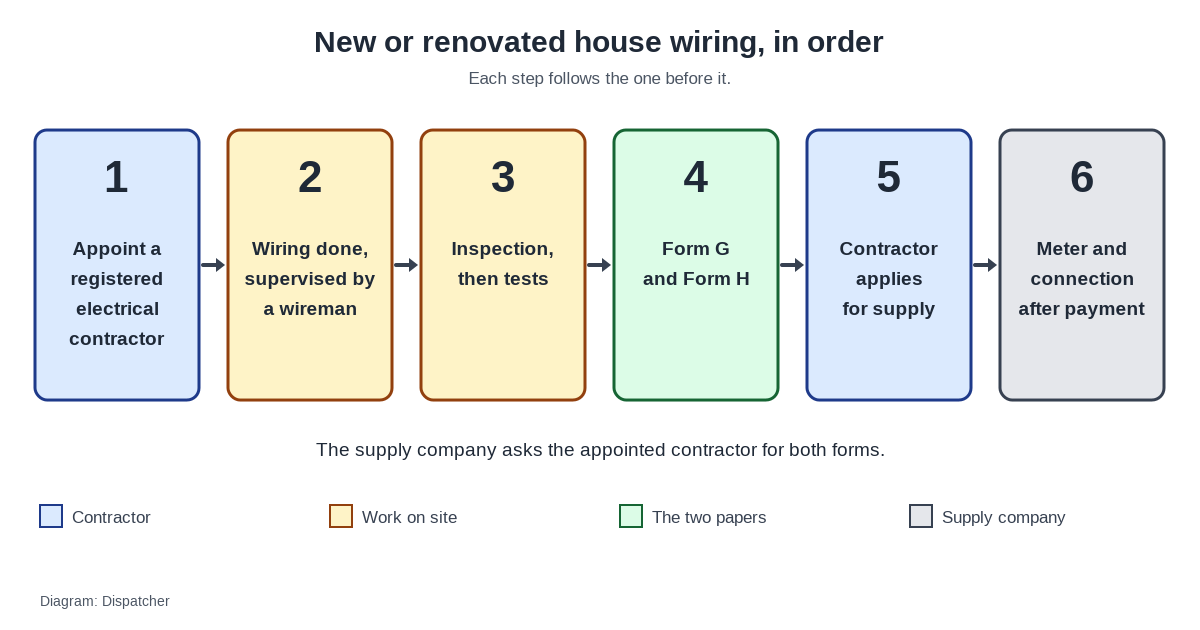
The six steps in order, from the contractor you appoint to the meter.
You have just got the keys to a new house, or you are about to open the walls of an old one. The wiring job runs in a set order, and it ends with two papers, not a handshake.
This page follows that order once. It says who does each part and what to ask for. It gives no prices, job times or cable sizes, because the sources name none.
Who do you appoint to wire a new or renovated house?
You appoint an electrical contractor registered with the Energy Commission (Suruhanjaya Tenaga, or ST). ST's page on wiring at a residence tells consumers to contact one for inspection and internal house wiring. It points to the public list on ECOS, ST's online system.
The same choice decides who files your supply application later. The supply company is Tenaga Nasional Berhad (TNB). Its Electricity Supply Application Handbook starts the same way. You appoint an electrical contractor. The contractor acts for you and submits the application through the myTNB portal.
Wiring, inspection and testing are for a registered contractor and a wireman. A wireman is the person who supervises the wiring on site.
Check the business first
Dispatcher has not checked listed businesses' licences yet, so the check is yours. Look the business up on ST's list of registered electrical contractors before you agree to anything.
How to check an electrical contractor shows the steps.
Questions for the contractor before you agree
Four questions cover the order of the job:
- Who will supervise the wiring on site, and who will test it?
- Will you give me Form G and Form H when the job ends?
- Who submits the supply application, and which charges do I pay the supply company?
- What happens to the papers if I add wiring later?
Electrician home visit: what to prepare covers what to have ready when the contractor first comes to look.
If you need to change contractor
TNB's handbook says that to end the contractor's services, you tell the contractor in writing and copy TNB. It adds that TNB is not a party to any dispute between you and the contractor.
What goes into home wiring, and what should you decide first?
Home wiring is more than cable. ST's home wiring guideline says it covers cables, a main switch, an MCB or fuse and an RCD. It also lists light points, power points and lightning protection, among other items.
An MCB (miniature circuit breaker) is a switch that trips when a circuit is overloaded. An RCD (residual current device) is the switch that cuts power if current leaks to earth.
The guideline sets rules on sockets, the DB board and surface wiring. Dispatcher's table puts them next to what you decide:
| Part | What ST's guideline says | What you decide |
|---|---|---|
| Sockets | The number depends on the circuit type and the largest floor area served, and spare capacity must be kept | Where you want sockets, and how much spare room to leave |
| DB board | The main switch sits where an adult can reach it easily | Where the board goes, with the contractor |
| Surface wiring | It must be protected by conduit or trunking | Whether you accept visible trunking |
| Lights | Light points are part of the wiring | Where the lights and switches go |
Dispatcher's plain advice: tell the contractor your plan before the walls are closed, so the wiring follows it.
This page gives no point counts, cable sizes or breaker ratings. The contractor sets those for your home. Adding a power point at home: what to know covers sockets, and New house wiring colour code: what changed covers cable colours.
What is checked before the wiring is switched on?
The wiring is inspected first, then tested. ST's guideline says inspection is done before testing. The tests confirm the circuits work and the equipment is safe to use.
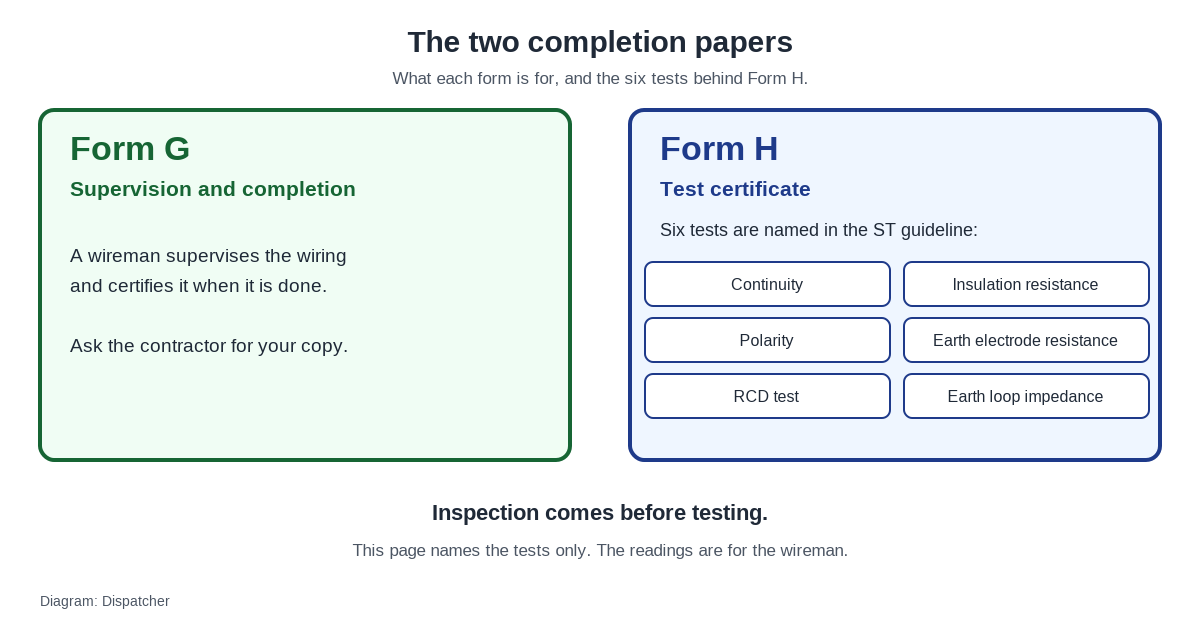
Form G and Form H side by side, with the six tests behind Form H.
The same guideline names six tests for Form H: continuity, insulation resistance, polarity, earth electrode resistance, an RCD test and an earth loop impedance test. This page names them only. The wireman takes and records the readings.
Two rules in the Electricity Regulations 1994 set who does what. This is how ST's guideline reads them:
- Supervision. Regulation 12 says a wireman with a single-phase or three-phase restriction supervises the wiring and confirms it when it is done.
- Testing. Regulation 13 says that when wiring or rewiring is finished, a wireman authorised to test checks the installation and confirms its test certificate.
What are Form G and Form H, and who keeps them?
Form G is the Supervision and Completion Certificate. Form H is the Test Certificate. Regulation 14(1) names them as the papers for the supervision under regulation 12 and the test under regulation 13.
The supply company wants both. Its Required Documents by Applicant list asks the appointed electrical contractor for Form G and Form H.
Neither source says who holds the originals. Ask your contractor for a copy of each at handover.
Dispatcher does not file the forms and cannot get them for you.
Completion and test certificates after rewiring explains both forms in more detail, so this page does not repeat it.
How does the electricity supply follow?
The supply follows the papers, and your contractor files the application. For a load up to 100 A, TNB's handbook says a contractor registered with the Energy Commission submits it. That part covers single-phase and three-phase low voltage supply.
The handbook gives four steps:
- Appoint. The contractor acts on your behalf and submits the application through the myTNB portal.
- Documents. You or the contractor complete the application form and attach the required documents.
- Pay. The first payments are the connection charge, the security deposit and stamp duty. They can be paid at a Kedai Tenaga counter or online through myTNB.
- Connect. TNB installs the meter and connects supply once all payments are received.
For the documents, TNB's Required Documents by Applicant lists these for the appointed contractor: Form G, Form H, a self-estimation form for connection charges and deposit, a location map, a premise picture that shows the meter panel location, and pictures of the nearest power supply. The list also asks for a metering schematic only above 100 A of maximum demand, which this page leaves out.
This page names the charges and gives no amounts. The sources give no amounts and no times for each step, so ask the contractor.
If the house already has supply
If you move into a house that already has supply, with no change in electricity load, TNB's handbook says to skip the first step, which is appointing a contractor. Any new or extra wiring still goes to a registered contractor.
What if you add wiring later in a renovation?
Added wiring voids Form G and Form H. ST's guideline says the forms stay valid only while the wiring is unchanged. New forms must be made before you take supply.
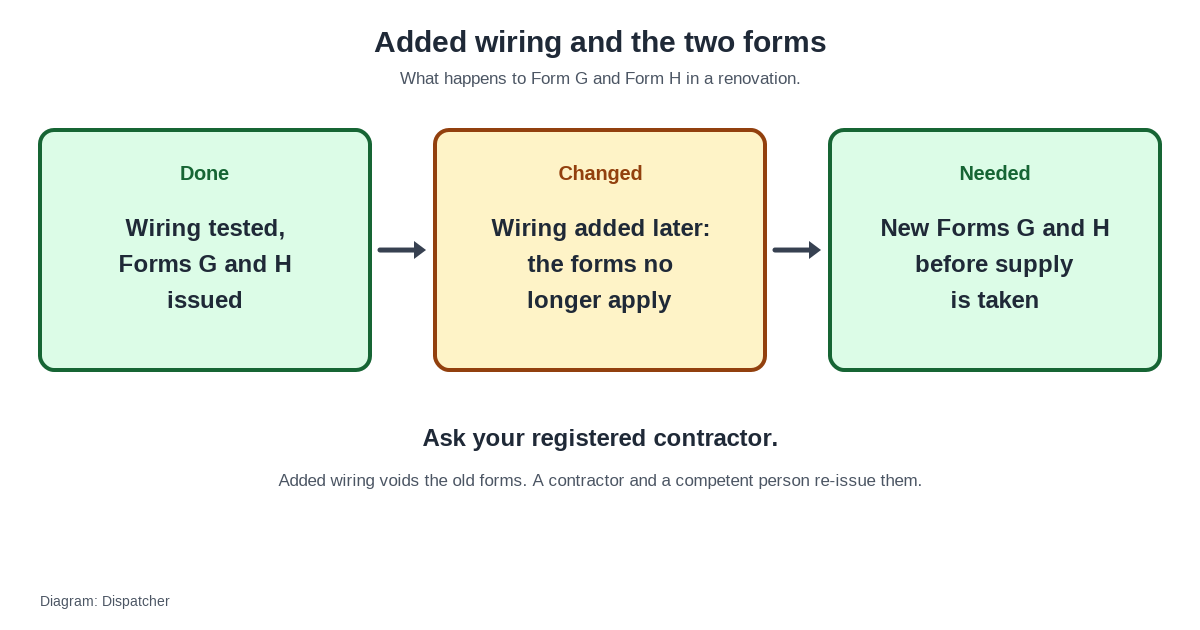
What happens to the two forms when wiring is added.
For a home, ST's guideline says an electrical contractor and a competent person must re-issue the forms.
So talk to your registered contractor before the work starts. Ask which forms need re-issuing and who does the new tests.
Renovating an older house? Old house wiring: signs it is time to rewire helps you judge the state of the wiring. Rewiring a house while you still live in it covers living through the job.
Get quotes on Dispatcher
Free for homeowners. Describe the job in one short form and we pass it to matched local contractors, who contact you directly. Have a photo of your DB board ready to send to the matched contractors when they contact you.
Dispatcher does not do the work. The contractor does, and Dispatcher has not checked listed businesses' licences yet, so check each one on the ST list first.
Related guides
- How to check an electrical contractor shows how to use the ST list.
- Completion and test certificates after rewiring goes deeper on Form G and Form H.
- Electrician home visit: what to prepare is for the first visit.
- Old house wiring: signs it is time to rewire is for an older home.
Written by the Dispatcher editorial team from the sources above. See how Dispatcher works.
Sources
- Suruhanjaya Tenaga (ST), "Garis Panduan Pendawaian Elektrik Pepasangan Domestik" (in Malay). The st.gov.my PDF is used for section 6.2 (parts of home wiring), section 11.1 (regulations 12 to 14) and section 11.2 (testing), read on 24 November 2026 from a text copy dated 21 November 2026. Dispatcher gives its own plain-English reading and names the section each time.
- Tenaga Nasional Berhad (TNB), "Electricity Supply Application Handbook", page "Supply Application". The tnb.com.my page is used for sections 1.1.5.1 (who submits), 1.2.1 (the four steps) and 1.2.4 (dispute with the contractor), read 24 November 2026.
- TNB, PDF "Required Documents by Applicant", block "Required Documents by the Appointed Electrical Contractor": tnb.com.my PDF, read 24 November 2026.
- ST, page "I intend to carry out new wiring, modification, wiring upgrade, rewiring, additional wiring in my residence": st.gov.my, read 24 November 2026.
- ST, public list "Senarai Kontraktor Elektrik Berdaftar" (ECOS). The link is as printed on the ST page above. The list itself was not opened from our server. ecos.st.gov.my, read 24 November 2026 (the ST page that links to it).
The guidance above is dated. Check the current rules with ST and TNB before you rely on them.
Frequently asked questions
Who can wire my new house in Malaysia?
An electrical contractor registered with the Energy Commission. ST's page on wiring at a residence tells consumers to contact one for inspection and internal house wiring, and the public list is on ECOS. Dispatcher has not checked listed businesses' licences yet, so look the business up there first.
What are Form G and Form H?
Form G is the Supervision and Completion Certificate, and Form H is the Test Certificate. A wireman supervises and signs off the wiring for Form G, and Form H records the tests. TNB's list of required documents asks the appointed electrical contractor for both.
What tests are done before the supply is switched on?
The wiring is inspected first, then six tests are done: continuity, insulation resistance, polarity, earth electrode resistance, RCD test and earth loop impedance. ST's home wiring guideline names them for Form H. A wireman authorised to test confirms the results, and this page gives no readings.
Who applies to the supply company for a new house?
The electrical contractor you appoint does. TNB's handbook says that for a load up to 100 A, a contractor registered with the Energy Commission submits the application through the myTNB portal. You then pay the first charges, and TNB installs the meter and connects supply once payment is received.
Do I need new forms if I add wiring later?
Yes, if the wiring changes, because ST's guideline says Forms G and H stay valid only while the wiring is unchanged, and added wiring voids them. New forms must be made before supply is taken. For a home, an electrical contractor and a competent person must re-issue them, so ask your registered contractor before you add anything.
Can I skip the contractor when I move in to a house that already has supply?
Yes, if nothing changes. For a move-in to an existing house with no change in electricity load, TNB's handbook says to skip the step of appointing a contractor. Any new or extra wiring still goes to a registered contractor, as ST's page on wiring at a residence says.
Last updated: 24 November 2026