Replacing a kitchen tap in a Malaysian home: steps and checks
Last updated
Quick answer: In Malaysia, swapping a kitchen tap like for like is a small job if you can shut the water off at an isolating valve under the sink. Call a plumber if there is no valve, the pipes are old or the joint at the wall leaks. Check which pipe feeds the tap first.
Get quotes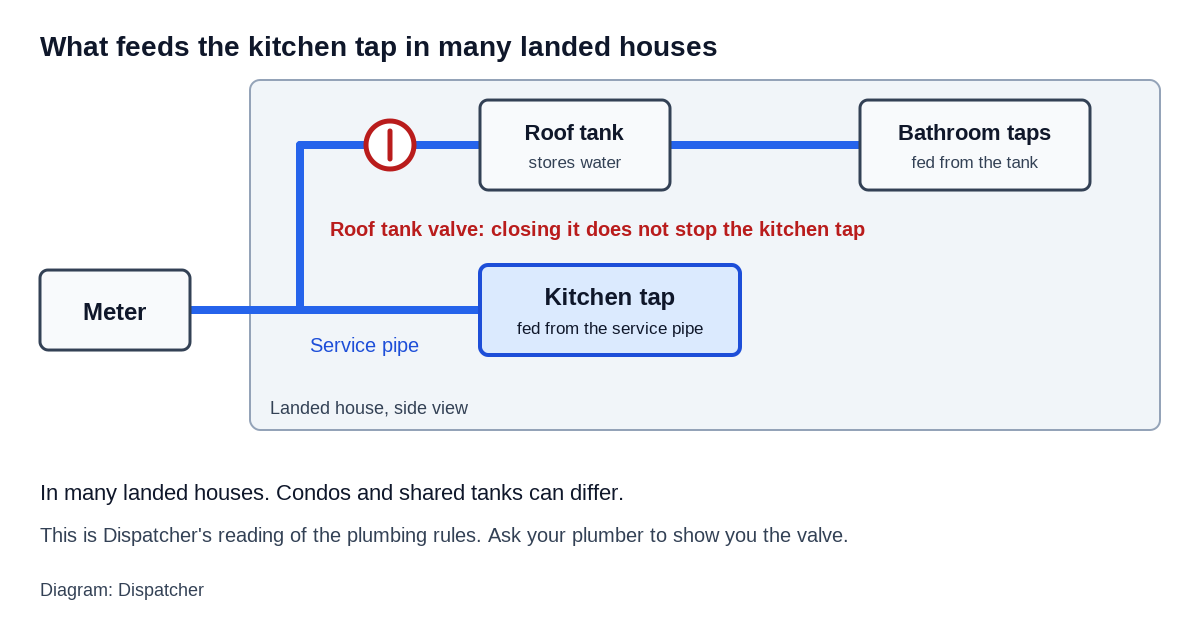
This guide covers one job: taking out a kitchen tap and fitting another in its place. New sinks, moved pipes and bathroom taps are different jobs. For a kitchen rebuild, start with our guide to plumbing for a bathroom or kitchen renovation.
Dispatcher does not do plumbing work. This page gives you the facts to decide, and to ask a plumber the right questions.
Which pipe feeds your kitchen tap?
In many landed houses in Malaysia, the kitchen tap runs straight off the service pipe, not from the roof tank. That is Dispatcher's reading of the water plumbing rules, so check your own house before you rely on it.
The diagram under the quick answer shows the path. Water comes from the meter and the pipe splits: one branch goes to the kitchen tap, and the other goes up to the roof tank, which feeds the bathroom taps.
Rule 46(1) of the Water Services Industry (Water Reticulation and Plumbing) Rules 2014 says a storage tank goes between the meter and all taps, except the draw-off tap that supplies water for a kitchen tap.
Rule 42(1) of the same rules says that, except in buildings with a shared storage tank, each premises gets a draw-off tap on the service pipe for the kitchen tap.
Dispatcher is reading these two rules together. No single sentence in them says the kitchen tap skips the tank.
So closing the roof tank valve may not stop the kitchen tap.
Rule 40(4) of the same rules says each inlet and outlet of a storage tank gets a stop valve, other than a warning pipe or overflow pipe. In Dispatcher's reading, a kitchen line piped as in the diagram does not pass through that valve.
Condos can differ. Rule 42(1) leaves out buildings with a shared storage tank, so a unit's kitchen tap may be fed from tank water. Ask your building management or a plumber before you assume.
You can test your own house. Close the roof tank valve and open the kitchen tap. If water still runs, that valve does not control this tap, so you need another way to shut it off.
Our guide to how the water pipes in your home work shows the path from the meter to each tap.
Check the tap before you buy it
Check five things before you pay: the holes in your sink, the tap style, the hoses, the room under the spout and any pull-out spray. A tap that looks right in the shop can still miss your sink or your valves.
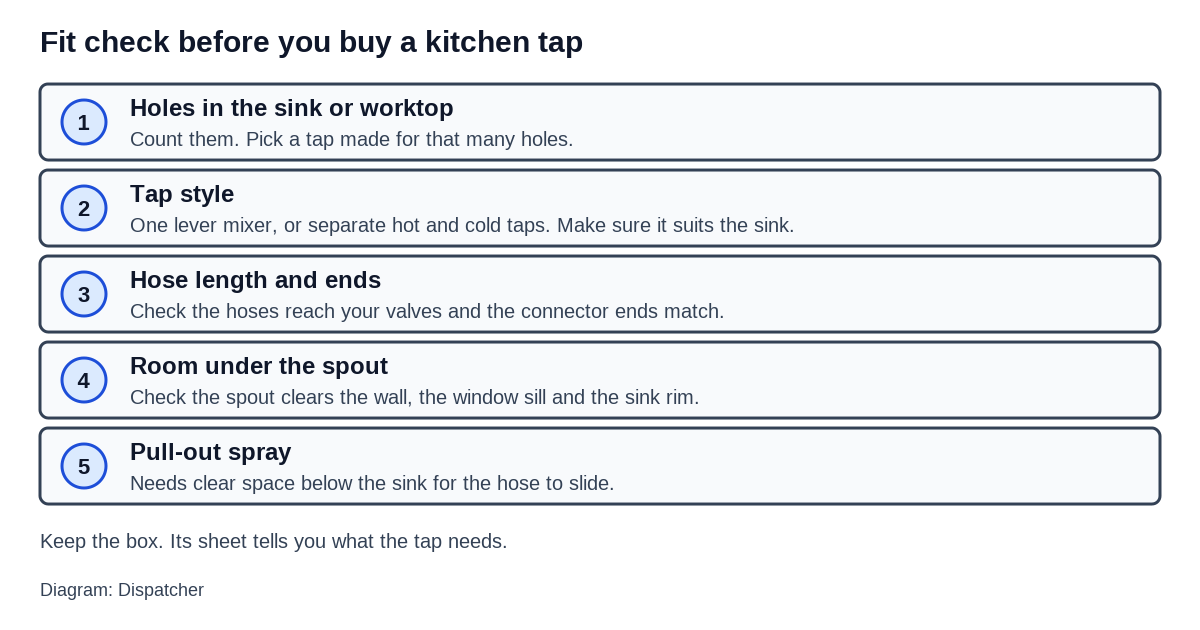
Holes. Count the holes in your sink or worktop and pick a tap made for that many. Do not enlarge a hole to make a tap fit.
Hoses. Look at the hoses that come with the tap. They must reach your valves, and their ends must match the valve ends. One maker's fitting sheet warns you not to bend, twist or crush the flexible pipes.
Room under the spout. Look at the wall, any window sill and the sink rim. Rule 42(2) of the same rules says the outlet of the tap that rule 42(1) describes must sit at least 150 millimetres above the upper edge of any tub, jar or sink it may discharge into. Ask your plumber how that applies to the spout you chose.
Pull-out spray. A pull-out head needs clear space under the sink so its hose can slide. Check what sits in the cupboard, such as a bin or a storage box.
The box. The Water Services Industry (Water Reticulation and Plumbing) Rules 2014 list taps and mixers in the First Schedule of recognised standards for water supply products (item (H), bib, pillar and mixer taps).
Rule 4(1) of the same rules says a person who designs, constructs or alters water fittings shall comply with those recognised standards. Rule 5 says a person who uses or supplies materials for pipes and fittings shall ensure they comply with the recognised standards.
The Rules do not mention a mark for buyers. Asking the shop whether a tap meets the recognised standards in the First Schedule is Dispatcher's advice, not a line from the Rules.
A KPKT list of green certification schemes describes the Water Efficient Product Labelling Scheme (WEPLS) as a voluntary scheme by Suruhanjaya Perkhidmatan Air Negara (SPAN), and says it covers water taps and mixers. A label tells you about water use. It does not tell you how to fit the tap.
The parts under the sink have names, and our plumbing fittings guide explains them.
The job in order
The job runs in six steps: close the isolating valve, drain the old tap, undo the hoses, lift the old tap out, fit the new one hand-tight, then open the valve slowly and look for leaks. Your own tap's sheet comes first, because every model differs.
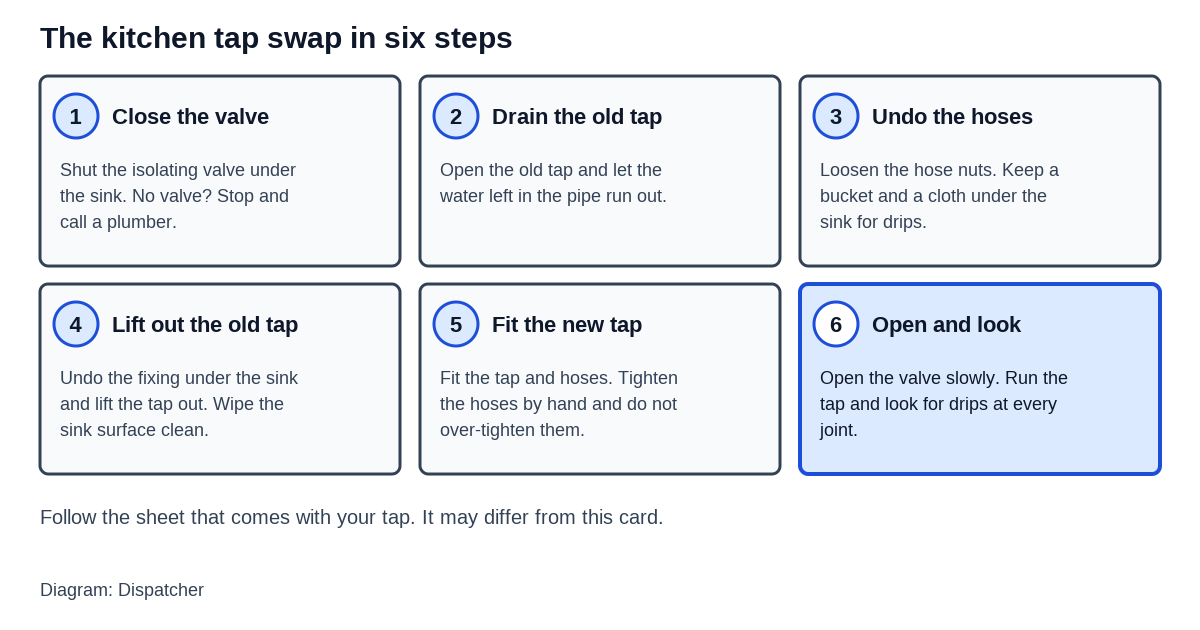
The example here is one maker's fitting sheet for a UK sink mixer. It is not a Malaysian rule. Where a step quotes the sheet, it says so, and the rest is Dispatcher's advice.
- Close the isolating valve first. The sheet says to turn off the mains water before you connect to existing pipework. If you cannot find a valve on the pipe that feeds the tap, stop here.
- Drain the old tap. Open it and let the water left in the pipe run out.
- Undo the hoses. Put a bucket and a cloth under the sink, then loosen the hose nuts.
- Lift out the old tap. Undo its fixing under the sink and lift it out. Wipe the sink surface clean.
- Fit the new tap. Follow the sheet that came with it. The example sheet says to tighten the flexible pipes by hand only, and not to overtighten them.
- Open the valve slowly and look. Run the tap and check every joint under the sink with a dry cloth. Look again later in the day.
Do not skip the flush. The same sheet says to flush the pipework before you fit the new tap, to wash out leftovers such as swarf (metal shavings) and solder. Ask a plumber how to flush your pipes safely.
For easier maintenance later, the sheet also recommends isolating valves on the inlet feeds. If your sink has none, ask a plumber to fit them, because that means working on the pipe. This is Dispatcher's advice.
Some kitchen taps have a hot hose as well. Before you undo it, ask your plumber which heater it comes from. Our guide to instant and storage water heaters explains the two types.
This page gives no time or price for the job, because homes and taps differ.
When to call a plumber
Call a plumber if you cannot shut the water off at an isolating valve, or if any sign below applies. The example sheet puts it this way: "If you are in any doubt about your ability to install this product safely you must employ the services of an experienced qualified plumber."
- No isolating valve. Cutting into the pipe to fit one is plumber's work.
- Old or corroded pipe. In Dispatcher's view, rust or green crust on the pipe or valve is a warning sign. Let a plumber look before you pull anything apart.
- A leak at the wall. If water seeps where the pipe meets the wall, read our guide to a leaking pipe at home and call a plumber.
- A different pipe size. If the hose ends do not match your valves, do not force them. Fitting adapters or changing pipe is plumber's work.
- A kitchen being renovated. The tap is then one part of a bigger plan, so see plumbing for a bathroom or kitchen renovation.
If water is gushing, close the valve you can reach and call a plumber straight away. This is Dispatcher's advice.
Ask any plumber what registration they hold, and ask to see it. Our guide on how to check a plumber's permit explains where to look. Whether a tap swap needs one is a question for the plumber, and this page does not answer it.
Get quotes on Dispatcher
Free for homeowners. Describe the job in one short form and we pass it to matched local contractors, who contact you directly.
Say that you want a like-for-like kitchen tap swap, and whether there is an isolating valve under the sink. Dispatcher does not do the work. It has not checked the licences of listed businesses yet, so you check them.
Related guides
- Plumbing fittings explained: names and what they do
- How do the water pipes in your home work?
- How to check a plumber's permit before you hire
- Instant or storage water heater: which one fits your home
Sources
- Water Services Industry (Water Reticulation and Plumbing) Rules 2014, P.U.(A) 36/2014, rules 40(4), 42(1), 42(2) and 46(1), English text of the gazette copy hosted by PBA. Read 20 November 2026, First Schedule and rules 4(1) and 5 re-read 23 November 2026.
- Water Services Industry (Water Reticulation and Plumbing) Rules 2014, P.U.(A) 36/2014, First Schedule item (H) Tap and Mixer, and rules 4(1) and 5, English text of the gazette copy hosted by PBA (a state water operator). Read 23 November 2026.
- KPKT list of green certification or labelling schemes under the MyHIJAU Mark, entry for the Water Efficient Product Labelling Scheme (Type I-like Voluntary Sustainable Scheme) by Suruhanjaya Perkhidmatan Air Negara, covering water taps and mixers. Read 23 November 2026.
- Bristan, installation instructions for the Thyme Easyfit Sink Mixer, one UK maker's sheet used as an example only: safety notes, installation requirements and installation steps. Read 20 November 2026.
- Dispatcher, how do the water pipes in your home work?, the page this guide's reading of the rules builds on. Read 20 November 2026.
Written by the Dispatcher editorial team from the sources above. See how Dispatcher works.
Frequently asked questions
Can I replace a kitchen tap myself in Malaysia?
That depends on your pipes. A like-for-like swap is a small job if you can shut the water off at an isolating valve and the pipes are sound. One maker's fitting sheet says that if you are in any doubt about your ability to install the tap safely, you must employ an experienced qualified plumber.
How do I stop the water to my kitchen tap?
Close the isolating valve on the pipe that feeds the tap. Then open the tap to check the flow has stopped. One maker's sheet recommends isolating valves on the inlet feeds. If there is no valve, ask a plumber to show you where the water can be shut off.
Does closing the roof tank valve stop the kitchen tap?
Often not. In many landed houses the kitchen tap is fed straight from the service pipe, not from the roof tank, so closing the tank valve may not stop it. This is Dispatcher's reading of the water plumbing rules. Condos and shared tanks can differ, so test by opening the tap after you close the valve.
Do taps in Malaysia need a SPAN mark?
The 2014 water plumbing rules do not mention a mark for buyers. They list taps and mixers in the First Schedule of recognised standards, and rule 4(1) of those rules says water fittings must comply with those standards. Dispatcher's advice is to ask the shop whether the tap meets the recognised standards in that schedule.
What is WEPLS on a tap box?
WEPLS is the Water Efficient Product Labelling Scheme. A KPKT list of green certification schemes describes it as a voluntary scheme by Suruhanjaya Perkhidmatan Air Negara (SPAN), and says it covers water taps and mixers. A tap may or may not carry the label. It tells you about water use, not about how to fit the tap.
When should I call a plumber instead?
Call a plumber if there is no isolating valve, the pipes are old or corroded, the joint at the wall leaks, the tap needs a different pipe size, or the kitchen is being renovated. Our permit guide shows what to ask. Dispatcher has not checked listed businesses' licences yet.
Ready for a plumber? Get quotes
Last updated: 23 November 2026